

Zuidelijke roodsnaveltok vs Trompetneushoornvogel
Tockus rufirostris versus Bycanistes bucinator
Speel een quiz met Zuidelijke roodsnaveltok en Trompetneushoornvogel
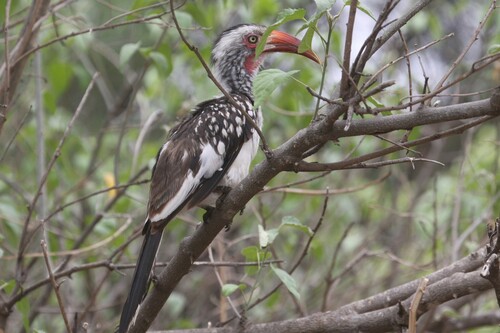 Zuidelijke roodsnaveltok
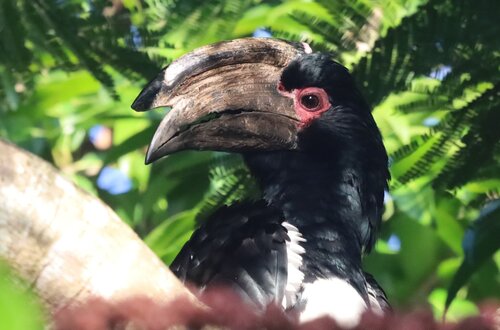 Trompetneushoornvogel
Kort gezegd
The most reliable field mark to separate Southern Red-billed Hornbill from Trumpeter Hornbill is the presence of a large grey casque on the bill of the Trumpeter, which is completely absent in the Southern Red-billed. In flight, Trumpeter Hornbill shows striking white underwing coverts and white-tipped wings, while Southern Red-billed Hornbill has clearly spotted wing coverts but lacks the bold white underwing. Southern Red-billed is much smaller, with a slender red bill and yellow iris, compared to the Trumpeter's bulkier build, red/pink facial skin, and brown or red eyes. Habitat and behavior also differ: Southern Red-billed prefers dry savanna and bushveld, while Trumpeter is a forest species often seen in noisy groups.
Herkenningstips
- Bill casque: Trumpeter Hornbill always shows a large grey casque on top of the bill (smaller in females but never absent), while Southern Red-billed Hornbill has no casque at all. This is the single most decisive field mark at any age or angle.
- Underwing pattern in flight: Trumpeter Hornbill of all ages shows white underwing coverts and white-tipped wings, creating a bold flash in flight. Southern Red-billed Hornbill lacks this and instead has spotted wing coverts; its underwing is not strikingly white.
- Bill color and shape: Southern Red-billed Hornbill has a slender, all-red bill (males may have some black on lower mandible). Trumpeter's bill is thicker, darker, and topped with the casque.
- Iris and facial skin: Southern Red-billed Hornbill has a yellow iris and pale (pink to greyish) orbital skin. Trumpeter Hornbill has brown or red eyes and red or pink facial skin, which can be quite prominent.
- Body size and bulk: Trumpeter Hornbill is much larger and heavier, with a noticeably bulkier head and body. Southern Red-billed is slim and small by comparison.
- Plumage above: Southern Red-billed Hornbill is pale below with a white throat and belly, and blackish streaking from ear coverts to neck. Trumpeter Hornbill is glossy black above with a white belly and underwing.
- Wing coverts (perched): Southern Red-billed Hornbill shows clearly spotted wing coverts when perched; Trumpeter Hornbill's wing coverts are plain black.
- Tail pattern: Some Southern Red-billed Hornbill subspecies (e.g., T. r. ngamiensis) have a more distinct tail bar, but this is not a primary separation from Trumpeter, which has a plain, long tail.
- Group size and behavior: Trumpeter Hornbill is often in noisy groups, especially in forest canopy. Southern Red-billed is usually solitary or in pairs, foraging on the ground or low in trees.
- Habitat: If seen in deep or continuous forest, especially in the canopy, Trumpeter is likely. In dry bushveld or open savanna, Southern Red-billed is expected.
- Display: Southern Red-billed Hornbill does not raise its wings in display, unlike some other red-billed hornbills, but this is not a separation from Trumpeter.
- Vocalizations: Trumpeter Hornbill's loud, trumpeting call is very different from the accelerating 'kuk kuk kuk...' of Southern Red-billed Hornbill.
- Sex differences: Both species show some sexual dimorphism in bill size (males larger), but this is not a reliable field mark for separation.
- Juvenile confusion: No evidence that juvenile Trumpeter Hornbill ever lacks the casque or white underwing, so even young birds can be separated by these marks.
- Pitfalls: Do not confuse the red bill of Southern Red-billed Hornbill with the red/pink facial skin of Trumpeter; always check for the casque and underwing pattern.
Grootte
Trumpeter Hornbill is substantially larger and heavier, with a body mass around 644 g [wikidata], and a length of 58–65 cm [wikipedia]. Southern Red-billed Hornbill is notably smaller and lighter (exact mass not provided, but much less than Trumpeter). The Trumpeter's bill is not only longer but also topped with a prominent casque, making the head appear even bulkier. In the field, Trumpeter Hornbill's size and structure are much more imposing, especially in flight or when perched beside other hornbills.
Verenkleed
- Juvenile/immature flight views: Trumpeter Hornbill of all ages shows white underwing coverts and white-tipped wings in flight, creating a bold contrast with the otherwise black wings and back. Southern Red-billed Hornbill, including immatures, lacks this pattern; instead, it has spotted wing coverts and more subdued upperwing contrast.
- Adults (perched): Southern Red-billed Hornbill is pale below with a white throat and belly, spotted wing coverts, and blackish streaking from ear coverts to neck sides. Its iris is yellow, and the orbital skin is pale (pink to greyish). Trumpeter Hornbill is glossy black above with a white belly and underwing, and has red or pink facial skin with brown or red eyes. The casque is always present on Trumpeter, smaller in females but never absent.
- Bill color: Southern Red-billed has a red bill (males may have some black on lower mandible), while Trumpeter's bill is dark with a large grey casque.
Gedrag
Trumpeter Hornbill is typically gregarious, often seen in groups of 2–5 or even up to 50 birds, and is noisy and active in the canopy of evergreen forests. Southern Red-billed Hornbill is more often seen singly or in pairs, foraging in dry savanna or bushveld, and does not display the same flocking behavior. In display, Trumpeter Hornbill may be quite conspicuous, while Southern Red-billed does not raise its wings in display (unlike some other red-billed hornbills).
Habitat
Southern Red-billed Hornbill is a bird of dry savannas and bushveld, found from Malawi and Zambia south to northern South Africa, mostly avoiding dense forests. Trumpeter Hornbill is a forest specialist, locally common in tropical evergreen forests from eastern South Africa northwards, and rarely overlaps with Southern Red-billed except perhaps at forest edges. If seen in deep forest, Trumpeter is far more likely; in open, arid bush, Southern Red-billed is the default.
Geluid
Southern Red-billed Hornbill gives an accelerating series of 'kuk kuk kuk...' ending in a crescendo of double notes ('kuk-we kuk-we'). Trumpeter Hornbill is named for its loud, far-carrying, trumpeting calls, which are much more resonant and distinctive than the Southern Red-billed's. The difference in vocalizations is usually obvious if both are heard well.
Zuidelijke roodsnaveltok · Trompetneushoornvogel · Mijn lastige vogels