

Kortsnavelcanastero vs Vuurlandcanastero
Asthenes baeri versus Asthenes anthoides
Speel een quiz met Kortsnavelcanastero en Vuurlandcanastero
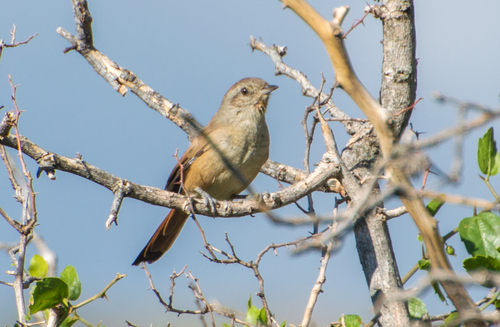 Kortsnavelcanastero
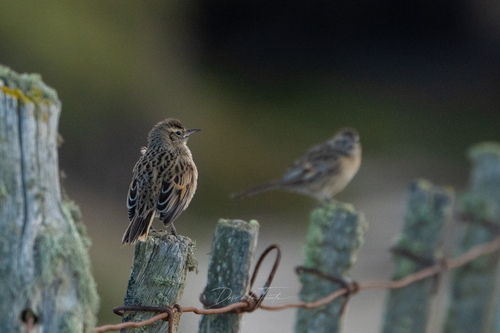 Vuurlandcanastero
Kort gezegd
The most reliable way to separate Short-billed Canastero from Austral Canastero is by the presence or absence of bold blackish streaking on the upperparts and breast: Austral Canastero (all ages) shows strong dark streaks on the crown, back, and flanks, while Short-billed Canastero is plain and unstreaked above and below. Juvenile Austral Canastero also has heavy blackish streaks on the breast and sides, unlike the more mottled, less patterned juvenile Short-billed. Structure helps: Short-billed Canastero has a notably short, thick bill and a more compact look, while Austral Canastero is larger and heavier-bodied. Both can occur in similar open habitats in Argentina, but Austral is more southern and restricted to Argentina and Chile, while Short-billed ranges farther north and east. Voice and behavior are not well described for separation in these notes.
Herkenningstips
- Upperpart Streaking (All Ages): Austral Canastero always shows bold blackish streaks on the crown, back, and flanks; Short-billed Canastero is plain and unstreaked above and below. This is the single most reliable field mark.
- Juvenile Breast Pattern: Juvenile Austral Canastero has strong blackish-brown streaks on the breast and sides, while Short-billed Canastero juveniles are only mottled on the upper breast and lack clear streaks.
- Bill Structure: Short-billed Canastero has a short, thick bill—noticeably stubbier than Austral's, which is longer and finer. This is visible on perched birds and sometimes in profile in the field.
- Supercilium: Austral Canastero has a pale buff or whitish supercilium that is more distinct, while Short-billed Canastero's is a dull, broad, grayish stripe that is less obvious.
- Throat Color (Adults): Short-billed Canastero adults show a distinct orange-tawny patch on the upper throat, bordered below by a darker margin; Austral Canastero's throat is whitish, sometimes with a faint pale orange-rufous patch, but never as bold as Short-billed's.
- Underparts: Short-billed Canastero is plain pale dull grayish below with pale rufescent flanks; Austral Canastero is paler overall, but with dark streaks on the sides of the breast and flanks.
- Tail Pattern: Austral Canastero's tail is more varied, with central feathers olive-brown and others dusky with whitish ochre tips; Short-billed Canastero's tail is mostly dull rufous except for the inner two pairs, which are dark brownish.
- Size in the Field: Austral Canastero is noticeably larger and bulkier, often appearing heavier-bodied and longer-tailed than Short-billed Canastero.
- Leg Color: Both species have gray to dusky legs, but Austral Canastero may show a pinkish tinge at times; this is subtle and not always reliable.
- Face Pattern: Austral Canastero's face is sandy brownish with dark dusky lores, while Short-billed Canastero's is dull grayish brown overall.
- Habitat Context: If in southern Argentina or Chile, especially in Patagonian steppe or open southern scrub, Austral Canastero is more likely. In Chaco, Monte Desert, or more northern/eastern lowlands, Short-billed is expected.
- Range: Austral Canastero does not occur in Brazil, Paraguay, Uruguay, or Bolivia; Short-billed is absent from Chile and the far south.
- Sexes: Both species are sexually monomorphic—sex does not help with identification.
- Season: Both breed in austral spring/summer, but plumage marks are consistent year-round; age-related differences (especially juvenile streaking) are most important in late spring and summer.
- Confusion Risk: Beware of individual variation in Austral Canastero—some birds may appear less streaked, but always more so than any Short-billed Canastero. If in doubt, focus on the presence or absence of streaking and bill shape.
Grootte
Austral Canastero is distinctly larger and heavier: 15.5–16.5 cm in length and 21–23 g in mass, compared to Short-billed Canastero's 14–15 cm and 10–18 g. In the field, Austral Canastero often appears bulkier and longer-bodied, while Short-billed Canastero is more compact and smaller overall. Bill structure also differs: Short-billed has a short, thick bill, while Austral's is proportionally longer and finer.
Verenkleed
- Juveniles: Austral Canastero juveniles show blackish-brown streaks on the breast and sides, and bold streaking on the upperparts. Short-billed Canastero juveniles lack these streaks, instead showing a mottled upper breast and little or no orange-tawny on the throat.
- Adults: Austral Canastero stands out with strong blackish streaks on the crown, back, and flanks, as well as some streaks on the sides of the breast. Its supercilium is pale buff or whitish, and the face is sandy brownish. Short-billed Canastero adults are plain grayish-brown above, with only a faint, wide grayish supercilium and no streaking; the throat is orange-tawny (except in juveniles), and the underparts are pale dull grayish with pale rufescent flanks.
- Wings and Tail: Austral Canastero's wings are brownish with cinnamon to brown coverts and dusky flight feathers, and the tail has a mix of olive-brown and dusky feathers with whitish ochre tips. Short-billed Canastero's wings are dull grayish brown with paler edges, and the tail is mostly dull rufous except for the inner feathers which are dark brownish.
Gedrag
Both species are terrestrial and forage low in scrub or open woodland, often moving through dense vegetation. There is no strong behavioral difference noted for field separation. Both build domed or globular nests of sticks, but nest structure is not a field mark.
Habitat
Short-billed Canastero is found in arid lowland scrublands, Gran Chaco scrub and woodlands, and Monte Desert woodlands across Argentina, Bolivia, Brazil, Paraguay, and Uruguay. Austral Canastero is more southern, found in Argentina and Chile, and typically occupies open, shrubby habitats, often in Patagonian steppe or southern scrub. In areas of overlap (central/southern Argentina), habitat alone is not diagnostic, but Austral is absent from the Chaco and more northern/eastern lowlands.
Kortsnavelcanastero · Vuurlandcanastero · Mijn lastige vogels