

Ekstertangare vs Kaptangare
Cissopis leverianus versus Nemosia pileata
Speel een quiz met Ekstertangare en Kaptangare
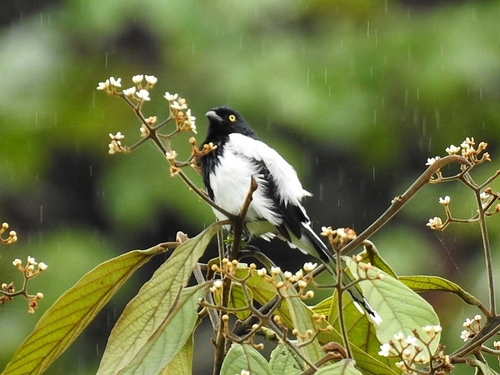 Ekstertangare
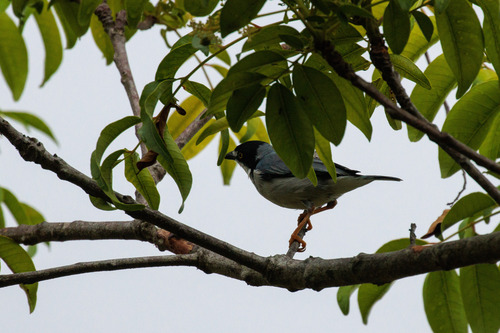 Kaptangare
Kort gezegd
The most reliable way to separate Magpie Tanager from Hooded Tanager is by overall size and tail length: Magpie Tanager is much larger and has a dramatically long tail, while Hooded Tanager is small and compact. In the field, Magpie Tanager’s striking black-and-white pattern and magpie-like jizz stand out, while Hooded Tanager males show a black hood and blue-gray upperparts, and females lack the black hood entirely. Juvenile Hooded Tanagers are pale blue above and bluish gray below, never showing the bold, crisp black-and-white of any Magpie Tanager. Both species occur in similar habitats, but Magpie Tanager is often in larger, noisy groups and is much more conspicuous.
Herkenningstips
- Size and Tail Length: Magpie Tanager is much larger than Hooded Tanager, with a dramatically long tail that is nearly as long as its body. Hooded Tanager is small and compact, with a proportionally short tail. This is the quickest field check, even at a distance or in flight.
- Group Behavior: Magpie Tanagers are often in noisy, conspicuous groups of up to 10, frequently participating in mixed flocks. Hooded Tanagers are usually alone or in pairs and are less conspicuous.
- Adult Male Head Pattern: Hooded Tanager males have a solid black hood (head and throat) with white lores and throat sides. Magpie Tanager never shows a black hood; its head is blue-black, blending with the back, and the face is not isolated by white.
- Adult Female Head Pattern: Female Hooded Tanagers lack the black hood; their head is blue-gray like the back. Magpie Tanager females are not sexually dimorphic and always show the bold black-and-white pattern.
- Juvenile Plumage: Juvenile Hooded Tanagers are pale blue above and bluish gray below, with rose-orange legs and feet. They never show the crisp black-and-white or the long tail of Magpie Tanager juveniles or adults.
- Body Pattern: Magpie Tanager is sharply black above and white below, with a broad white wing patch and white-edged tail. Hooded Tanager is blue-gray above and white below, with males showing a black hood and females a buff wash on the underparts.
- Tail Pattern: Magpie Tanager’s tail is very long and white-edged, often wagged up and down. Hooded Tanager’s tail is short and lacks obvious white edges.
- Leg Color: Hooded Tanager adults have yellow or yellow-brown legs and feet; juveniles have rose-orange legs. Magpie Tanager’s leg color is not described as distinctive, so this is only a minor check.
- Bill Color: Male Hooded Tanager has a black bill; female has a black upper mandible and pale lower mandible. Magpie Tanager’s bill color is not highlighted as a field mark.
- Underpart Color: Magpie Tanager is always sharply white below; Hooded Tanager females and juveniles have a buff or grayish wash on the underparts.
- Jizz: Magpie Tanager’s magpie-like stance, long tail, and upright posture are unique among tanagers. Hooded Tanager is more generic in shape and posture.
- Flight Style: Magpie Tanager’s long tail is obvious in flight, often wagged. Hooded Tanager’s flight is more typical of small tanagers, with no tail wagging.
- Habitat Context: Both can occur in similar habitats, but Magpie Tanager is more likely in open, edge, or riverine areas, especially in groups.
- Vocalization: Not described as a reliable separator in these notes.
- Range: Both are widespread in South America, but if you are in Chile, Ecuador, or Uruguay, only Magpie Tanager is possible.
Grootte
Magpie Tanager is a giant among tanagers, weighing about 76 g and measuring 25–30 cm in length, most of which is its long tail. Hooded Tanager is much smaller, weighing only 16 g and measuring 12–13.5 cm. Even at a distance or in mixed flocks, Magpie Tanager’s size and tail length are immediately obvious, while Hooded Tanager is sparrow-sized and much more delicate in build.
Verenkleed
No age-specific upperwing or flight pattern marks are described for either species, so focus on body plumage. Adult Magpie Tanager is boldly patterned: glossy blue-black above and white below, with a broad white wing patch and a very long, white-edged tail. Hooded Tanager adult males have a black hood (head and throat) with white lores and throat sides, blue-gray upperparts and tail, and white underparts with pale gray flanks. Adult females lack the black hood; their entire head and upperparts are blue-gray, and their underparts are white with a buff tinge. Juvenile Hooded Tanagers are pale blue above and bluish gray below, lacking any black or crisp white. Magpie Tanager of all ages is much more sharply patterned, with no blue-gray tones or buffy underparts.
Gedrag
Magpie Tanagers are usually seen in noisy, conspicuous groups or pairs, often wagging their long tails up and down and joining mixed-species flocks. Their behavior is bold and active, often perching in the open. Hooded Tanagers are less conspicuous, typically seen singly or in pairs, and do not show the exaggerated tail movements of Magpie Tanager. Magpie Tanager’s magpie-like jizz, with a long tail and upright posture, is distinctive.
Habitat
Both species can be found in a wide range of wooded and semi-open habitats across much of South America, but Magpie Tanager is more tied to humid lowland and foothill forests, especially in open areas, edges, and near rivers. It is spreading with deforestation. Hooded Tanager is widespread in similar habitats but is absent from Chile, Ecuador, and Uruguay. Habitat alone is not diagnostic, but Magpie Tanager is more likely in larger, open groups.