

Groenstaartglansspreeuw vs Purperglansspreeuw
Lamprotornis chalybaeus versus Lamprotornis purpureus
Speel een quiz met Groenstaartglansspreeuw en Purperglansspreeuw
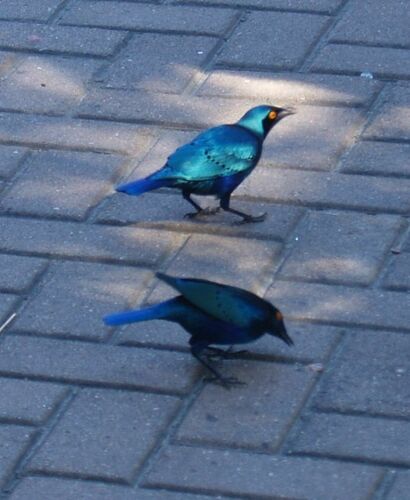 Groenstaartglansspreeuw
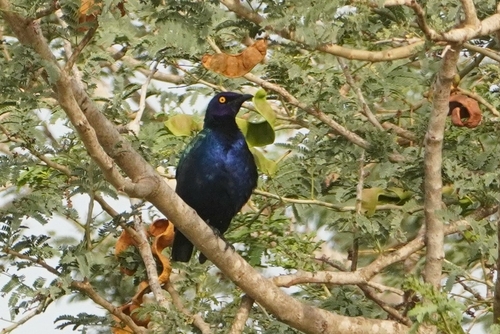 Purperglansspreeuw
Kort gezegd
The most reliable field mark to separate Greater Blue-eared Starling from Purple Starling is the overall color of the underparts: Greater Blue-eared Starling shows a glossy blue-green body with a distinct purple-blue belly and blue ear patch, while Purple Starling is metallic purple throughout the head and body, with glossy green wings. Juveniles of both species are duller, but Greater Blue-eared juveniles have blackish brown underparts, whereas Purple Starling juveniles are grey below with a brown iris. Both species are similar in size and have short tails and yellow eyes as adults, so careful attention to the color and extent of blue or purple on the belly and face is key. In the field, misidentification is most likely with dull immatures or in poor light, so focus on underpart color and ear patch.
Herkenningstips
- Underpart color (adults): Greater Blue-eared Starling has a glossy blue-green body with a purple-blue belly, while Purple Starling is metallic purple throughout the head and body. Look for the extent and hue of blue or purple on the belly and flanks.
- Ear patch: Only Greater Blue-eared Starling has a distinct blue ear patch; Purple Starling lacks this feature. In good light, check the area behind the eye for this mark.
- Wing and back color: Purple Starling has glossy green wings contrasting with the purple body, while Greater Blue-eared Starling is more uniformly blue-green above. In flight or perched, note any contrast between wing and body.
- Juvenile underparts: Juvenile Greater Blue-eared Starling is dull with blackish brown underparts; juvenile Purple Starling is dull with grey underparts. This is subtle and may be hard to judge except at close range.
- Eye color (adults): Both species have bright yellow eyes as adults, so this is not a separator, but note that juvenile Purple Starling has a brown iris, while juvenile Greater Blue-eared Starling is darker but not specifically brown.
- Tail and structure: Both are short-tailed and stocky; tail length and body shape do not help in separation.
- Sex differences: Both species are sexually similar, so do not rely on sex for identification.
- Behavior: If you see a starling perching on livestock and feeding on insects disturbed by the animal, Greater Blue-eared Starling is more likely, but this is not exclusive.
- Habitat: Both species occur in open woodland and similar habitats; do not use habitat alone for separation.
- Vocalizations: Only Greater Blue-eared Starling's call is described ('squee-ar'); if you hear this, it supports Greater Blue-eared, but silence or unfamiliar calls are not helpful.
- Flight views: No distinctive upperwing pattern or flight mark is described for either species, so rely on body color and underpart hue even in flight.
- Lighting conditions: Both species can appear dark or similar in poor light; always try to view in good light to assess color accurately.
- Mixed flocks: Both can join mixed starling flocks; do not assume a single species in a group.
- Geographic range: Both have broad ranges in Africa with overlap; range is not a reliable separator in much of their shared area.
- Common pitfalls: The biggest risk is misjudging color in shade or on dull juveniles; focus on the extent of blue vs. purple on the belly and the presence or absence of a blue ear patch.
Grootte
Both species are very similar in size, with Greater Blue-eared Starling at about 22 cm in length and a body mass of 85.8 g [wikidata]. Purple Starling is listed as 22–23 cm long [wikipedia], so there is no meaningful difference in size or structure to use in the field. Both are stocky, short-tailed starlings.
Verenkleed
- Juveniles: Greater Blue-eared Starling juveniles are duller than adults, with blackish brown underparts and a darker iris, while Purple Starling juveniles are much duller overall, with grey underparts and a brown iris. The difference in underpart color (blackish brown vs. grey) is subtle but can help in good views.
- Adults: Greater Blue-eared Starling adults are glossy blue-green overall, with a purple-blue belly and a blue ear patch. The blue of the belly is extensive, reaching forward of the legs. In contrast, Purple Starling adults have a metallic purple head and body, with glossy green wings, lacking the blue ear patch and with a more uniform purple underpart. Both have bright yellow eyes as adults.
- Flight views: No distinctive upperwing pattern or flight mark is described for either species, so separation relies on body and underpart color even in flight.
- Sexes: Both species are sexually similar, so sex is not a useful field mark.
Gedrag
Both species are gregarious and will join mixed flocks, often perching conspicuously. Greater Blue-eared Starling is noted for perching on livestock to feed on insects, a behavior not specifically mentioned for Purple Starling. Both forage mainly on the ground for insects and fruit. Roosting in large groups is typical for Greater Blue-eared Starling, sometimes with other starlings, but this is not specified for Purple Starling.
Habitat
Greater Blue-eared Starling is a very common bird of open woodland across a wide range from Senegal to Ethiopia and south to northeastern South Africa and Angola. Purple Starling's habitat is not specified in the notes, but both are generally birds of open country and woodland. Habitat overlap is likely, so habitat alone is not a reliable separator.
Geluid
Greater Blue-eared Starling has a range of musical or grating calls, with the most familiar being a nasal 'squee-ar.' No vocalization information is provided for Purple Starling, so voice is not a reliable separator in this pair.
Groenstaartglansspreeuw · Purperglansspreeuw · Mijn lastige vogels