

Goudplevier vs Kievit
Pluvialis apricaria versus Vanellus vanellus
Speel een quiz met Goudplevier en Kievit
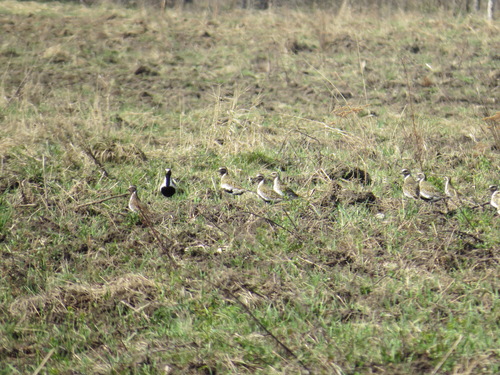 Goudplevier
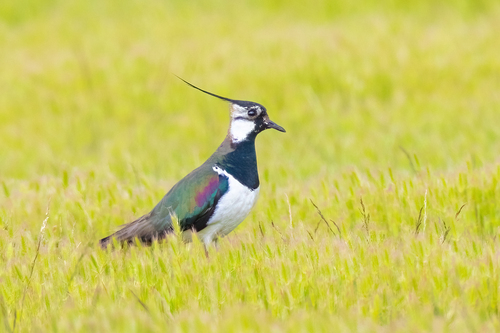 Kievit
Kort gezegd
The most reliable field mark to separate European Golden Plover from Northern Lapwing is overall structure and wing shape: Golden Plovers are compact, thickset birds with relatively short wings and tail, while Lapwings are larger, longer-winged, and have a distinctive rounded wing shape and a prominent head crest. In flight, Lapwings show broad, rounded wings and a slow, floppy flight style, while Golden Plovers have more pointed wings and rapid, direct flight. Plumage differences are also strong: Golden Plovers are golden-spangled above with a white S-shaped band on the face and flanks, while Lapwings are boldly black-and-white with a greenish gloss on the back and a striking black crest. These differences are visible at all ages, but especially clear in adults. Voice and habitat can help, but structure and flight style are the quickest field clues.
Herkenningstips
- Wing shape in flight: Lapwing has broad, rounded wings with a slow, floppy flight; Golden Plover has pointed wings and rapid, direct flight. This is visible at all ages and is the quickest separation in the air.
- Crest: Only Lapwing has a prominent, wispy crest, especially long in males. Golden Plover never shows a crest.
- Face pattern: Golden Plover has a white S-shaped band from forehead to flanks in breeding plumage; Lapwing has a white face with a black crown and throat, but no S-band.
- Upperparts: Golden Plover is golden-spangled above; Lapwing has a greenish gloss to the back, but is otherwise black-and-white.
- Underparts (breeding): Golden Plover shows black from face to belly, sharply bordered by white; Lapwing has a black breast and throat, but the pattern is less sharply defined and always combined with a white face.
- Underwing pattern: Lapwing shows white underwings with a strong black trailing edge; Golden Plover's underwing is paler but lacks this bold contrast.
- Bill and legs: Lapwing is the shortest-legged lapwing, but still appears longer-legged than the compact Golden Plover. Lapwing's bill is slightly longer and more slender.
- Size and structure: Lapwing is larger, bulkier, and longer-winged, with a more upright stance. Golden Plover is thickset, compact, and sits lower to the ground.
- Flight action: Lapwing's flight is slow and floppy, often with exaggerated wingbeats and display dives; Golden Plover flies rapidly and directly, with regular, powerful wingbeats.
- Vocalization: Lapwing's loud 'pee-wit' and display calls are distinctive; Golden Plover's 'tuu' is softer and less likely to be heard at a distance.
- Habitat: In breeding season, Lapwing prefers wet grassland and marshes; Golden Plover favors drier moorland or tundra. In winter, Lapwing is more likely in wet fields and in large flocks.
- Group behavior: Lapwings often form large, noisy flocks in winter; Golden Plovers are quieter and more tightly grouped.
- Juvenile/immature confusion: Both species' young lack the full adult face patterns, but Lapwing juveniles still show rounded wings and a hint of crest, while Golden Plover juveniles are more uniformly golden above.
- Perched silhouette: Lapwing's upright stance, long legs, and crest are unique; Golden Plover is lower, rounder, and lacks a crest.
- Pitfalls: At long range, Lapwing's black-and-white pattern and flight style are usually enough. Beware of Golden Plovers in non-breeding plumage appearing plainer, but they never show the Lapwing's bold face pattern or crest.
Grootte
European Golden Plover is a relatively large plover, but Northern Lapwing is even larger and heavier (Lapwing mass ranges from 128–330g, Golden Plover averages 175g [wikidata]). Lapwing is longer overall (28–33 cm vs. Golden Plover's slightly smaller size), with a much longer wingspan (67–87 cm). Lapwing appears bulkier and more elongated, especially due to its long, rounded wings and prominent crest. Golden Plover is thickset and compact, with shorter wings and tail relative to body size.
Verenkleed
- Juvenile/immature flight: No explicit age-specific upperwing pattern is described for either species, but in all ages, Lapwing shows broad, rounded wings with a strong black-and-white contrast and a greenish gloss on the back; Golden Plover has more evenly golden-spangled upperparts and lacks the Lapwing's bold black-and-white wing pattern.
- Adults (breeding): Golden Plover has a striking white S-shaped band from forehead to flanks, black face and underparts, and golden-spangled upperparts. Lapwing is boldly black and white, with a black crown, throat, and breast, white face, and greenish back. The long crest is unique to Lapwing.
- Non-breeding/immature: Lapwing retains its black-and-white contrast and greenish gloss, but crest is shorter and head markings less distinct. Golden Plover loses the black underparts and S-band becomes less crisp, but still shows golden upperparts and a more compact, plain-faced look compared to Lapwing.
- In flight: Lapwing's underwings are white with a contrasting black edge, and the upperwing is broad and rounded. Golden Plover's underwings are paler but not as starkly black-and-white, and the wings are more pointed.
Gedrag
Lapwing is highly vocal and conspicuous, especially in the breeding season, performing tumbling display flights with slow, floppy wingbeats and constant calling. Golden Plover is quieter, with rapid, direct flight and less flamboyant display. Lapwing often forms large, noisy flocks in winter, while Golden Plovers are more likely to be seen in tighter, quieter groups or singly. On the ground, Lapwing's upright stance and long crest are distinctive, while Golden Plover is more compact and crouched.
Habitat
Both species may overlap in open country, but Lapwing is more often found in wetter, marshy fields, rough grassland, and arable land, especially in lowlands. Golden Plover prefers drier, open moorland, tundra, or upland pastures, especially in the breeding season. In winter, both may be found in agricultural fields, but Lapwing tends to favor wetter ground and is more likely to be seen in large flocks.
Geluid
Lapwing is much more vocal, especially in the breeding season, with a loud, shrill 'pee-wit' call and a variety of squeaks and mewing sounds. Golden Plover's call is a softer, monosyllabic, slightly descending 'tuu', less likely to draw attention. In mixed flocks or at a distance, Lapwing's calls are usually the first clue to its presence.