

Smaragdkeelkolibrie vs Kroonbosnimf
Abeillia abeillei versus Thalurania colombica
Speel een quiz met Smaragdkeelkolibrie en Kroonbosnimf
 Smaragdkeelkolibrie
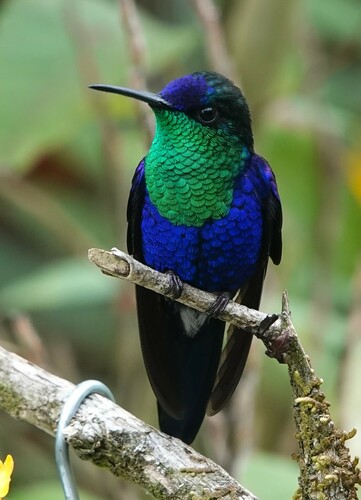 Kroonbosnimf
Kort gezegd
The most reliable field mark between Emerald-chinned Hummingbird and Crowned Woodnymph is the male's throat and crown: Emerald-chinned males show a brilliant metallic emerald chin and upper throat with a blackish lower throat, while Crowned Woodnymph males have a glittering green throat and chest, with a violet crown and forehead. Females of both are green above and gray below, but the woodnymph's tail is deeply forked with white tips (female), while Emerald-chinned has a shorter, squarer tail with brownish gray tips. Size is also a strong clue: Crowned Woodnymph is noticeably larger and heavier. Immature Crowned Woodnymphs lack the adult's bright colors and may be confused with Emerald-chinned, but structural and tail differences remain useful.
Herkenningstips
- Size is a strong clue: Crowned Woodnymph is much larger and heavier than Emerald-chinned Hummingbird. If the bird looks notably small and compact, Emerald-chinned is more likely; if it seems long and robust, consider Crowned Woodnymph (all ages).
- Bill structure: Both have straight bills, but Emerald-chinned's is short and dull black, while Crowned Woodnymph's is proportionally longer (especially in males). This is subtle but can help with good views.
- Male throat and crown: Adult male Emerald-chinned has a brilliant emerald chin and upper throat with a blackish lower throat, lacking any violet or blue on the crown. Crowned Woodnymph males have a glittering green throat and chest, and a violet (not green) crown and forehead. If you see violet on the head, it's a woodnymph.
- Tail shape (perched or in flight): Crowned Woodnymph males have a deeply forked blue-black tail; females have blue-black tails with white tips on the outer three pairs. Emerald-chinned has a shorter, squarer tail with brownish gray tips and no deep fork.
- Female underparts: Both females are green above and gray below, but Crowned Woodnymph females have a paler gray throat and chest and a darker gray belly, with a blue-black tail and white tips. Emerald-chinned females have entirely pale gray underparts with some metallic green spots on the sides and brownish gray tail tips.
- Facial markings: Emerald-chinned Hummingbird has a bold white spot behind the eye (both sexes), which is not described for Crowned Woodnymph. Look for this spot as a quick check.
- Upperparts gloss: Emerald-chinned males are metallic bronze green to greenish bronze above; Crowned Woodnymph males have a violet crown, bronzy green nape, and bluish green lower back/rump. Females of both are green above, but woodnymphs may show a brighter or more uniform green.
- Immature birds: Immature Crowned Woodnymph males are duller, with dusky crown/throat and limited iridescence, but retain the longer, more deeply forked tail. Immature females are dull green above and pale gray below, similar to Emerald-chinned, but tail shape and white tips still help.
- Subspecies variation: Some Crowned Woodnymph subspecies have green (not violet) crowns or all-green backs, but tail shape and size remain reliable. Emerald-chinned subspecies differ mainly in shade (golden green vs bronze green) but not in structure.
- Foraging height: Emerald-chinned is usually low in cover, while Crowned Woodnymph may be higher or in more open forest, but this is only a weak clue.
- No distinctive juvenile wing pattern: Neither species has a unique juvenile upperwing mark, so rely on throat, tail, and size for young birds.
- Context: If you are in montane forest in southern Mexico to Nicaragua, Emerald-chinned is more likely; in humid lowland or foothill forest from Belize to Peru, especially outside Mexico, Crowned Woodnymph is more likely.
- No strong vocal differences described: Calls and songs are not detailed here, so do not rely on voice for separation.
- Pitfalls: Immature and female Crowned Woodnymphs are the most likely to be confused with Emerald-chinned, especially in poor light or at a distance. Use tail shape, size, and the white post-ocular spot for best separation.
- Male display: If you see a male with a brilliant emerald chin and no violet crown, it's Emerald-chinned; if the crown is violet and the tail deeply forked, it's Crowned Woodnymph.
Grootte
Crowned Woodnymph is substantially larger: males are 9.5–11.5 cm and 4–5.5 g, females 8.5–9.2 cm and 3.5–4.2 g [wikipedia]. Emerald-chinned Hummingbird is much smaller, at 7–8.6 cm and 2.7–3.5 g [wikipedia]. In the hand or with a good view, the woodnymph appears bulkier and longer-tailed, while Emerald-chinned is compact and short-billed.
Verenkleed
No distinctive juvenile wing or upperwing pattern is described for either species, so focus on head, throat, and tail. Adult male Emerald-chinned has a metallic emerald chin and upper throat, with a blackish or dusky metallic lower throat and bronze-green upperparts. Its tail is mostly black with a bronzy gloss and brownish gray tips, not deeply forked. Adult male Crowned Woodnymph (nominate) has a violet crown and forehead, glittering green throat and chest, dark bronzy green nape, and a deeply forked blue-black tail. Females of both are green above and gray below, but woodnymph females have blue-black tails with white tips on the outer three pairs, while Emerald-chinned females have a shorter, squarer tail with brownish gray tips. Immature Crowned Woodnymph males are duller, with dusky crown and throat and limited iridescence, but still show a longer, more deeply forked tail than Emerald-chinned. Immature females are dull green above and pale gray below, similar to Emerald-chinned, but again tail shape and tips differ.
Gedrag
Emerald-chinned Hummingbird typically forages low to the ground and prefers cover, often defending flower clusters at low levels. Crowned Woodnymph's foraging behavior is not detailed here, but its larger size and longer tail may make its flight more buoyant and less close to the ground compared to the compact, low-foraging Emerald-chinned.
Habitat
Emerald-chinned Hummingbird is native to montane areas of southern Mexico through Central America, usually in forested or covered habitats at mid-elevations [wikipedia]. Crowned Woodnymph ranges from Belize and Guatemala to northern Peru, often found in humid lowland and foothill forests. Overlap is possible in Guatemala and Honduras, but Emerald-chinned is more tied to montane forest and lower strata, while Crowned Woodnymph is more widespread and often in lower, wetter forests.