

Damarastern vs Lachstern
Sternula balaenarum versus Gelochelidon nilotica
Speel een quiz met Damarastern en Lachstern
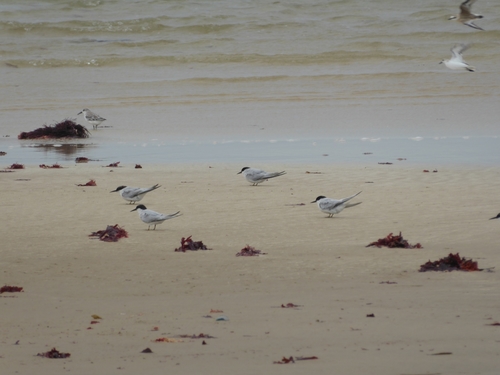 Damarastern
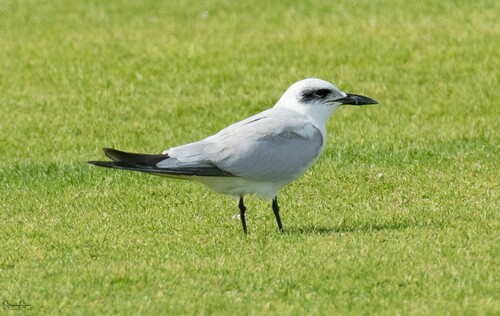 Lachstern
Kort gezegd
The most reliable field mark separating Damara Tern from Gull-billed Tern is size and structure: Damara is much smaller, with a delicate build and fine bill, while Gull-billed is robust, with a thick, short, gull-like bill. In flight, Damara Tern shows a sharp black triangle at the wing tip (adults), whereas Gull-billed Tern’s wings are broader and lack such a sharply defined black triangle. Juvenile Damara Terns have buff bars on the mantle, a feature not seen in Gull-billed. Bill shape and overall proportions are the quickest checks at distance, especially when perched or feeding.
Herkenningstips
- Size and structure: Damara Tern is much smaller and finer-billed than Gull-billed. If the bird appears chunky, with a thick, short bill, it is not a Damara.
- Bill shape: Damara has a slender, pointed bill; Gull-billed’s bill is thick, short, and almost gull-like, especially obvious at close range or in profile.
- Wing tip pattern (adults in flight): Damara Tern shows a sharply defined black triangle at the wing tip, extending from the carpal to the tip. Gull-billed Tern’s upperwing is plain grey, lacking any sharp black triangle.
- Juvenile/immature plumage: Look for buff bars across the mantle on young Damara Terns; Gull-billed juveniles do not show this, instead resembling duller adults with a faint eye mask.
- Breeding cap: Both species have a black cap in breeding plumage, but Damara’s is proportionally larger relative to its tiny head. In non-breeding, both lose the cap and show a black eye mask, so this is not reliable alone.
- Leg length: Gull-billed Tern has noticeably long legs for a tern, often obvious when standing. Damara’s legs are short and fine.
- Body shape in flight: Damara is slim and agile, with narrow wings; Gull-billed is broad-winged and robust, with a heavier flight style.
- Feeding behavior: Damara plunge-dives for fish; Gull-billed often hawks insects over land or picks prey from the ground. If seen feeding over fields, it is almost certainly Gull-billed.
- Habitat context: Damara is strictly coastal in southern Africa; Gull-billed may be found inland or at the coast, but is absent from Damara’s breeding range outside southern Africa.
- Perched jizz: Damara looks petite and delicate, often dwarfed by other terns; Gull-billed appears squat and heavyset.
- Voice: If you hear a harsh 'ker-wik', it is Gull-billed. Damara’s call is not described here.
- Flock spacing: Damara Terns feed spaced apart (10–50 m); Gull-billed may be seen in looser groups, especially when hawking insects.
- Seasonal confusion: In non-breeding plumage, both show a dark eye mask, but Damara’s smaller size and finer bill remain diagnostic.
- Comparison with other terns: Juvenile Sandwich Tern can be confused with Gull-billed due to short bill, but Damara is much smaller than either.
- When in doubt: If you are unsure, focus on bill thickness and overall size—these are the most consistent differences across all ages and seasons.
Grootte
Damara Tern is tiny and light (body mass ~46 g), with a length of about 23 cm (9.1 in). Gull-billed Tern is much larger and heavier (length 33–42 cm/13–17 in, mass 150–292 g), with a much bulkier body and broader wings. The difference is striking side-by-side, but even singly, Damara looks petite and dainty, while Gull-billed appears thickset and powerful.
Verenkleed
- Juvenile/immature Damara Tern: Shows distinctive buff bars across the mantle, a unique feature not present in Gull-billed Tern at any age.
- Adult Damara Tern (breeding): Black cap from forehead to nape, very pale grey back, and in flight, a sharp black triangular wing tip from carpal to tip.
- Adult Damara Tern (non-breeding): White forehead and crown, black mask through the eye to nape.
- Gull-billed Tern (breeding adult): Grey upperparts, white underparts, full black cap, but no sharp black triangle on the wing tips. Bill is thick and black.
- Gull-billed Tern (non-breeding/juvenile): Cap recedes to a dark eye patch (mask), otherwise similar to winter Damara, but lacks Damara’s fine structure and buff mantle bars. Juveniles have a faint mask but no strong mantle pattern.
- In flight: Damara’s black triangle at the wing tip is diagnostic for adults; Gull-billed’s wings are broad and plain grey above, lacking sharp black markings.
Gedrag
Damara Tern feeds by repeated plunge-diving for small fish, typically alone and spaced well apart from others, often over shallow coastal waters. Gull-billed Tern does not usually plunge-dive; instead, it hawks insects in flight, often over fields or marshes, and may also pick prey from the ground, including small mammals and amphibians. Gull-billed’s foraging is more reminiscent of marsh terns than typical Sterna terns.
Habitat
Damara Tern is a southern African breeder, strictly coastal, and winters along tropical African coasts. It is almost always seen near the sea or coastal lagoons. Gull-billed Tern is cosmopolitan, breeding in scattered colonies across Europe, Asia, Africa, and the Americas, and uses a wider range of habitats, including inland lakes, marshes, and coastal areas. In Africa, Damara is strictly coastal; Gull-billed may be found well inland as well as at the coast.
Geluid
Gull-billed Tern gives a distinctive, harsh 'ker-wik' call. No specific vocalization is described for Damara Tern in the provided notes, so voice is only diagnostic if Gull-billed’s call is heard.