
Ceylonese goudrugspecht vs Rode goudrugspecht
Chrysocolaptes stricklandi versus Dinopium psarodes
Speel een quiz met Ceylonese goudrugspecht en Rode goudrugspecht
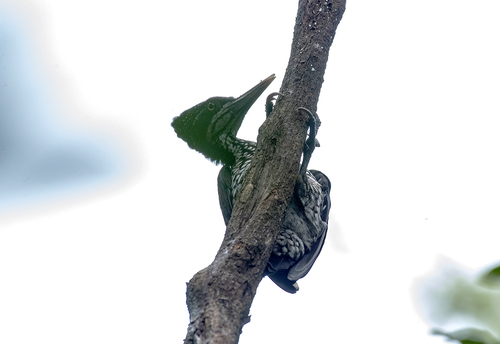 Ceylonese goudrugspecht
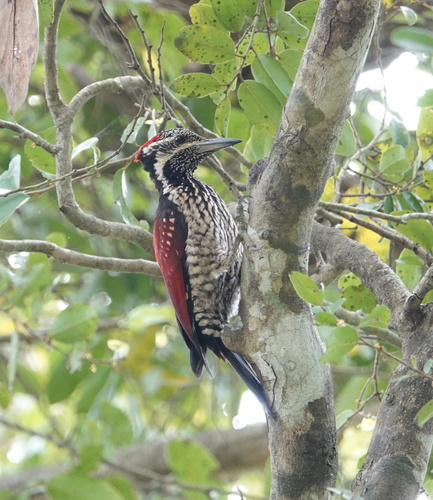 Rode goudrugspecht
Kort gezegd
The most reliable field mark between Crimson-backed Flameback (Chrysocolaptes stricklandi) and Red-backed Flameback (Dinopium psarodes) is the color of the upperparts and bill: Crimson-backed has a deep crimson back and a yellow bill, while Red-backed is also crimson above but has a grey, blunt-tipped bill and distinctive black trailing edges to the wings. For perched or flying birds, check the bill color and the extent and pattern of black on the face and wings. Juveniles of Red-backed are duller and less boldly marked, which can cause confusion, but the bill and facial pattern differences remain useful. Both are endemic to Sri Lanka, but Red-backed is far more common and widespread.
Herkenningstips
- Bill color is a key field mark: Crimson-backed Flameback always has a yellow bill, while Red-backed Flameback has a grey, blunt-tipped bill. This is reliable at all ages and in all seasons.
- Upperparts color: Both species have crimson backs, but Crimson-backed's is described as deeper and more uniform, while Red-backed's crimson is broken by prominent black trailing edges to the wings (visible in flight and often at rest).
- Wing pattern in flight: Red-backed Flameback shows black trailing edges to the wings, a strong field mark in all plumages, including juveniles. Crimson-backed lacks this feature, appearing more uniformly crimson above.
- Facial stripes: Red-backed Flameback has a bold black eyestripe that runs to the nape and upper back, with white streaks between the eye and neck. Crimson-backed has a weaker, spotty supramoustachial stripe and a less noticeable eyebrow stripe, giving a less sharply marked face.
- Underparts: Red-backed shows white underparts with messy black marks, and a black breast and neck with white spots and streaks. Crimson-backed's underparts are less described, but lack the bold black-and-white pattern of Red-backed.
- Crown (female): Female Red-backed has a red crown with a black-and-white speckled forecrown and forehead; this is not described for Crimson-backed, but may help if seen well.
- Juvenile marks: Juvenile Red-backed are duller, with less bold markings; males have white spots on the crown, females have few or none. Use bill color and wing pattern to separate even dull young birds.
- Habitat and abundance: If you are in a home garden, disturbed area, or anywhere outside deep forest, Red-backed is much more likely. Crimson-backed is less common and more restricted.
- Voice: If you hear a sharp, screeching whinny or dull drumroll, suspect Red-backed. Lack of vocal description for Crimson-backed means this is only a positive mark for Red-backed.
- Structural features: Red-backed's bill is described as blunt-tipped and grey, while Crimson-backed's is yellow and not described as blunt. Both are similar in size and overall jizz.
- Hybrid confusion: Some hybrids may show intermediate plumage (orange or yellow mixed with red), but bill color and facial pattern still help.
- Sex differences: Female Red-backed has a distinctive speckled crown; sex differences in Crimson-backed are not described here.
- Perched vs. flight views: In flight, focus on the black trailing edge to the wings for Red-backed; perched, check bill color and facial stripes.
- Context: Red-backed is the most common woodpecker in Sri Lanka; Crimson-backed is much less likely in disturbed or open habitats.
- When in doubt: Use a combination of bill color, wing pattern, and facial stripes, as these are the most consistently reliable marks across ages and conditions.
Grootte
Red-backed Flameback is about 28 cm in length, and is described as the most common and conspicuous woodpecker in Sri Lanka. Crimson-backed Flameback is not given a specific measurement here, but both are medium-to-large woodpeckers. Size alone is not a reliable separator in the field, as both are similar and overlap in size.
Verenkleed
- Juveniles: Red-backed Flameback juveniles are duller overall, with less bold markings; males have white spots on the crown, females have few or no spots. Crimson-backed Flameback juvenile plumage is not detailed, but adults are diagnostic.
- Adults: Crimson-backed Flameback has a deep crimson upper body (back and wings), a yellow bill, and a weaker, spotty supramoustachial (moustache) stripe with a less distinct eyebrow. Red-backed Flameback is also mostly crimson above but always shows black trailing edges to the wings and a black eyestripe that extends to the nape and upper back, with white streaks between the eye and neck. Underparts differ: Red-backed has white underparts with messy black marks, black breast and neck with white spots/streaks; Crimson-backed's underpart pattern is not described in detail, but the facial stripes are weaker and less defined. Female Red-backed has a red crown with a black-and-white speckled forecrown and forehead, while Crimson-backed's crown pattern is not specified here.
Gedrag
Both species forage in typical woodpecker fashion, climbing trunks and branches using their tails for support. Red-backed Flameback is noted for joining mixed-species flocks and foraging both in trees and on the ground, especially for ants. Its flight is described as a flap-and-glide bounding pattern, which is typical for woodpeckers. No unique behavioral field marks are described for Crimson-backed Flameback, so behavior is not a reliable separator.
Habitat
Both species are endemic to Sri Lanka. Red-backed Flameback is much more widespread and common, found in a wide range of habitats including dry and moist lowland forests, mangroves, and even home gardens, mostly in the dry zone but also in humid environments. Crimson-backed Flameback is also endemic but its habitat preferences are not detailed here. In practice, if you are in a home garden or disturbed habitat, Red-backed is far more likely.
Geluid
Red-backed Flameback has a sharp, unmusical, screeching whinny, with rhythmic or repeated 'woik-woik-wik-wi-ti-ti-t-t t-t-trrrrrr!' calls and a dull drumroll. No vocal description is given for Crimson-backed Flameback. Voice may help confirm Red-backed, but is not a direct separator unless you know the calls well.
Ceylonese goudrugspecht · Rode goudrugspecht · Mijn lastige vogels