

シルスイキツツキ 対 アカエリシルスイキツツキ
Sphyrapicus varius 対 Sphyrapicus nuchalis
シルスイキツツキとアカエリシルスイキツツキのクイズ
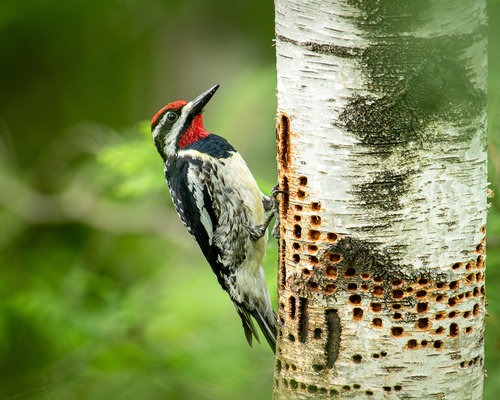 シルスイキツツキ
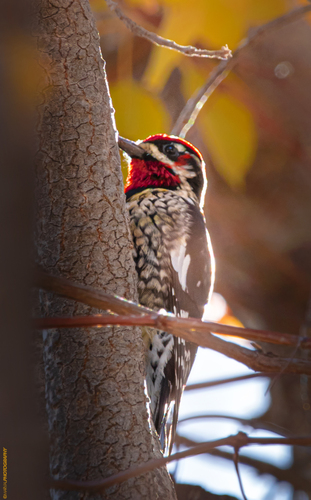 アカエリシルスイキツツキ
要点
The most reliable field mark between Yellow-bellied and Red-naped Sapsucker is the presence of a distinct red patch on the nape of Red-naped Sapsucker adults, which is absent in Yellow-bellied. Both species are medium-sized woodpeckers with similar size and structure, but subtle differences in head and throat pattern, especially in females and juveniles, are key for separation. In the field, focus on the head and nape pattern, throat color, and extent of yellow on the underparts. Juvenile birds can be especially tricky, but the nape and throat remain useful clues. Range is also a strong context clue: Yellow-bellied is found in northeastern North America, Red-naped in the interior west.
識別のコツ
- Red nape patch (adults only): Red-naped Sapsucker always shows a distinct red spot on the nape, visible from the side or back. Yellow-bellied Sapsucker never shows red on the nape at any age or sex.
- Throat color (sex-specific): Adult male Yellow-bellied and Red-naped both have red throats. Adult female Yellow-bellied has a white throat, while female Red-naped has a two-part throat: white above, red below. This is a key mark for separating females.
- Head pattern: Yellow-bellied has a red crown bordered by black, with a white supercilium that widens on the nape but is interrupted by a black line. Red-naped has a black head with white stripes and a red nape spot; the white lines are more continuous and bolder.
- Underparts: Both have yellowish underparts, but Red-naped tends to have a more distinctly yellow breast and upper belly with a whiter lower belly and rump. Yellow-bellied shows yellow restricted to the lower underparts, with black arrowhead markings on the sides of the breast and flanks.
- Juvenile plumage: Juvenile Yellow-bellied is dark olive-brown with a buff-striped head and streaked crown, a mostly white throat, and a scaly breast. Juvenile Red-naped is not detailed here, but look for any hint of a red nape patch as a clue for Red-naped even in young birds.
- Tail pattern: Yellow-bellied juveniles have a more heavily barred tail than adults; this may help in tricky immature birds.
- Wing panel: Both species have a large white wing patch, so this is not diagnostic between the two.
- Bill and structure: Both have a short, straight, chisel-tipped bill and similar proportions; structure is not useful for separation.
- Range: If you are in the eastern US or Canada, your sapsucker is almost certainly Yellow-bellied. In the interior west (Rockies, Great Basin, western US/Canada), expect Red-naped. Vagrants do occur, so always check plumage.
- Sex differences: Red-naped females show a unique two-part throat (white above, red below), while Yellow-bellied females have a white throat; males of both are similar with red throats.
- Crown color: Both have a red crown, but in Yellow-bellied, the red is more extensive and bordered by black, while in Red-naped, the crown is red but the head is more black overall.
- Supercilium: Yellow-bellied's white supercilium widens on the nape and is broken by a black line; Red-naped's white stripes are more continuous.
- Flank markings: Yellow-bellied shows black arrowhead-shaped markings on the sides of the breast and flanks; Red-naped's flanks are less distinctly marked.
- Context: Both species may hybridize where their ranges meet (Rocky Mountains); hybrids can show intermediate features and should be left unidentified if classic marks are missing.
- Habitat: Both prefer deciduous trees, but Yellow-bellied is more tied to birch and poplar in the east, while Red-naped is often found in aspen groves in the west.
大きさ
Both species are nearly identical in size, with Yellow-bellied Sapsucker averaging 50.3g and Red-naped Sapsucker 49.0g [wikidata]. Length and wingspan overlap completely (19–21 cm long), so size alone is not helpful for separation in the field.
羽色
Juvenile Yellow-bellied Sapsuckers are overall dark olive-brown with a buff-striped head and streaked crown, a mostly white throat (sometimes with red in males), and a scaly breast with a pale yellowish belly. Their tail is more heavily barred than adults. Juvenile Red-naped Sapsuckers are not described in detail here, but adults of both species share a black-and-white barred back and wings with a large white wing patch. For adults, the key difference is the red nape patch in Red-naped (absent in Yellow-bellied). Adult males of both have a red throat, but in females, Yellow-bellied shows a white throat, while Red-naped females have a two-toned throat: red below, white above. Both have yellowish underparts, but Red-naped tends to have a more distinctly yellow breast and upper belly, with a whiter lower belly and rump. Head pattern is also critical: Yellow-bellied has a red crown (more extensive in males), bordered by black, and a white supercilium that widens on the nape but is broken by a black line; Red-naped has a black head with white stripes and a clear red spot on the nape.
行動
Both species behave similarly, drilling sap wells in trees and foraging for insects. No strong behavioral differences are noted in the sources for field separation.
生息環境
Yellow-bellied Sapsucker breeds in Canada and the northeastern United States, favoring deciduous forests, especially with poplar and birch. Red-naped Sapsucker is found in the interior west of North America, often in aspen groves and mixed woodlands. Thus, geography is a strong clue: eastern birds are almost always Yellow-bellied, while birds in the Rockies and Great Basin are Red-naped.
シルスイキツツキ · アカエリシルスイキツツキ · 苦手な鳥