

モリムシクイ 対 キタヤナギムシクイ
Phylloscopus sibilatrix 対 Phylloscopus trochilus
モリムシクイとキタヤナギムシクイのクイズ
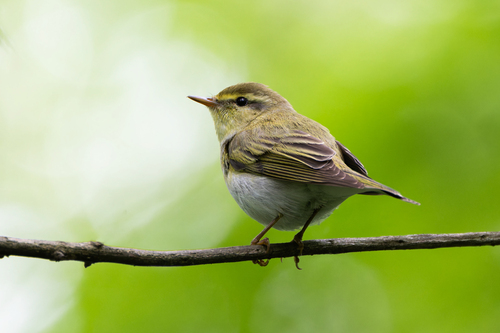 モリムシクイ
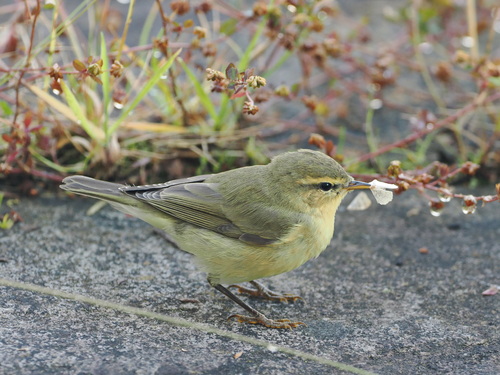 キタヤナギムシクイ
要点
The most reliable way to separate Wood Warbler from Willow Warbler is by their brighter, more sharply contrasting plumage: Wood Warbler shows a vivid yellow throat and breast with a crisp white belly, while Willow Warbler is generally paler below and less sharply marked, often with a yellowish or off-white wash. Wood Warbler also has a longer primary projection and a broader, shorter tail, giving it a distinctly different shape, especially when perched. Juvenile Willow Warblers are yellower below than adults, but never show the Wood Warbler’s clear-cut yellow-and-white contrast. In flight or at rest, the Wood Warbler’s structure and brighter face pattern are key. Voice is also distinctive, but less useful if birds are silent.
識別のコツ
- Yellow throat and breast (Wood Warbler): Look for a vivid yellow throat and upper breast, sharply contrasting with a white belly. Willow Warbler never shows this crisp division; its yellow is more diffuse and limited.
- Supercilium (Wood Warbler): Wood Warbler has a brighter, more prominent yellow supercilium (eyebrow), especially in fresh plumage. Willow Warbler’s is paler and less sharply defined.
- Underparts (Willow Warbler): Willow Warbler is generally off-white to yellowish below, lacking the Wood Warbler’s sharp yellow-white contrast. Juveniles are yellower but still lack the Wood Warbler’s pattern.
- Upperparts (Wood Warbler): Wood Warbler is green above, often brighter and cleaner than Willow Warbler’s greenish-brown.
- Primary projection (Wood Warbler): When perched, Wood Warbler shows a noticeably longer primary projection (the tips of the longest wing feathers extend well beyond the tertials). This gives the wing a longer, sleeker look compared to Willow Warbler.
- Tail shape (Wood Warbler): Wood Warbler’s tail is shorter and broader, while Willow Warbler’s is longer and more tapered. This can be subtle but is visible when birds are side by side.
- Tertial edges (Wood Warbler): Pale edges to the tertials are more obvious in Wood Warbler, though this is a supporting mark.
- Leg color: Both species have pale legs, so this is not useful for separation (unlike Chiffchaff).
- Jizz: Wood Warbler often appears more robust and broad-bodied, with a more upright stance. Willow Warbler is more slender and delicate.
- Song: Wood Warbler’s accelerating trill and descending piping notes are unique; Willow Warbler’s song is a sweet, descending, repetitive whistle. If you hear a metallic trill, it’s Wood Warbler.
- Call: Wood Warbler gives a single, soft piping note; Willow Warbler’s call is a disyllabic 'hoo-eet'.
- Habitat: In mature, closed-canopy woodland, especially in upland areas, expect Wood Warbler. In open, scrubby, or young woodland, Willow Warbler is more likely.
- Season and age: Juvenile Willow Warblers are yellower below but never show the Wood Warbler’s sharply defined yellow throat and breast. Use structure and face pattern for young birds.
- Flight views: In flight, Wood Warbler’s longer wings and broader tail may be apparent, but are subtle. Rely on plumage and structure if possible.
- Pitfalls: Beware of worn or faded Wood Warblers, which can appear less bright, and of juvenile Willow Warblers, which can look surprisingly yellow. Always check for the sharpness of the yellow-white division and the overall structure.
大きさ
Both species are similar in length (11–12.5 cm), but Wood Warbler is slightly heavier on average (10.0 g) [wikidata]. In the field, size is rarely a reliable separator, but Wood Warbler may appear a touch bulkier and broader-bodied, especially when compared side-by-side with Willow Warbler.
羽色
- Juveniles: Willow Warbler juveniles are noticeably yellower below than adults, but lack the sharply defined yellow throat and breast of Wood Warbler. Wood Warbler juveniles retain the strong yellow-white contrast of adults.
- Adults: Wood Warbler is green above with a vivid yellow supercilium, throat, and upper breast, sharply demarcated from a white belly. Willow Warbler is greenish-brown above and off-white to yellowish below, but the yellow is more diffuse and less sharply defined. Both lack wingbars, but Wood Warbler has paler tertial edges. Willow Warbler’s underparts are more uniform and less striking.
- Wing pattern: No strong wing pattern differences are described for either species, but Wood Warbler’s longer primary projection is a subtle structural clue, visible when the wing is closed.
行動
Both species are active, often foraging in the canopy or mid-levels of woodland. Wood Warbler may appear more restless and is often seen sallying out from exposed perches, sometimes flicking its wings and tail. Willow Warbler is more likely to be seen feeding lower in scrub or among smaller trees, with a more delicate, less abrupt movement style. In flight, Wood Warbler’s broader tail and longer wings can give it a slightly different jizz, but this is subtle.
生息環境
Both breed in northern and temperate Europe and are strongly migratory, wintering in Africa. Wood Warbler favors mature, often deciduous woodland with a more closed canopy, especially in hilly or upland areas. Willow Warbler is more catholic, found in open woodlands, young birch, alder, and willow stands, and often in scrubby or regenerating areas. Overlap occurs, but Willow Warbler is more likely in open, bushy habitats.
声
Wood Warbler has two song types: a high-pitched, fluid metallic trill that accelerates, and a series of 3–5 descending piping notes (piüü-piüü-piüü). Its contact call is a soft, single piping note. Willow Warbler’s song is a simple, repetitive, descending whistle, very different in rhythm and tone. Its contact call is a disyllabic 'hoo-eet'. If heard well, these are diagnostic, but beware of brief or partial phrases.