

Western Woodhaunter 対 Eastern Woodhaunter
Automolus virgatus 対 Automolus subulatus
Western WoodhaunterとEastern Woodhaunterのクイズ
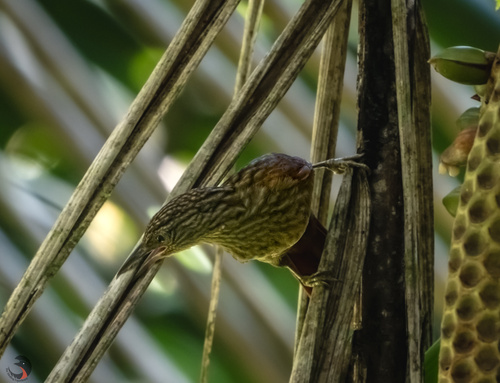 Western Woodhaunter
 Eastern Woodhaunter
要点
Western and Eastern Woodhaunter are extremely similar in size, structure, and general coloration, but differ in subtle but consistent plumage features, especially on the back, rump, and tail. The most reliable field mark is the color of the rump and tail: Western Woodhaunter shows a dull rusty-olivaceous rump and lighter cinnamon tail, while Eastern Woodhaunter has a richer chestnut rump and tail. Streaking on the breast and back is also subtly different, with Eastern tending to show broader, blurrier streaks on the breast. Juvenile Easterns are paler below with less distinct streaking. Bill and face pattern are nearly identical, so focus on rump/tail color and breast streaking when separating these two in the field.
識別のコツ
- Rump and tail color: Western Woodhaunter shows a dull rusty-olivaceous rump and lighter cinnamon tail, while Eastern Woodhaunter has a richer chestnut rump and tail. This is the most consistent field mark for adults of both sexes and all seasons, but beware of lighting and worn plumage.
- Breast streaking: Eastern Woodhaunter has wide, blurry golden-buff streaks on the breast that fade before the belly, while Western's breast is a deeper fawn with dusky edges but less extensive streaking. This is best seen at close range or in good light.
- Back color and streaking: Western's back is blackish brown with golden-buff streaks that widen as they extend onto the back; Eastern's upper back is a rich dark brown with similar but slightly less contrasting streaks. Subspecies may blur this difference.
- Juvenile/immature plumage: Only described for Eastern: juveniles are paler below and have less distinct streaking, making them look plainer than adults and potentially more like Western, but the chestnut rump and tail should still be evident.
- Face pattern: Both have a dark brownish face with golden-buff streaks, pale eyering, and stripe behind the eye; this is not useful for separation.
- Bill color: Both species have a brownish-black to dusky bill with some yellow or pale on the mandible; not diagnostic.
- Leg color: Western has brown legs and feet; Eastern's are slate gray to olive-gray, but this is subtle and rarely visible in the field.
- Subspecies variation: Some Western subspecies (assimilis) are more rufous, and some Eastern (lemae) are more olivaceous. Always check rump and tail color, not just overall tone.
- Geographic range: If in Central America or west of the Andes, expect Western; east of the Andes in Amazonia, expect Eastern. Overlap is minimal except in western Amazonian Colombia/Ecuador.
- Habitat: Both use humid forest understory and mid-levels; habitat is not a separator except as a proxy for range.
- Foraging behavior: Both species forage in a similar way, often with mixed flocks and by probing among dead leaves and epiphytes. Behavior does not separate them.
- Size and structure: Both are large for their genus, with a short, heavy bill and similar proportions. Size is not a useful field mark.
- Sex and season: No sexual dimorphism or strong seasonal change in plumage; all field marks apply year-round and to both sexes.
- Lighting and wear: Cinnamon and chestnut tones can look similar in poor light or on worn birds; always try to see the rump and tail in good light.
- Voice: No comparative information available; do not rely on vocalizations for separation based on current sources.
大きさ
Both species are very similar in size, with a length of 17–18 cm. Western Woodhaunter averages about 35 g, while Eastern Woodhaunter ranges from 25–38 g, so there is complete overlap and no reliable size difference in the field. Both have a short, heavy bill typical of Automolus, and overall proportions are alike.
羽色
Juvenile and immature plumage is only described for Eastern Woodhaunter: juveniles are paler below and have less distinct streaking, which may make them appear even plainer than Western. For adults, Western Woodhaunter (nominate) shows a dull rusty-olivaceous brown rump, deep reddish cinnamon uppertail coverts, and a lighter cinnamon tail, with the back streaks widening as they extend onto the blackish brown back. Eastern Woodhaunter has a chestnut rump and tail, with the upper back a rich dark brown and the breast showing wide, blurry golden-buff streaks that fade before reaching the belly. Subtle differences in the face and crown streaking exist, but both species have a dark brownish face with golden-buff streaks and a pale eyering. Subspecies variation complicates things: some Western subspecies (assimilis) are more rufous, while some Eastern (lemae) are more olivaceous, so always check the color of the rump and tail in good light.
行動
Both species forage in a similar manner, usually singly and often as part of mixed-species flocks, moving through the forest understory to mid-levels. They probe and glean along large branches, vines, and among dead leaves, sometimes 'burrowing' into clumps. No behavioral differences are noted that help with field separation.
生息環境
Range is the best habitat clue: Western Woodhaunter is found from Honduras and Nicaragua south through Costa Rica and Panama into western Colombia and Ecuador. Eastern Woodhaunter occurs east of the Andes in the Amazon basin (Bolivia, Brazil, Colombia, Ecuador, Peru, Venezuela). Both occupy humid forest, but if you are west of the Andes or in Central America, you are almost certainly seeing Western; east of the Andes in Amazonia, it is Eastern.