

ヒマラヤガビチョウ 対 キンバネガビチョウ
Trochalopteron variegatum 対 Trochalopteron affine
ヒマラヤガビチョウとキンバネガビチョウのクイズ
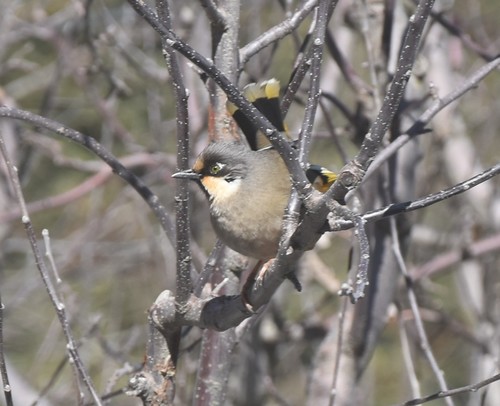 ヒマラヤガビチョウ
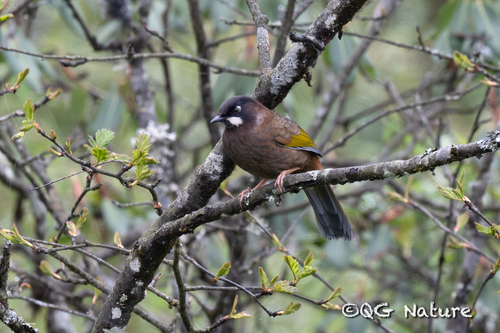 キンバネガビチョウ
要点
The most reliable field mark to separate Variegated Laughingthrush from Black-faced Laughingthrush is the presence of yellow in the wing and tail: Variegated (especially the T. v. variegatum subspecies) shows distinctive yellow primary and secondary feathers and yellow outer tail feathers, while Black-faced Laughingthrush lacks these yellow tones and is generally more uniformly colored. Both species are medium-sized, similar in structure and mass, but the Variegated Laughingthrush’s combination of olive-buff body, black throat stripe, and yellow wing/tail contrasts is unique. Subtle differences around the face and throat, as well as regional range, can also help, but the wing and tail coloration is the most straightforward field clue when visible.
識別のコツ
- Yellow in the wing and tail (Variegated only): Look for yellow primary and secondary feathers and yellow outer tail feathers, especially in T. v. variegatum. This is the most reliable field mark and is visible in both perched and flying birds. Black-faced Laughingthrush never shows yellow in these areas.
- Cinnamon-tipped greater coverts and black primary coverts (Variegated): On perched birds or in good flight views, note the cinnamon tips and black coverts, which are absent in Black-faced.
- Uniform wing and tail (Black-faced): Black-faced Laughingthrush has a more uniform, gray-brown wing and tail, lacking any yellow or cinnamon highlights.
- Facial pattern: Variegated Laughingthrush has a black area around the beak extending to the eye, broken by a white eye-ring, and a buff area at the base of the mandible fading to whitish. Black-faced Laughingthrush is described as having a darker, more uniform face, but detailed face pattern differences are subtle and less reliable than wing/tail color.
- Throat stripe (Variegated): A black stripe down the center of the throat is present in Variegated Laughingthrush; check for this mark in close views. Black-faced does not have this feature.
- Forehead and crown: Variegated (T. v. variegatum) shows a buff forehead with a brownish-gray crown; T. v. simile is duller, but still paler than Black-faced, which is generally more uniformly dark-headed.
- Tail pattern: Both have a large tail with a gray subterminal band and white tip, so this is not a separator. Only the yellow outer tail feathers (Variegated) are diagnostic.
- Subspecies confusion: If you encounter T. v. simile (Variegated), the yellow in the wings and tail is replaced by gray, making separation from Black-faced more difficult. In these cases, rely more on facial pattern, throat stripe, and subtle differences in overall coloration.
- Range: If you are in the western or central Himalayas (e.g., Himachal Pradesh, Uttarakhand, western Nepal), you are more likely to see Variegated; in the eastern Himalayas (e.g., Arunachal Pradesh, eastern Nepal, Bhutan, Myanmar), Black-faced is more likely. In overlap zones (eastern Nepal, Bhutan), use plumage marks.
- Size and structure: Both are similar in size and shape, so do not rely on bulk or length for separation.
- Juvenile/immature birds: No specific juvenile or immature wing pattern differences are described in the sources, so use adult wing and tail coloration for all ages unless further information is available.
- Sex differences: No sexual dimorphism is mentioned for either species; all field marks apply to both sexes.
- Behavior: Both species behave similarly in the field, so do not use behavior as a separator.
- Voice: No diagnostic vocal differences are described in the sources provided.
- Pitfalls: In poor light or distant views, yellow in the wings and tail of Variegated can be missed; always try to get a good look at the flight feathers and tail edges. In duller subspecies or worn plumage, rely on facial pattern and throat stripe.
大きさ
Both species are very similar in size, with Variegated Laughingthrush averaging about 65 g and Black-faced Laughingthrush about 68 g [wikidata]. Both measure around 24–26 cm in length [wikipedia]. In the field, neither species is likely to appear noticeably larger or smaller than the other, and size alone is not a reliable separator.
羽色
Plumage differences are most pronounced in the wing and tail. Adult Variegated Laughingthrush (T. v. variegatum) shows yellow primary and secondary feathers, yellow outer tail feathers, and cinnamon-tipped greater coverts, with black primary coverts. The tail has a gray subterminal band and a white tip. The face features a black area around the beak extending to the eye, interrupted by a white eye-ring, and a buff forehead with a brownish-gray crown. The throat has a black central stripe. The T. v. simile subspecies is duller, with gray (not yellow) primaries, secondaries, and outer tail feathers, and a duller buff on the forehead, but still shows some contrast compared to Black-faced. Black-faced Laughingthrush lacks yellow in the wings and tail, presenting a more uniform, darker face and overall coloration. Both species have a large tail with a gray subterminal band and white tip, but only Variegated shows yellow in the flight feathers. Juvenile and immature plumages are not specifically described in the sources, so the adult wing/tail pattern is the primary separator.
行動
No distinctive behavioral differences are noted in the sources for field separation. Both species are typical laughingthrushes, likely to be seen foraging in flocks in dense undergrowth or secondary forest, moving actively through the mid-story and lower canopy.
生息環境
Variegated Laughingthrush is found mainly in the northern Indian subcontinent, especially the low-to-mid elevations of the western and central Himalayas (Bhutan, India, Nepal, Tibet) [wikipedia]. Black-faced Laughingthrush is found further east, from eastern Nepal through Arunachal Pradesh, Bhutan, southeastern Tibet, and into Myanmar [wikipedia]. There is some range overlap in eastern Nepal and Bhutan, but in most areas, the two species are separated geographically. Habitat preferences are broadly similar, with both occupying forested hills and montane regions.