

Motmot

タウンゼンドアメリカムシクイ 対 クロボシアメリカムシクイ

Setophaga townsendi 対 Cardellina canadensis

タウンゼンドアメリカムシクイとクロボシアメリカムシクイのクイズ
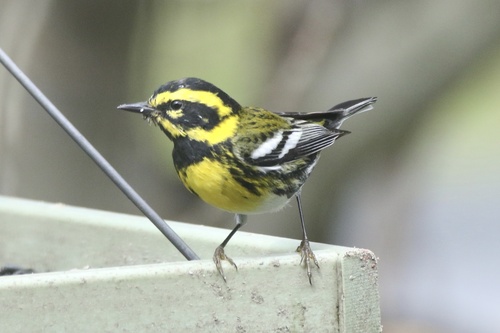
タウンゼンドアメリカムシクイ (Setophaga townsendi) タウンゼンドアメリカムシクイ
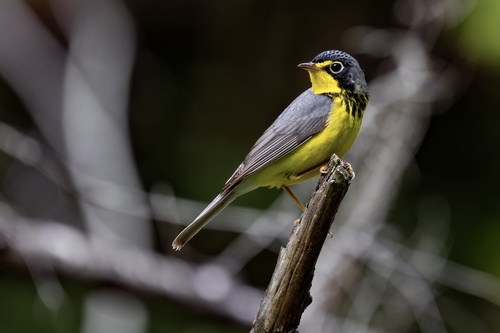
クロボシアメリカムシクイ (Cardellina canadensis) クロボシアメリカムシクイ

メディア

読み込み中…

要点

The most reliable field mark to separate Townsend's Warbler from Canada Warbler is the presence of bold white wingbars and a black cheek patch on Townsend's, versus the Canada Warbler's lack of wingbars and its distinctive white eyering ('spectacles') and black 'necklace' of streaks across the yellow chest. Immature Townsend's can resemble Canada Warbler in dullness, but the face pattern and wingbars remain diagnostic. In flight or perched, check for wingbars and facial contrast first. Both are small, active warblers, but their facial and wing patterns are the quickest way to avoid confusion.

識別のコツ

  1. Wingbars: Townsend's Warbler (all ages) has two bold white wingbars; Canada Warbler (all ages) has plain wings with no wingbars. This is the fastest way to separate them, especially in flight or poor light.
  2. Facial Pattern: Townsend's shows a yellow face with a black (adult male) or dark green (immature/female) cheek patch, and a thin pointed bill. Canada Warbler has a bright yellow face with a prominent white eyering ('spectacles') and no cheek patch.
  3. Chest Markings: Canada Warbler has a black 'necklace' of streaks across the yellow chest (bolder in males, present but fainter in immatures/females). Townsend's has black streaks on the flanks but not a necklace; adult males have a black throat, females/immatures a yellow throat.
  4. Cap and Throat: Townsend's adult males have a black cap and throat; females/immatures have a darker or greenish cap and yellow throat. Canada Warbler has a plain gray crown and bright yellow throat (no black cap or throat).
  5. Back Color: Townsend's has olive upperparts with black streaks; Canada Warbler has a plain dark gray back.
  6. Belly and Flanks: Townsend's belly is white with black streaks on the flanks. Canada Warbler's underparts are uniformly yellow except for the necklace.
  7. Undertail: Canada Warbler shows white on the underside of the tail; this is not noted for Townsend's.
  8. Bill Shape: Both have thin, pointed bills typical of warblers; not a strong separator.
  9. Flight View: In flight, look for Townsend's wingbars and facial contrast; Canada Warbler will show a plain wing and white undertail.
  10. Habitat: In breeding season, Townsend's is in mature coniferous forests high in the canopy; Canada Warbler is in dense, shrubby understory or near the ground in boreal/mixed forests. In migration, check the foraging height and habitat structure.
  11. Behavior: Townsend's often forages high and actively in conifers, sometimes hovering; Canada Warbler is more skulking, low in dense cover or understory.
  12. Voice: If you hear a buzzy, Black-throated Green-like song, suspect Townsend's. Canada Warbler's song is not described here, so use with caution.
  13. Sex/Age Pitfalls: Immature Townsend's can be dull and may lack the full black cap/throat, but always show wingbars and a cheek patch. Immature Canada Warblers are duller but still have the necklace and eyering.
  14. Seasonal Context: In the Pacific Northwest, Townsend's is expected; in the Northeast, Canada Warbler is more likely. In migration, check both plumage and habitat carefully.
  15. When in Doubt: Prioritize wingbars (present = Townsend's), eyering/necklace (present = Canada), and cheek patch (present = Townsend's). These three marks rarely fail, even on immatures.

大きさ

Both species are small warblers and overlap considerably in size. Canada Warbler averages 12–15 cm in length with a wingspan of 17–22 cm and a mass of 9–13 g [wikipedia]. Townsend's Warbler is similar in size (no precise numbers in the notes), so size is not a reliable field mark for separation.

羽色

Immature and adult Townsend's Warblers always show two clear white wingbars, which Canada Warbler lacks at all ages. Townsend's also has a yellow face with a bold black cheek patch (adults) or dark green cheek (immatures), and a white belly with black streaks on the flanks. Adult males have a black cap and throat, while females and immatures have a dark or greenish cap and a yellow throat. Canada Warbler, by contrast, has a clean, dark gray back, no wingbars, and a bright yellow throat, chest, and belly. Its most distinctive feature is the black 'necklace' of streaks across the chest (bolder in males), and a prominent white eyering ('spectacles'). Immature Canada Warblers are duller but retain the eyering and necklace, though less pronounced. In flight, Townsend's wingbars and facial pattern are visible; Canada Warbler shows a plain wing and white undertail.

行動

Both species are active foragers but use different parts of the forest. Townsend's Warbler tends to forage high in coniferous trees, often gleaning insects from foliage, sometimes hovering or sallying for prey. Canada Warbler is more likely to be found lower in dense understory, on or near the ground, or in bushes, especially outside the breeding season. After fledging, young Canada Warblers stay low in the understory. Both join mixed flocks outside the breeding season, but their preferred foraging strata differ.

生息環境

Townsend's Warbler breeds in mature coniferous forests with large trees along the northwestern coast of North America. Canada Warbler breeds in boreal and mixed forests, especially in dense, shrubby understory, often near water, across Canada and the northeastern US. In migration and winter, Townsend's is more likely in coniferous or mixed forests, while Canada Warbler favors dense thickets and forest edges, often lower to the ground. Habitat overlap is possible in migration, but breeding habitats are distinct.

声

Townsend's Warbler sings a buzzy, slightly variable song ("zee-zee-zee-bzz-zee" or "weazy weazy weazy twea"), somewhat similar to Black-throated Green Warbler. Its call is a sharp "tup." Canada Warbler's song is not described in the notes, so voice is only partially helpful; if you hear a buzzy, Black-throated Green-like song, Townsend's is more likely.

より良い説明を送る

比較と同じ項目を使ってください。文章はすぐに公開されます。

The most reliable field mark to separate Townsend's Warbler from Canada Warbler is the presence of bold white wingbars and a black cheek patch on Townsend's, versus the Canada Warbler's lack of wingbars and its distinctive white eyering ('spectacles') and black 'necklace' of streaks across the yellow chest. Immature Townsend's can resemble Canada Warbler in dullness, but the face pattern and wingbars remain diagnostic. In flight or perched, check for wingbars and facial contrast first. Both are small, active warblers, but their facial and wing patterns are the quickest way to avoid confusion.

  1. Wingbars: Townsend's Warbler (all ages) has two bold white wingbars; Canada Warbler (all ages) has plain wings with no wingbars. This is the fastest way to separate them, especially in flight or poor light.
  2. Facial Pattern: Townsend's shows a yellow face with a black (adult male) or dark green (immature/female) cheek patch, and a thin pointed bill. Canada Warbler has a bright yellow face with a prominent white eyering ('spectacles') and no cheek patch.
  3. Chest Markings: Canada Warbler has a black 'necklace' of streaks across the yellow chest (bolder in males, present but fainter in immatures/females). Townsend's has black streaks on the flanks but not a necklace; adult males have a black throat, females/immatures a yellow throat.
  4. Cap and Throat: Townsend's adult males have a black cap and throat; females/immatures have a darker or greenish cap and yellow throat. Canada Warbler has a plain gray crown and bright yellow throat (no black cap or throat).
  5. Back Color: Townsend's has olive upperparts with black streaks; Canada Warbler has a plain dark gray back.
  6. Belly and Flanks: Townsend's belly is white with black streaks on the flanks. Canada Warbler's underparts are uniformly yellow except for the necklace.
  7. Undertail: Canada Warbler shows white on the underside of the tail; this is not noted for Townsend's.
  8. Bill Shape: Both have thin, pointed bills typical of warblers; not a strong separator.
  9. Flight View: In flight, look for Townsend's wingbars and facial contrast; Canada Warbler will show a plain wing and white undertail.
  10. Habitat: In breeding season, Townsend's is in mature coniferous forests high in the canopy; Canada Warbler is in dense, shrubby understory or near the ground in boreal/mixed forests. In migration, check the foraging height and habitat structure.
  11. Behavior: Townsend's often forages high and actively in conifers, sometimes hovering; Canada Warbler is more skulking, low in dense cover or understory.
  12. Voice: If you hear a buzzy, Black-throated Green-like song, suspect Townsend's. Canada Warbler's song is not described here, so use with caution.
  13. Sex/Age Pitfalls: Immature Townsend's can be dull and may lack the full black cap/throat, but always show wingbars and a cheek patch. Immature Canada Warblers are duller but still have the necklace and eyering.
  14. Seasonal Context: In the Pacific Northwest, Townsend's is expected; in the Northeast, Canada Warbler is more likely. In migration, check both plumage and habitat carefully.
  15. When in Doubt: Prioritize wingbars (present = Townsend's), eyering/necklace (present = Canada), and cheek patch (present = Townsend's). These three marks rarely fail, even on immatures.

Both species are small warblers and overlap considerably in size. Canada Warbler averages 12–15 cm in length with a wingspan of 17–22 cm and a mass of 9–13 g [wikipedia]. Townsend's Warbler is similar in size (no precise numbers in the notes), so size is not a reliable field mark for separation.

Immature and adult Townsend's Warblers always show two clear white wingbars, which Canada Warbler lacks at all ages. Townsend's also has a yellow face with a bold black cheek patch (adults) or dark green cheek (immatures), and a white belly with black streaks on the flanks. Adult males have a black cap and throat, while females and immatures have a dark or greenish cap and a yellow throat. Canada Warbler, by contrast, has a clean, dark gray back, no wingbars, and a bright yellow throat, chest, and belly. Its most distinctive feature is the black 'necklace' of streaks across the chest (bolder in males), and a prominent white eyering ('spectacles'). Immature Canada Warblers are duller but retain the eyering and necklace, though less pronounced. In flight, Townsend's wingbars and facial pattern are visible; Canada Warbler shows a plain wing and white undertail.

Both species are active foragers but use different parts of the forest. Townsend's Warbler tends to forage high in coniferous trees, often gleaning insects from foliage, sometimes hovering or sallying for prey. Canada Warbler is more likely to be found lower in dense understory, on or near the ground, or in bushes, especially outside the breeding season. After fledging, young Canada Warblers stay low in the understory. Both join mixed flocks outside the breeding season, but their preferred foraging strata differ.

Townsend's Warbler breeds in mature coniferous forests with large trees along the northwestern coast of North America. Canada Warbler breeds in boreal and mixed forests, especially in dense, shrubby understory, often near water, across Canada and the northeastern US. In migration and winter, Townsend's is more likely in coniferous or mixed forests, while Canada Warbler favors dense thickets and forest edges, often lower to the ground. Habitat overlap is possible in migration, but breeding habitats are distinct.

Townsend's Warbler sings a buzzy, slightly variable song ("zee-zee-zee-bzz-zee" or "weazy weazy weazy twea"), somewhat similar to Black-throated Green Warbler. Its call is a sharp "tup." Canada Warbler's song is not described in the notes, so voice is only partially helpful; if you hear a buzzy, Black-throated Green-like song, Townsend's is more likely.

変更を破棄しますか?

保存していない編集があります。今離れると失われます。

タウンゼンドアメリカムシクイ · クロボシアメリカムシクイ · 苦手な鳥