

キマユコオニキバシリ 対 キタヨコジマオニキバシリ
Dendrocincla anabatina 対 Dendrocolaptes sanctithomae
キマユコオニキバシリとキタヨコジマオニキバシリのクイズ
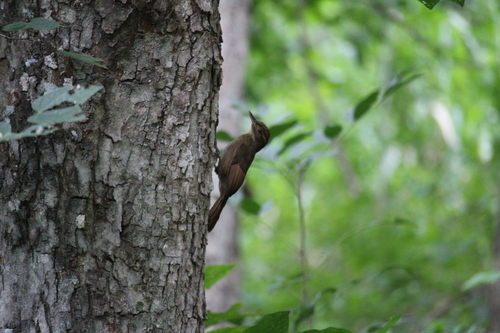 キマユコオニキバシリ
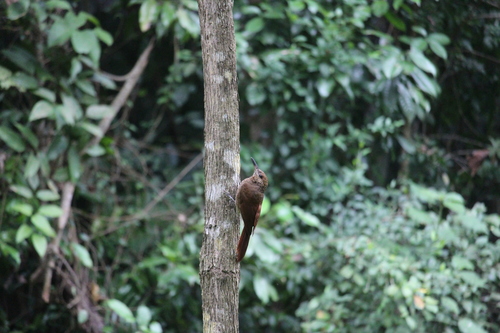 キタヨコジマオニキバシリ
要点
The most reliable field mark between Tawny-winged Woodcreeper and Northern Barred-Woodcreeper is the presence of strong black barring on the underparts and upperparts of the Northern Barred-Woodcreeper (all ages), which the Tawny-winged Woodcreeper completely lacks. Juveniles of both species are similar to adults, but the barring on the Barred-Woodcreeper remains a constant and distinctive feature. Structurally, Northern Barred-Woodcreeper is much larger, with a noticeably longer tail and heavier build, while Tawny-winged is medium-sized, shorter-tailed, and slimmer. Bill shape is similar (straight), but the Barred-Woodcreeper's is heavier. In flight or perched, look for the Barred-Woodcreeper's prominent barring and larger size versus the plain, olive-brown and rufous tones of Tawny-winged. Both follow army ant swarms, so context alone is not diagnostic.
識別のコツ
- Check for black barring on underparts and upperparts: Northern Barred-Woodcreeper always shows strong black barring on the throat, breast, belly, crown, and back. Tawny-winged Woodcreeper is entirely unbarred and plain below and above. This is the single most reliable field mark at all ages and in all lights.
- Look for overall size and structure: Barred-Woodcreeper is much larger and bulkier, with a longer tail and heavier build. Tawny-winged is medium-sized, slimmer, and shorter-tailed. If you see both together, the size difference is striking.
- Tail and wing color: Both have rufous-chestnut tails and flight feathers, but Barred-Woodcreeper's are richer and more extensive, matching the cinnamon-buff tones of the face and underparts. Tawny-winged's tail is more cinnamon-rufous, and the wings are dark olive-brown with tawny flight feathers.
- Face pattern: Barred-Woodcreeper has a cinnamon-brown face with fine barring, a faint rufous supercilium, and black lores. Tawny-winged has a brown head with a buffy supercilium and bare gray skin around the eye, lacking barring or strong facial contrast.
- Underparts color: Barred-Woodcreeper's underparts are golden to cinnamon-buff with black barring throughout. Tawny-winged's are plain light olive-brown, becoming cinnamon on the belly and undertail coverts, never barred.
- Bill color and shape: Both have straight bills, but Barred-Woodcreeper's is heavier and mostly blackish (juveniles entirely black), while Tawny-winged's is dark brown or black above, gray or bluish below, and slimmer.
- Juvenile differences: Juvenile Barred-Woodcreeper has more diffuse barring below and an all-black bill, but still shows barring. Juvenile Tawny-winged is like adult but with a duller throat, wider supercilium, and sometimes a white eye—still never barred.
- Perched vs. in flight: In flight, Barred-Woodcreeper's size, long tail, and barred underparts are obvious. Tawny-winged appears smaller, with plain underparts and a shorter tail.
- Habitat context: Tawny-winged can occur in more disturbed or edge habitats and sometimes in mangroves or semi-deciduous forests, especially in the Yucatán and Costa Rica. Barred-Woodcreeper is more restricted to mature, undisturbed forest and is sensitive to fragmentation.
- Behavior at ant swarms: Both follow army ants, but Tawny-winged is more aggressive and tends to stay lower (up to 3 m above ground). Barred-Woodcreeper may be found higher and sometimes in small groups.
- Supercilium and eye color: Tawny-winged has a more pronounced buffy supercilium and sometimes a white eye in juveniles. Barred-Woodcreeper's supercilium is faint and rufous, with a more uniform facial pattern.
- Iris color: Tawny-winged has a yellowish brown to gray iris; Barred-Woodcreeper's is light to dark brown.
- Leg color: Both have dark legs, but Barred-Woodcreeper's can vary more (dark brown, black, grayish green, bluish, or horn), while Tawny-winged's are dark blue-gray to blackish.
- Regional abundance: Tawny-winged is generally fairly common except on the Yucatán, where both species are rare. Barred-Woodcreeper is generally uncommon to common but less so at higher elevations or in marginal habitat.
- Never rely on voice alone: No distinctive vocal differences are noted in the sources, so always use plumage and structure first.
大きさ
Northern Barred-Woodcreeper is significantly larger: 25–29 cm long and 53–83 g, compared to Tawny-winged Woodcreeper's 17–19 cm and 29–42 g. The Barred-Woodcreeper is among the largest woodcreepers, with a long tail and heavier, bulkier build. Tawny-winged is medium-sized for its genus, with a shorter tail and lighter, slimmer appearance. In mixed flocks or at ant swarms, the size difference is usually obvious with direct comparison, but can be harder to judge alone.
羽色
Juvenile and adult Northern Barred-Woodcreeper always show strong black barring on the crown, back, and especially the underparts (from throat to belly), with a cinnamon-buff ground color. The barring is well-defined in adults and more diffuse in juveniles, but always present. Upperparts also show barring, and the face is cinnamon-brown with fine barring and a faint rufous supercilium. Flight feathers and tail are rufous-chestnut, with dusky tips on the primaries. Juveniles have redder undertail coverts and an all-black bill.
Tawny-winged Woodcreeper (all ages) lacks any barring. It is plain dark olive-brown above, with a buffy supercilium and bare gray skin around the eye, and a ruffled nape. The tail and uppertail coverts are cinnamon-rufous to rufous-chestnut, but the wings are dark olive-brown with tawny flight feathers and dusky tips. The underparts are plain light olive-brown, becoming cinnamon on the belly and undertail coverts. Juveniles are similar to adults but with a duller throat, wider supercilium, and sometimes a white eye. No barring is ever present at any age.
行動
Both species are near-obligate followers of army ant swarms, typically foraging by clinging to trunks or branches and making short flights to the ground to catch prey disturbed by the ants. Tawny-winged Woodcreeper tends to stay low (up to 3 m above ground), is usually solitary or in pairs, and is highly aggressive to other birds at swarms. Northern Barred-Woodcreeper also follows ant swarms, sometimes in groups up to four, and is sensitive to disturbance and fragmentation, generally requiring larger tracts of forest. Both may forage away from ants on occasion, but this is rare.
生息環境
Both species inhabit humid lowland and foothill forests, but Tawny-winged Woodcreeper is more tolerant of secondary forest, edges, and even some semi-open landscapes, especially on the Yucatán Peninsula and in Costa Rica (including mangroves). Northern Barred-Woodcreeper is more restricted to mature forest and is less likely to be found in disturbed or fragmented habitats. Both can be found from southern Mexico through Central America, but the Barred-Woodcreeper's range extends farther south into Colombia, Venezuela, and Ecuador. On the Yucatán Peninsula, both are rare, but the Barred-Woodcreeper is generally less common at higher elevations or in marginal habitat.