

ニッケイカマドドリ 対 オリーブカマドドリ
Limnoctites sulphuriferus 対 Cranioleuca obsoleta
ニッケイカマドドリとオリーブカマドドリのクイズ
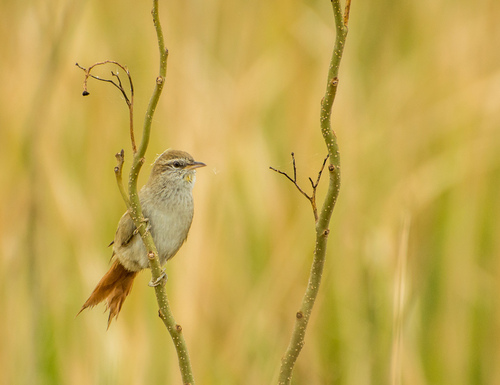 ニッケイカマドドリ
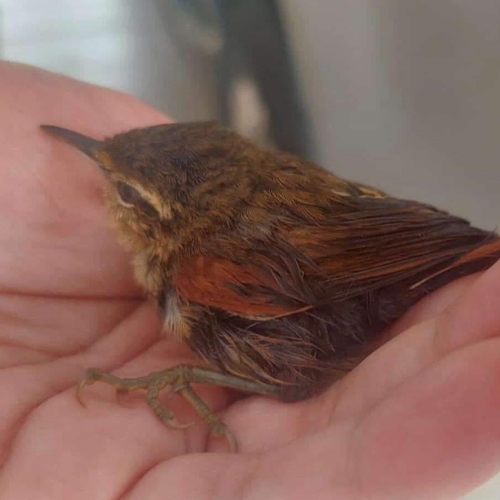 オリーブカマドドリ
要点
The most reliable field mark between Sulphur-bearded Reedhaunter and Olive Spinetail is the Reedhaunter's distinctive yellow throat and chin, which is never shown by Olive Spinetail at any age. In addition, the Reedhaunter has a more strongly streaked whitish face and a longer, more pointed tail with central feathers extending beyond the rest. Juvenile birds are especially tricky, but even then, the Reedhaunter lacks breast streaking and yellow on the chin, while Olive Spinetail juveniles may show variable breast scaling. Both species are similar in size and general structure, but careful attention to throat color, face pattern, and tail shape will separate them in the field.
識別のコツ
- Yellow throat and chin (adults): Only Sulphur-bearded Reedhaunter shows a yellow chin and throat. Olive Spinetail always has a whitish throat. This is the single most reliable mark for adults.
- Juvenile underparts: Juvenile Reedhaunter lacks yellow on the chin and has unstreaked ochraceous underparts, while juvenile Olive Spinetail may show variable breast scaling. If you see a juvenile with any breast scaling, lean toward Olive Spinetail.
- Face pattern: Reedhaunter has a buffish white supercilium and a grayish-streaked whitish face, giving a more contrasting and streaked appearance. Olive Spinetail has a whitish supercilium but a dull brown band behind the eye and streaky ear coverts, resulting in a less contrasting face.
- Tail structure: Reedhaunter's tail is sharply pointed, with the central pair of feathers longer and brownish, outer feathers more rufous. Olive Spinetail's tail is chestnut-rufous throughout, with all feathers spiky (due to lack of barbs at the tip) but not with elongated central feathers. In flight or when fanned, look for the Reedhaunter's central tail extension.
- Wing coverts and flight feathers: Both species have rufous or chestnut tones in the wing coverts, but Reedhaunter's primaries are rufous with rich tawny bases, while Olive Spinetail's flight feathers are warm brown. This is subtle and best used in good light.
- Breast and belly: Reedhaunter has a whitish breast with thin grayish streaks and a whitish belly, while Olive Spinetail is buffy brownish on the breast and pale olive-buff on the belly, lacking strong streaking.
- Flanks and undertail: Reedhaunter's flanks and undertail coverts are tawny-buff, contrasting with its paler belly. Olive Spinetail's flanks and undertail coverts are somewhat darker than its belly but not strongly contrasting.
- Bill and leg color: Both have similar bill and leg coloration, not useful for separation.
- Habitat: If the bird is in a reedbed or marsh, it's almost certainly a Reedhaunter. If in forest or woodland, especially with Araucaria, it's Olive Spinetail.
- Behavior: Olive Spinetail often forages in mixed-species flocks and climbs trunks/branches in the mid-story to canopy. Reedhaunter is more likely to be low in reeds.
- Voice: If you hear a high, hesitant 'tzit-tzit-tzit' followed by a short trill, it's Olive Spinetail. Reedhaunter's voice is undescribed here, so absence of this song is not diagnostic.
- Geographic overlap: Both species occur in Argentina and Brazil, but Olive Spinetail also reaches Paraguay, and Reedhaunter is found in Uruguay. Check local lists for likelihood.
- Iris color: Reedhaunter's iris is whitish red to orange-pink; Olive Spinetail's is variable. This is subtle and rarely visible in the field.
- Sexes: Both species are sexually monomorphic, so sex is not a separator.
- Season: No strong seasonal plumage differences are described for either species; all marks above apply year-round.
大きさ
Both species are nearly identical in mass (about 13 g) and fall within a similar length range (Sulphur-bearded Reedhaunter 15–16 cm, Olive Spinetail 12.5–15 cm). The Reedhaunter is on average slightly longer, but this difference is subtle and not reliable in the field. Bill size and shape are not highlighted as distinctive between the two. Overall, size is not a strong separating feature.
羽色
- Juveniles: Sulphur-bearded Reedhaunter juveniles have darker upperparts and more ochraceous underparts than adults, with no yellow on the chin and no breast streaks. Olive Spinetail juveniles have darker upperparts than adults and may show variable scaling (not streaking) on the breast. Both lack the adult Reedhaunter's yellow throat, but only the Reedhaunter juvenile is unstreaked below.
- Adults: The Reedhaunter shows a yellow chin and throat, a buffish white supercilium, a grayish-streaked whitish face, olive-brown upperparts, and a tail with longer, sharply pointed central feathers and more rufous outer feathers. Olive Spinetail adults have a whitish supercilium, dull brown band behind the eye, buff and brown streaky ear coverts, a plain buff malar, dull brownish olive crown, richer brown back/rump, and a uniformly chestnut-rufous, spiky tail. The Reedhaunter's breast is whitish with thin grayish streaks, while Olive Spinetail's is buffy brownish without strong streaking. Underparts of the Reedhaunter are paler, with tawny-buff flanks and undertail, compared to the Olive Spinetail's pale olive-buff belly and darker flanks.
行動
Both species are typically seen in pairs and are active foragers. Olive Spinetail is noted for joining mixed-species flocks and foraging acrobatically in the mid-story to canopy, often hitching along trunks and branches. The Reedhaunter's foraging behavior is less detailed, but it is associated with reedbeds and marshy vegetation, often seen low in dense cover. In flight, both may appear spiky-tailed, but the Reedhaunter's tail has more pronounced central feather extension.
生息環境
Sulphur-bearded Reedhaunter is restricted to marshes and reedbeds in Argentina, Brazil, and Uruguay, always closely tied to dense emergent vegetation near water or wet ground. Olive Spinetail, in contrast, is found in humid forests and woodlands (often with Araucaria) from southern Brazil through Paraguay to northeast Argentina, and is not associated with marshes. Thus, habitat context is a strong clue: a spinetail in a reedbed is almost certainly a Reedhaunter, while one in forest or woodland is Olive Spinetail.
声
Olive Spinetail has a described song: a short, high, hesitant series followed by a short trill, and calls including a 'tst' and a soft, hurried trill. No vocalization details are provided for Sulphur-bearded Reedhaunter, so voice is not a reliable separator unless Olive Spinetail's song is heard.