

コユビシトドコヒバリ 対 タンビコヒバリ
Spizocorys starki 対 Spizocorys fringillaris
コユビシトドコヒバリとタンビコヒバリのクイズ
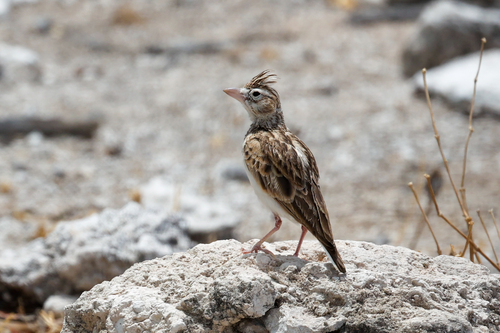 コユビシトドコヒバリ
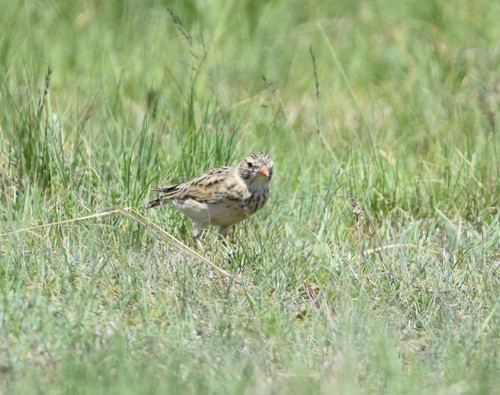 タンビコヒバリ
要点
The most reliable way to separate Stark's Lark from Botha's Lark is by face pattern and bill color: Botha's Lark shows a bold, well-marked face and a distinctly pinkish, conical bill, while Stark's Lark has a paler, more subtly streaked face and a pale, slightly swollen bill. Stark's Lark is overall paler and sandier with a raised, streaked crest, whereas Botha's Lark is compact, with grey-brown upperparts and a buffy-streaked chest. Both species can be found in South Africa, but Botha's Lark is much rarer and restricted to specific grasslands. Look for the combination of face pattern, bill color, and chest streaking to make a confident ID.
識別のコツ
- Face Pattern: Botha's Lark has a bold, well-marked face, while Stark's Lark's face is paler and more subtly streaked. This is often the quickest field check.
- Bill Color and Shape: Botha's Lark shows a distinctly pinkish, conical bill; Stark's Lark's bill is pale, stout, and appears slightly swollen. Bill color is especially helpful in good light.
- Crest: Stark's Lark often raises a streaked crest, especially when alert or in heat. Botha's Lark does not show such a pronounced crest.
- Chest and Flank Streaking: Botha's Lark has a buffy, streaked chest and spread-out streaking on the flanks. Stark's Lark is much paler below, with only faint streaking and cleaner flanks.
- Upperparts Color: Stark's Lark is sandy-brown above with subtle streaking; Botha's Lark is grey-brown and more contrasting.
- Eyebrow: Stark's Lark has a distinct pale eyebrow, which can stand out in the field; Botha's Lark's eyebrow is less emphasized compared to its bold face pattern.
- Overall Contrast: Botha's Lark is more contrasting and patterned; Stark's Lark is paler and more washed out.
- Structure and Jizz: Botha's Lark is compact and stubby; Stark's Lark is medium-small but may appear longer and less compact. Bill shape adds to this impression.
- Habitat: If you are in arid, gravelly grassland, especially outside South Africa, Stark's Lark is more likely. Botha's Lark is restricted to specific, often protected, South African grasslands.
- Flocking Behavior: Large flocks, especially after rain, suggest Stark's Lark. Botha's Lark is rarely seen in large groups.
- Display Flight: Aerial acrobatics with varied trills and whistles point to Stark's Lark; Botha's Lark does not display this behavior.
- Vocalizations: Complex, musical display songs indicate Stark's Lark; short, simple calls suggest Botha's Lark, but use with caution unless you have a clear view.
- Conservation Context: Botha's Lark is critically endangered and extremely rare; if you are outside a known Botha's Lark site, the odds favor Stark's Lark.
- Juvenile/Immature Birds: No distinctive age-specific wing or flight patterns are described for either species, so rely on face, bill, and chest streaking at all ages.
- Pitfalls: Beware of pale light or worn plumage making Stark's Lark look even paler, or of Botha's Lark appearing less contrasting in poor light. Always check multiple features.
大きさ
Stark's Lark (body mass ~18.6g [wikidata]) is a pale, medium-small lark, while Botha's Lark is described as small and compact. Direct size comparison in the field is difficult, but Botha's Lark may appear slightly more compact and stubby, especially when perched. Stark's Lark's bill is described as stout and slightly swollen, while Botha's is more conical and pinkish. Overall, size is not the most reliable separator, but structure and bill shape can help when seen well.
羽色
No age-specific wing or flight pattern differences are described for these species in the available sources, so focus is on perched plumage. Stark's Lark is pale sandy-brown above with subtle streaking and a distinct pale eyebrow, a whitish, faintly streaked belly, and a raised, streaked crest. Botha's Lark is more contrasting: grey-brown above, with a boldly marked face, a buffy, streaked chest, and spread-out streaking on the flanks. Botha's Lark's underparts are pale but the chest is noticeably buffy and streaked, while Stark's Lark is cleaner and paler below. The face pattern is much stronger in Botha's Lark, and the bill is pinkish and conical, compared to Stark's paler, stouter bill. In summary: Botha's Lark is more contrasting and boldly marked; Stark's Lark is paler and more subtly streaked.
行動
Stark's Lark is highly mobile and nomadic, often forming flocks after rain and sometimes mixing with sparrow-larks or buntings. It is adapted to arid grasslands, seeking shade and adopting a characteristic posture (raised crest, open mouth, drooped wings) in heat. During courtship, it performs aerial acrobatics with varied trills, whistles, and chirps. Botha's Lark's behavior is less described, but it is not noted for such pronounced flocking or display flights. Botha's Lark is more localized and less likely to be encountered in large groups.
生息環境
Stark's Lark prefers arid grasslands with gravelly substrates, avoiding sandy areas, and is found across Angola, Botswana, Namibia, and South Africa. Botha's Lark is endemic to South Africa and restricted to specific grasslands, making it much rarer and more localized. If you are in a typical arid, gravelly grassland, especially outside South Africa, Stark's Lark is far more likely. Botha's Lark is critically endangered and mostly found in protected or managed grassland patches in South Africa.
声
Stark's Lark has a varied courtship display song with trills, whistles, and chirps, especially during aerial displays. Botha's Lark gives a short, simple call that can be heard both in flight and on the ground. If you hear a complex, musical display, Stark's Lark is more likely; a brief, simple call suggests Botha's Lark. However, vocalizations are not the most reliable separator unless display is observed.
コユビシトドコヒバリ · タンビコヒバリ · 苦手な鳥