

Motmot

ススイロライチョウ 対 オジロライチョウ

Dendragapus fuliginosus 対 Lagopus leucura

ススイロライチョウとオジロライチョウのクイズ
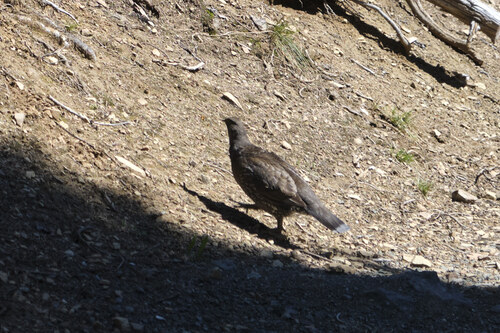
ススイロライチョウ (Dendragapus fuliginosus) ススイロライチョウ
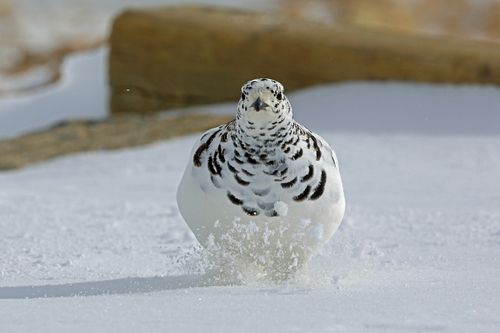
オジロライチョウ (Lagopus leucura) オジロライチョウ

メディア

読み込み中…

要点

The most reliable field mark between Sooty Grouse and White-tailed Ptarmigan is the tail: Sooty Grouse always shows a long, square tail with a pale gray tip, while White-tailed Ptarmigan has a much shorter, all-white tail visible in all plumages. In flight or perched, Sooty Grouse is much larger and bulkier, with a dark overall appearance, whereas White-tailed Ptarmigan is compact, stocky, and changes from brownish in summer to entirely white in winter, but always keeps white wings and tail. If you see a small, round-bodied grouse with feathered feet and a white tail above treeline, it is a ptarmigan; a large, dark grouse with a gray-tipped tail in forested areas is a Sooty Grouse.

識別のコツ

  1. Tail color and length: Sooty Grouse always has a long, square tail with a pale gray tip; White-tailed Ptarmigan always has a short, pure white tail. This is visible in flight and when perched, in all ages and seasons.
  2. Wing color in flight: White-tailed Ptarmigan has white wings in all plumages and ages; Sooty Grouse has dark wings with no white.
  3. Size and bulk: Sooty Grouse is much larger and heavier-bodied than White-tailed Ptarmigan. If the bird looks quail-sized, it's a ptarmigan; if chicken-sized, it's a grouse.
  4. Plumage seasonality: White-tailed Ptarmigan changes from brownish and finely barred above with white underparts in summer to all-white in winter, but always has white wings and tail. Sooty Grouse is never all-white and never shows white in the wings or tail.
  5. Feet and bill: Ptarmigan have feathered feet and toes, and feathers around the nostrils, visible at close range; Sooty Grouse has bare toes and a stouter bill.
  6. Sexual dimorphism: Male Sooty Grouse shows a yellow throat air sac and yellow eye wattle when displaying; female Sooty Grouse is mottled brown. Ptarmigan males have reddish eyecombs above the eye, visible year-round, but are otherwise similar to females in plumage.
  7. Habitat: Sooty Grouse is found in forested mountain slopes, never above treeline. White-tailed Ptarmigan is only found above treeline in alpine tundra, never in forest.
  8. Behavior: Ptarmigan often crouch or walk, rarely flying except when flushed, and may burrow in snow; Sooty Grouse is more likely to flush and fly a distance, or be seen perched in trees.
  9. Vocalizations: Sooty Grouse males may give deep hoots during display; ptarmigan are mostly silent, with only soft clucks or hoots.
  10. Underparts: In summer, ptarmigan have white bellies and underparts, contrasting with the brown upperparts; Sooty Grouse females have more mottled brown and white underparts but lack the sharp contrast and white wings/tail.
  11. Display features: Only Sooty Grouse males show a yellow throat sac and eye wattle during display. Ptarmigan males have reddish eyecombs but no throat sac.
  12. Flight style: Ptarmigan fly low and short distances, often dropping quickly; Sooty Grouse can fly higher and farther when flushed.
  13. Context clues: If you are in an alpine zone with no trees, expect ptarmigan; in forested areas, expect Sooty Grouse.
  14. Juvenile/immature birds: Both species' juveniles resemble adults in tail and wing pattern, so the white tail/wing of ptarmigan and gray-tipped tail of Sooty Grouse remain reliable.
  15. Potential confusion: Female Sooty Grouse and summer ptarmigan can look similar in ground color, but the tail and wing pattern are always diagnostic.

大きさ

Sooty Grouse is substantially larger: adults measure 40–50 cm (16–20 in) long and weigh 750–1,300 g (1.65–2.87 lb) [wikipedia]. White-tailed Ptarmigan is the smallest grouse in North America, at 31–34 cm (12–13 in) and only 325 g (11.5 oz) [wikipedia]. In the field, Sooty Grouse looks much bigger, longer-tailed, and heavier-bodied, while White-tailed Ptarmigan appears compact and almost quail-like.

羽色

Tail and wing pattern are the fastest clues in all ages and seasons. Sooty Grouse always shows a long, square tail with a pale gray tip, even when flushed; the tail is a strong contrast with the otherwise dark plumage. White-tailed Ptarmigan, in all ages and seasons, has a short, square, pure white tail and white wings, which are especially obvious in flight. In summer, ptarmigan are mottled gray-brown above with white underparts, but their white wings and tail stand out. In winter, ptarmigan are entirely white except for a small black bill and eye, but still keep the white tail and wings. Sooty Grouse males are dark overall with a yellow throat air sac and yellow eye wattle (displaying), while females are mottled brown with white and dark brown underparts, but never show white in the tail or wings. Female Sooty Grouse can be confused with ptarmigan in summer, but the tail and lack of white in the wings are key. Ptarmigan always have feathered feet and nostrils, and males show reddish eyecombs year-round.

行動

White-tailed Ptarmigan is adapted to cold alpine environments and often walks or crouches rather than flying, sometimes burrowing into snowbanks to roost. They avoid flight to conserve energy and are generally silent, moving in small groups or pairs. Sooty Grouse is a forest bird, often seen perched in trees or on the ground, and males display with visible throat sacs and eye wattles. Sooty Grouse is more likely to flush with a loud wingbeat and fly a considerable distance; ptarmigan flushes are short and low to the ground.

生息環境

Habitat is a strong separator. Sooty Grouse is found in forested areas of the Pacific Coast Ranges, often in coniferous forests at mid to high elevations, but always below treeline [wikipedia]. White-tailed Ptarmigan lives exclusively above treeline in alpine tundra, on rocky slopes, or in snowfields, and is never found in forested areas. If you are above treeline in the Rockies or high Cascades/Sierra, you are almost certainly seeing a ptarmigan; in forest, especially with trees overhead, it is Sooty Grouse.

声

White-tailed Ptarmigan is generally silent, but may give quiet, low hoots or soft clucking. Sooty Grouse males produce deep hoots and other display sounds, especially in spring, but these are not always heard and are not a reliable field mark unless you witness display.

より良い説明を送る

比較と同じ項目を使ってください。文章はすぐに公開されます。

The most reliable field mark between Sooty Grouse and White-tailed Ptarmigan is the tail: Sooty Grouse always shows a long, square tail with a pale gray tip, while White-tailed Ptarmigan has a much shorter, all-white tail visible in all plumages. In flight or perched, Sooty Grouse is much larger and bulkier, with a dark overall appearance, whereas White-tailed Ptarmigan is compact, stocky, and changes from brownish in summer to entirely white in winter, but always keeps white wings and tail. If you see a small, round-bodied grouse with feathered feet and a white tail above treeline, it is a ptarmigan; a large, dark grouse with a gray-tipped tail in forested areas is a Sooty Grouse.

  1. Tail color and length: Sooty Grouse always has a long, square tail with a pale gray tip; White-tailed Ptarmigan always has a short, pure white tail. This is visible in flight and when perched, in all ages and seasons.
  2. Wing color in flight: White-tailed Ptarmigan has white wings in all plumages and ages; Sooty Grouse has dark wings with no white.
  3. Size and bulk: Sooty Grouse is much larger and heavier-bodied than White-tailed Ptarmigan. If the bird looks quail-sized, it's a ptarmigan; if chicken-sized, it's a grouse.
  4. Plumage seasonality: White-tailed Ptarmigan changes from brownish and finely barred above with white underparts in summer to all-white in winter, but always has white wings and tail. Sooty Grouse is never all-white and never shows white in the wings or tail.
  5. Feet and bill: Ptarmigan have feathered feet and toes, and feathers around the nostrils, visible at close range; Sooty Grouse has bare toes and a stouter bill.
  6. Sexual dimorphism: Male Sooty Grouse shows a yellow throat air sac and yellow eye wattle when displaying; female Sooty Grouse is mottled brown. Ptarmigan males have reddish eyecombs above the eye, visible year-round, but are otherwise similar to females in plumage.
  7. Habitat: Sooty Grouse is found in forested mountain slopes, never above treeline. White-tailed Ptarmigan is only found above treeline in alpine tundra, never in forest.
  8. Behavior: Ptarmigan often crouch or walk, rarely flying except when flushed, and may burrow in snow; Sooty Grouse is more likely to flush and fly a distance, or be seen perched in trees.
  9. Vocalizations: Sooty Grouse males may give deep hoots during display; ptarmigan are mostly silent, with only soft clucks or hoots.
  10. Underparts: In summer, ptarmigan have white bellies and underparts, contrasting with the brown upperparts; Sooty Grouse females have more mottled brown and white underparts but lack the sharp contrast and white wings/tail.
  11. Display features: Only Sooty Grouse males show a yellow throat sac and eye wattle during display. Ptarmigan males have reddish eyecombs but no throat sac.
  12. Flight style: Ptarmigan fly low and short distances, often dropping quickly; Sooty Grouse can fly higher and farther when flushed.
  13. Context clues: If you are in an alpine zone with no trees, expect ptarmigan; in forested areas, expect Sooty Grouse.
  14. Juvenile/immature birds: Both species' juveniles resemble adults in tail and wing pattern, so the white tail/wing of ptarmigan and gray-tipped tail of Sooty Grouse remain reliable.
  15. Potential confusion: Female Sooty Grouse and summer ptarmigan can look similar in ground color, but the tail and wing pattern are always diagnostic.

Sooty Grouse is substantially larger: adults measure 40–50 cm (16–20 in) long and weigh 750–1,300 g (1.65–2.87 lb) [wikipedia]. White-tailed Ptarmigan is the smallest grouse in North America, at 31–34 cm (12–13 in) and only 325 g (11.5 oz) [wikipedia]. In the field, Sooty Grouse looks much bigger, longer-tailed, and heavier-bodied, while White-tailed Ptarmigan appears compact and almost quail-like.

Tail and wing pattern are the fastest clues in all ages and seasons. Sooty Grouse always shows a long, square tail with a pale gray tip, even when flushed; the tail is a strong contrast with the otherwise dark plumage. White-tailed Ptarmigan, in all ages and seasons, has a short, square, pure white tail and white wings, which are especially obvious in flight. In summer, ptarmigan are mottled gray-brown above with white underparts, but their white wings and tail stand out. In winter, ptarmigan are entirely white except for a small black bill and eye, but still keep the white tail and wings. Sooty Grouse males are dark overall with a yellow throat air sac and yellow eye wattle (displaying), while females are mottled brown with white and dark brown underparts, but never show white in the tail or wings. Female Sooty Grouse can be confused with ptarmigan in summer, but the tail and lack of white in the wings are key. Ptarmigan always have feathered feet and nostrils, and males show reddish eyecombs year-round.

White-tailed Ptarmigan is adapted to cold alpine environments and often walks or crouches rather than flying, sometimes burrowing into snowbanks to roost. They avoid flight to conserve energy and are generally silent, moving in small groups or pairs. Sooty Grouse is a forest bird, often seen perched in trees or on the ground, and males display with visible throat sacs and eye wattles. Sooty Grouse is more likely to flush with a loud wingbeat and fly a considerable distance; ptarmigan flushes are short and low to the ground.

Habitat is a strong separator. Sooty Grouse is found in forested areas of the Pacific Coast Ranges, often in coniferous forests at mid to high elevations, but always below treeline [wikipedia]. White-tailed Ptarmigan lives exclusively above treeline in alpine tundra, on rocky slopes, or in snowfields, and is never found in forested areas. If you are above treeline in the Rockies or high Cascades/Sierra, you are almost certainly seeing a ptarmigan; in forest, especially with trees overhead, it is Sooty Grouse.

White-tailed Ptarmigan is generally silent, but may give quiet, low hoots or soft clucking. Sooty Grouse males produce deep hoots and other display sounds, especially in spring, but these are not always heard and are not a reliable field mark unless you witness display.

変更を破棄しますか?

保存していない編集があります。今離れると失われます。

ススイロライチョウ · オジロライチョウ · 苦手な鳥