

スネアーズムジシギ 対 ムカシジシギ
Coenocorypha huegeli 対 Coenocorypha aucklandica
スネアーズムジシギとムカシジシギのクイズ
 スネアーズムジシギ
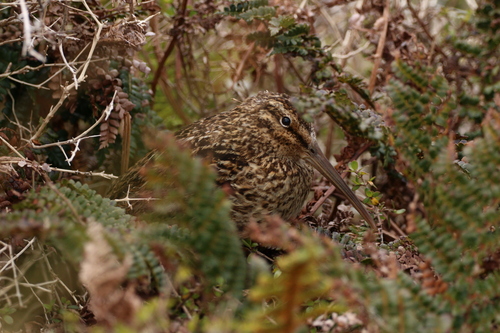 ムカシジシギ
要点
The most reliable field mark between Snares Snipe and Subantarctic Snipe is the underpart barring: Snares Snipe shows heavy barring across the entire underside, while Subantarctic Snipe lacks this all-over barring. Both are cryptically patterned, chunky snipes with similar structure, but Snares Snipe tends to have a more reddish overall tone and, in females, olive legs. Subtle differences in dorsal contrast and primary covert mottling can help, especially in hand or close views, but are challenging at a distance. Juveniles of Snares Snipe appear duller, which may overlap with Subantarctic Snipe's general coloration.
識別のコツ
- Underpart barring (all ages): Snares Snipe shows heavy barring across the entire underparts, which is unique among its group. If you see a snipe with completely barred underparts, it is Snares Snipe. Subantarctic Snipe lacks this feature.
- Overall color tone: Snares Snipe is generally more reddish, especially compared to the browner Subantarctic Snipe. This is subtle and best used in good light.
- Dorsal contrast (adults, especially males): Snares Snipe males have more strongly contrasting dorsal markings than Subantarctic Snipe. This is subtle and may require close views.
- Facial and crown stripes: Both have longitudinal stripes, but Snares Snipe's are more pronounced. Use this only as a supporting mark.
- Leg color (females): Female Snares Snipe have olive legs, while Subantarctic Snipe's leg color is not specified but is not noted as olive. This is only useful if sex can be determined.
- Primary covert mottling (females): Female Snares Snipe have mottling on the inner edges of the primary coverts, lacking in males and not described for Subantarctic Snipe. This is a subtle mark and difficult to see in the field.
- Juvenile dullness: Juvenile Snares Snipe are duller than adults, but still show underpart barring. Subantarctic Snipe juveniles are not described, but lack of barring remains diagnostic.
- Tail structure and display: Snares Snipe has narrow, stiffened outer tail feathers for its aerial display. If you observe the roaring display flight, it points to Snares Snipe.
- Bill length: Snares Snipe females have slightly longer bills (about 57 mm) than males (55 mm), but both overlap with Subantarctic Snipe (about 5 cm). Not reliable in the field.
- Size: Snares Snipe females are slightly heavier than Subantarctic Snipe, but this is not a field mark unless birds are side by side.
- Habitat and location: If you are on the Snares Islands, you are seeing Snares Snipe. Elsewhere in the subantarctic islands, it is likely Subantarctic Snipe.
- Feeding behavior: Both species feed by probing for invertebrates and behave similarly on the ground.
- Voice and display: Only Snares Snipe is noted for the roaring aerial display. If you hear or see this, it is diagnostic.
- Sexing challenges: No single feature reliably separates sexes in the field; combinations of plumage and size are needed for researchers but are not practical for birders.
- Plumage pitfalls: Both are cryptically patterned and can appear similar at a glance. Focus on the underpart barring and, if possible, the reddish tone to avoid confusion.
大きさ
Both species are small, chunky snipes with similar proportions. The Subantarctic Snipe averages about 108.65 g in mass [wikidata], while Snares Snipe females are slightly heavier (about 116 g) than males (101 g) [wikipedia]. Length is similar, with Subantarctic Snipe reaching about 23 cm. These differences are subtle and not reliable in the field unless birds are side by side, but Snares Snipe females may look marginally bulkier.
羽色
- Juvenile/Immature: Juvenile Snares Snipe are duller than adults, but still show the key feature of all-over underpart barring, which is not present in Subantarctic Snipe. No distinctive juvenile wing or upperpart pattern is described for either species, so separation relies on underpart and overall tone.
- Adult: Snares Snipe stands out by having the entire under surface barred, a unique feature in its group. Its plumage is more reddish overall, with strong longitudinal stripes on the face and crown. Subantarctic Snipe is brown, mottled with black and reddish brown, but lacks the extensive underpart barring. Both have cryptic dorsal patterns, but Snares Snipe males show more contrast above, and females have olive legs and mottled inner primary coverts (vs. less marked in Subantarctic Snipe).
行動
Both species feed by probing in soil and leaf litter for invertebrates and are generally secretive. Snares Snipe is noted for its nocturnal aerial 'hakawai' display, which produces a roaring sound using modified outer tail feathers. This display is not specifically described for Subantarctic Snipe in the notes, so may be less prominent or absent.
生息環境
Both species are restricted to subantarctic islands of New Zealand and occupy dense ground cover, but Snares Snipe is endemic to the Snares Islands, while Subantarctic Snipe is found on other subantarctic islands (such as Auckland Islands). In the field, location is a strong clue: Snares Snipe only occurs on the Snares, while Subantarctic Snipe is absent from there.
声
Snares Snipe is noted for its distinctive roaring sound during nocturnal aerial displays, produced by modified tail feathers. No vocal or display differences are described for Subantarctic Snipe in the notes.