

クロハラコビトサザイ 対 ノドグロダルマエナガ
Tesia olivea 対 Suthora davidiana
クロハラコビトサザイとノドグロダルマエナガのクイズ
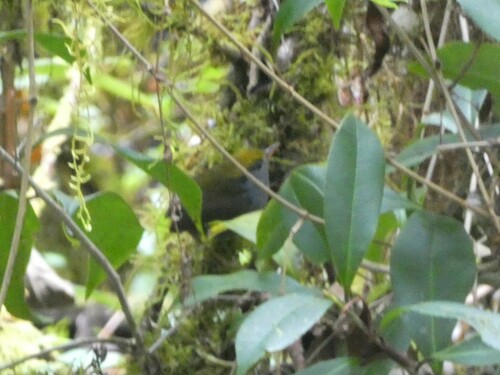 クロハラコビトサザイ
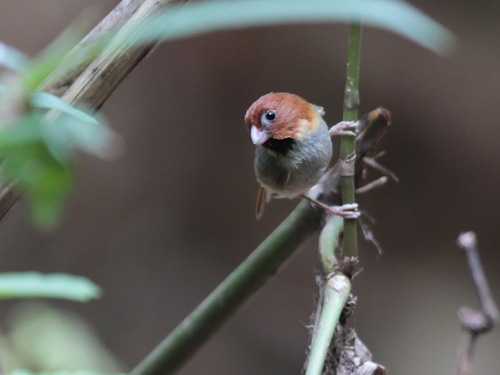 ノドグロダルマエナガ
要点
The most reliable way to separate Slaty-bellied Tesia from Short-tailed Parrotbill is by overall structure: Tesia is a tiny, short-tailed warbler with a fine bill, while Short-tailed Parrotbill is chunkier, with a strikingly thick, deep bill and a proportionally short but broad tail. In the field, Parrotbill's bright cinnamon-rufous head and black throat stand out, while Tesia is more uniformly olive with a slaty belly and lacks strong facial contrast. Both species can be found in similar forest habitats in Southeast Asia, but their shape and head pattern are the quickest field clues. Juvenile or immature-specific wing patterns are not described for either species, so focus on structure and adult plumage.
識別のコツ
- Bill shape: Short-tailed Parrotbill has a thick, deep, and broad bill—much larger in proportion to the head than Tesia’s fine, pointed warbler bill. This is visible even at a distance and is diagnostic for Parrotbill.
- Tail length and shape: Both species have short tails, but Parrotbill’s is short and broad, about three-fourths the wing length, while Tesia’s is extremely short and often held cocked or flicked, sometimes appearing almost tailless.
- Head pattern: Parrotbill shows a bright cinnamon-rufous crown and sides of the head, with a sharply contrasting black chin and throat. Tesia lacks any strong head or throat markings, being more uniformly olive above and slaty below.
- Underparts color: Tesia has a slaty-grey belly contrasting with olive upperparts, while Parrotbill’s underparts are brownish-ochraceous with a grey breast tinged buff. The slaty belly is unique to Tesia.
- Back and rump: Parrotbill’s back and rump are pale slate-grey with an olive wash, while Tesia is more uniformly olive above.
- Wing and tail coloration: Parrotbill’s wings and tail are grey-brown with rufescent (reddish) edges on the quills, while Tesia’s wings are not described as contrasting or rufous-edged.
- Size and jizz: Parrotbill is bulkier, with a large head and bill, and a compact, stubby look. Tesia is smaller, more delicate, and often appears very short-tailed and agile.
- Behavior: Tesia is restless, often flicking its tail and moving low in dense cover. Parrotbill is more likely to be seen in small, social groups, foraging methodically in shrubs or low trees.
- Habitat preference: While both can be in lowland forest, Tesia is more likely in dense undergrowth or montane forest, Parrotbill in shrubby or open areas within lowland forest.
- No age-specific wing pattern: There are no described juvenile or immature wing or flight marks to separate these species; focus on structure and adult plumage.
- No strong sexual dimorphism: Both species are similar across sexes; use structural and plumage marks for all individuals.
- Plumage pitfalls: In poor light, Parrotbill’s rufous head and black throat may be less obvious, but the bill size and head shape remain distinctive. Tesia’s lack of strong head pattern is a good clue.
- Flock association: Parrotbill is more likely to be in a group; Tesia is often solitary or in pairs.
- Bill color: Parrotbill’s bill is described as fleshy-horny; Tesia’s is not specified but is much finer and less prominent.
- Leg color: Parrotbill’s legs are plumbeous grey; Tesia’s leg color is not specified but is not a primary field mark.
大きさ
Short-tailed Parrotbill is slightly heavier (8.5g vs. 7.5g for Tesia) and appears bulkier in hand and in the field. Parrotbill’s body is stubbier, with a large, deep bill and a short, broad tail (tail length about three-fourths the wing), giving it a compact, almost ball-like appearance. Slaty-bellied Tesia is tiny, more slender, with a fine, pointed bill and a very short tail, often looking almost tailless. Both are small birds, but Parrotbill’s proportions are more robust and its head is noticeably larger relative to its body.
羽色
- Juvenile/immature wing pattern: No distinctive age-specific upperwing or flight marks are described for either species; separation does not rely on such features.
- Adult plumage: Slaty-bellied Tesia is olive above with a slaty-grey belly, lacking strong head or throat markings. Short-tailed Parrotbill has a bright cinnamon-rufous crown and sides of the head, a black chin and throat, pale slate-grey back and rump with olive wash, and clear brownish-ochraceous underparts. Parrotbill’s wings and tail are grey-brown, with quills edged rufous. The Parrotbill’s head pattern is much more contrasting, and the black throat is unique among the two.
行動
Slaty-bellied Tesia is typically active in dense undergrowth, moving mouse-like through low vegetation and often flicking its very short tail. Short-tailed Parrotbill is more likely to be seen in small, noisy flocks, often higher in the shrub layer or lower canopy, and may appear more deliberate and less restless than Tesia. Parrotbill’s feeding is often more methodical, using its strong bill to manipulate stems and leaves.
生息環境
Both species occur in subtropical or tropical moist lowland forests in overlapping regions of Southeast Asia. Slaty-bellied Tesia is also found in montane forest, while Short-tailed Parrotbill is more strictly a lowland forest species. In practice, both can occur in similar habitats, but Tesia may be more likely in dense, shady undergrowth, while Parrotbill can be found in slightly more open or shrubby areas within the forest.
クロハラコビトサザイ · ノドグロダルマエナガ · 苦手な鳥