

ウズラシギ 対 アメリカウズラシギ
Calidris acuminata 対 Calidris melanotos
ウズラシギとアメリカウズラシギのクイズ
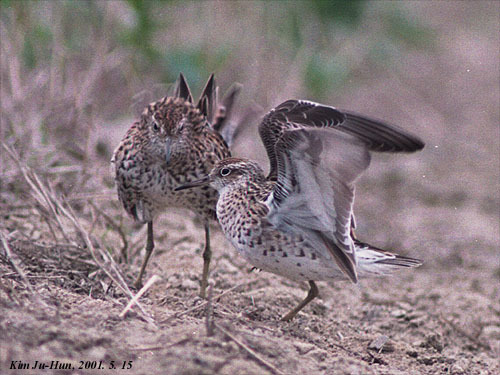 ウズラシギ
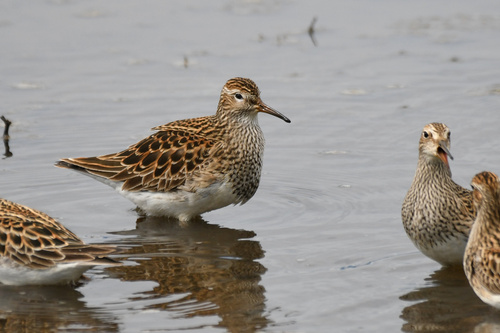 アメリカウズラシギ
要点
The most reliable field mark to separate Sharp-tailed Sandpiper from Pectoral Sandpiper is the breast pattern: Pectoral Sandpiper always shows a sharply defined, dark breast band with a clear cut-off to the white belly, while Sharp-tailed Sandpiper has a more diffused breast with '>'-shaped flank marks and no strong border. Juvenile Sharp-taileds are brighter overall, with a richer chestnut crown and stronger supercilium, while Pectoral juveniles are browner above with less rufous. Structurally, Sharp-tailed Sandpiper appears more pot-bellied and compact, with a flatter back and a slightly longer rear end. Both species are similar in size and general shape, but careful attention to head pattern and breast demarcation is key, especially in autumn when juveniles predominate. In flight, neither species shows a unique upperwing pattern, so focus on perched or foraging birds for best separation.
識別のコツ
- Breast demarcation is key: Pectoral Sandpiper always shows a sharply defined, dark breast band with a clear lower edge against a white belly. Sharp-tailed Sandpiper has a more diffused, mottled breast with '>'-shaped marks on the flanks and no strong border. This works for all ages and is the most reliable mark.
- Juvenile brightness: Juvenile Sharp-tailed Sandpipers are brighter and more rufous, with a rich chestnut crown, bold white mantle stripes, and a strong, pale supercilium. Juvenile Pectoral Sandpipers are browner above, with less rufous and a weaker supercilium.
- Crown color: Sharp-tailed Sandpiper (all ages, especially juveniles) has a chestnut cap that stands out, while Pectoral Sandpiper's crown is browner and less contrasting.
- Supercilium strength: Sharp-tailed Sandpiper has a stronger, more obvious supercilium (eyebrow), especially in juveniles and autumn birds. Pectoral Sandpiper's supercilium is weaker and less contrasting.
- Head and face pattern: Sharp-tailed Sandpiper shows a brown eye-stripe and a more contrasting face; Pectoral Sandpiper's face is plainer.
- Structure/jizz: Sharp-tailed Sandpiper appears more pot-bellied, with a flat back and slightly drawn-out rear end, giving a compact, portly look. Pectoral Sandpiper is more evenly proportioned.
- Bill color: Both species have dark-tipped bills, but Pectoral Sandpiper's bill is olive with a darker tip, while Sharp-tailed's is dark grey to black and straight. This is subtle and not always reliable.
- Leg color: Both can show yellowish legs, but Sharp-tailed's can be olive to yellow, while Pectoral's are yellowish. Overlap is considerable; use with caution.
- Adult breeding plumage: Sharp-tailed Sandpiper adults are more vividly colored, but the chestnut crown and strong supercilium remain key. Pectoral Sandpiper males have a blacker, spotted breast in breeding plumage.
- Non-breeding plumage: Both species become duller, but breast pattern (sharp vs. diffused) and head pattern (chestnut crown, supercilium) still separate them.
- Flight views: No distinctive upperwing or flight pattern differences are described in the sources; focus on perched or foraging birds for best separation.
- Size: Pectoral Sandpiper is slightly heavier, but size overlap is extensive and not reliable in mixed flocks.
- Habitat: Both use similar habitats on migration and in winter. Do not rely on habitat for separation.
- Sex and age overlap: Both species show overlap in size between sexes and ages; focus on plumage and structure.
- Pitfalls: Juvenile Pectoral can look quite bright, and dull Sharp-tailed can seem plain—always check multiple features, especially breast demarcation and crown/supercilium contrast.
大きさ
Pectoral Sandpiper is slightly heavier on average (81.4g vs. 66.9g for Sharp-tailed Sandpiper [wikidata]), but this difference is subtle in the field. Both are small-to-medium calidrids, with Pectoral Sandpiper described as 'largish' and Sharp-tailed as 'small-medium.' Size overlap is significant, so use structure and plumage rather than bulk alone.
羽色
Juvenile and first-autumn birds are most often confused. Juvenile Sharp-tailed Sandpiper is brighter overall, with a vivid chestnut crown, strong white mantle stripes, and a bold supercilium; the breast is buffy with fine, arrow-shaped ('>') marks on the flanks, and the transition to the white belly is gradual. Juvenile Pectoral Sandpiper is browner above, with rufous tones but less saturated, and the breast is grayish with a very sharp lower border—this strong demarcation is the classic field mark. Adults in breeding plumage are more vivid in both species, but Sharp-tailed retains the chestnut cap and strong supercilium, while Pectoral males have a darker, spotted breast. In non-breeding (winter) plumage, both species become duller, but the breast border in Pectoral remains diagnostic. Upperwing patterns are not described as distinctive for either species in the sources, so focus on body and head pattern.
行動
Both species forage in similar ways, picking at mud or shallow water for invertebrates. Sharp-tailed Sandpiper may appear more compact and 'pot-bellied,' with a flat back and drawn-out rear, while Pectoral Sandpiper is more evenly proportioned. No major behavioral differences are noted in the sources that are useful for field separation.
生息環境
Both species overlap in migration and wintering habitats, frequenting freshwater wetlands, mudflats, and grasslands. Sharp-tailed Sandpiper breeds in eastern Siberia and winters mostly in Australasia, while Pectoral Sandpiper breeds in arctic North America and Asia, wintering in South America and Oceania. On migration, both can occur together in suitable shorebird habitats, so habitat alone is not diagnostic.