

ミズカキチドリ 対 ヒレアシトウネン
Charadrius semipalmatus 対 Calidris pusilla
ミズカキチドリとヒレアシトウネンのクイズ
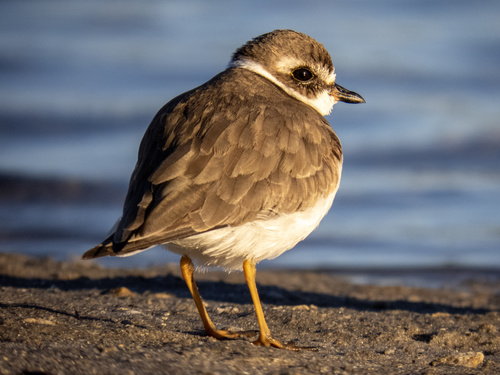 ミズカキチドリ
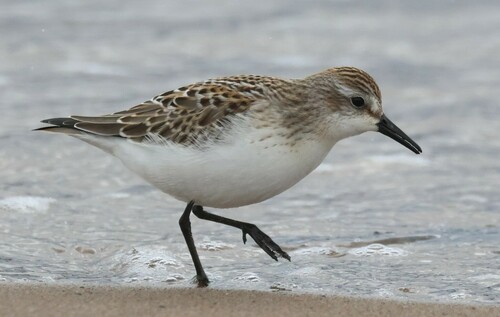 ヒレアシトウネン
要点
The most reliable way to separate Semipalmated Plover from Semipalmated Sandpiper is by overall structure and head pattern: the plover has a bold black-and-white face with a single black breast band, while the sandpiper is plainer-faced and lacks any breast band. In flight or at rest, the plover looks rounder and stockier with a short, thick bill and orange at the bill base, while the sandpiper is slimmer, longer-winged, and has a thin, all-dark bill. Juvenile and adult plumages are both distinctive if you focus on the face and breast. Both species may be found together on mudflats, but their shape, bill, and head pattern are diagnostic at any age.
識別のコツ
- Breast band (all ages): Semipalmated Plover always shows a single, complete black breast band; Semipalmated Sandpiper never shows any breast band. This is the quickest and most reliable field mark.
- Face pattern (all ages): Plovers have a bold white forehead, black mask, and brown cap, creating a striking contrast; sandpipers have a plain, pale face with only a faint eyebrow and no mask.
- Bill shape and color: Plovers have a short, thick bill with orange at the base and a black tip; sandpipers have a longer, thin, straight, all-dark bill. Bill color is especially useful at close range.
- Body shape: Plovers are round-bodied, compact, and short-tailed, often appearing 'chunky'; sandpipers are slimmer, longer-winged, and more elongated in profile.
- Leg color: While not always visible, plovers have orange legs; sandpipers have black legs. Use with caution as mud can obscure leg color.
- Foraging behavior: Plovers run and pause, picking at prey; sandpipers probe rapidly and continuously in mud or shallow water.
- Flight silhouette: Plovers show broad, rounded wings and a short tail; sandpipers have longer, narrower wings and a more attenuated rear end.
- Upperparts color: Plovers are grey-brown above with a clear contrast to white underparts; sandpipers are darker grey-brown above, but less contrasting and more uniform.
- Juvenile plumage: Juvenile plovers still show the single breast band and face pattern, though slightly duller; juvenile sandpipers never show a breast band and are only subtly paler above.
- Group association: Plovers are often solitary or in small groups; sandpipers gather in large, tight flocks, especially during migration.
- Context: If you see a bird with a bold face and breast band among a flock of small, plain sandpipers, it's a plover.
- Voice: Not diagnostic with current notes, but plovers generally give a clear, whistled call, while sandpipers have a higher, softer 'peep.'
- Size: Plovers are slightly larger and bulkier, but size overlap means this is only useful with direct comparison.
- Habitat: Both species overlap extensively; do not rely on habitat alone for identification.
- Pitfalls: Do not confuse the plover’s single breast band with the double bands of Killdeer; Semipalmated Sandpiper never shows any breast band at all.
大きさ
Semipalmated Plover is slightly larger and heavier: adults measure 17–19 cm in length and average 46–47 g in mass [wikipedia], while Semipalmated Sandpiper is 15–18 cm long and averages 18–51.5 g, but is typically lighter [wikipedia]. The plover appears more compact and round-bodied, with a shorter tail and bill. The sandpiper is slimmer, with a longer, more attenuated body and wings, and a noticeably longer primary projection when seen side-on.
羽色
Juvenile and adult Semipalmated Plovers of all ages show a single, crisp black breast band, a white forehead, and a black mask around the eyes, with a brown cap and orange at the base of the bill. This bold face and breast pattern is present year-round, though less crisp in worn birds. Semipalmated Sandpipers, in all plumages, lack any breast band and have a plain, pale face with only a faint supercilium and a generally uniform grey-brown upperpart. Their underparts are clean white with no band or collar. In flight, neither species shows a distinctive upperwing pattern (no black 'W' or contrasting panels), but the plover’s wings and back are solid grey-brown, while the sandpiper’s are darker and more uniform. Juvenile sandpipers may show slightly brighter feather edges above, but still lack any head or breast pattern like the plover.
行動
Semipalmated Plovers forage by running and pausing, picking at prey on the surface, often on drier ground or sandier patches. They may perform distraction displays if disturbed. Semipalmated Sandpipers are more likely to be seen probing in mud or shallow water, moving quickly and feeding continuously. In mixed flocks, plovers stand out by their more upright posture and tendency to pause more often.
生息環境
Both species can occur together on coastal mudflats, beaches, and tidal flats during migration. The plover sometimes uses slightly drier or sandier ground, while the sandpiper prefers wetter mud and the water’s edge. However, habitat overlap is extensive and not a reliable separator in the field.