

キバラヒタキモドキ 対 アカボウシヒタキモドキ
Myiozetetes cayanensis 対 Myiozetetes similis
キバラヒタキモドキとアカボウシヒタキモドキのクイズ
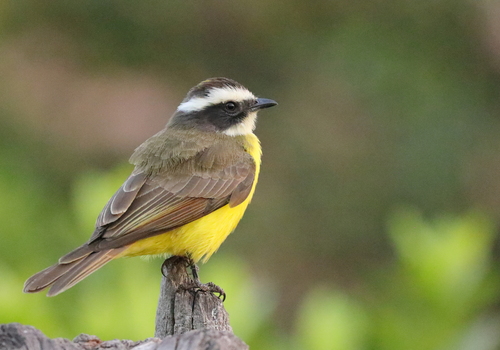 キバラヒタキモドキ
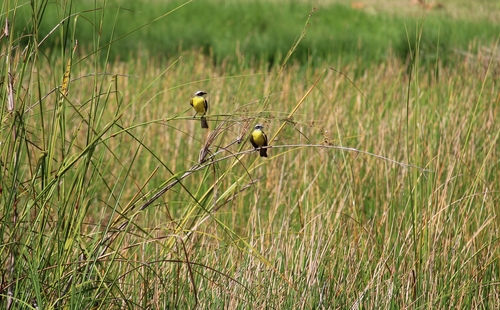 アカボウシヒタキモドキ
要点
Juvenile Rusty-margined Flycatchers show more extensive rusty-cinnamon edging on the wings and tail than juvenile Social Flycatchers, which have wider rufous edges but less overall saturation. On perched adults, look for the rusty or cinnamon-rufous margins on the Rusty-margined's outer secondaries and primaries, versus the Social's paler grayish or olivaceous edges and sometimes faint wing bars. Both species share a broad white supercilium and bright yellow underparts, but the Rusty-margined's upperparts are plainer brown-olive, while the Social is more olive-green and may show subtle wing bars. Structure and size are nearly identical, so careful attention to wing and tail edging, especially in juveniles, is key. Habitat overlap is extensive, so context is rarely helpful.
識別のコツ
- Juvenile wing and tail edging: Juvenile Rusty-margined Flycatchers have more extensive and richer rusty-cinnamon edges on the wings and tail than juvenile Social Flycatchers, which show wider but paler rufous edges. This is the most reliable mark in fresh juveniles and first-year birds.
- Adult wing edging: On perched adults, look for thin rusty or cinnamon-rufous margins on the Rusty-margined's outer secondaries and inner primaries. Social Flycatcher adults have pale grayish white edges on the inner secondaries and pale olivaceous edges elsewhere, sometimes producing two faint wing bars from the coverts.
- Upperparts color: Rusty-margined Flycatcher has plain brown to olive-brown upperparts, while Social Flycatcher is more olive-green to brownish olive, often with a slightly grayer hindneck. This is subtle and best judged in good light.
- Wing bars: Social Flycatcher may show two faint wing bars formed by pale edges to the coverts; Rusty-margined lacks these, instead showing more uniform rusty or cinnamon edging.
- Tail color and edging: Rusty-margined has a dusky brownish tail with light olive edges; Social Flycatcher has a deep grayish brown tail with pale olive edges. This is a minor mark and best used in combination with others.
- Crown patch: Both species have a mostly hidden crown patch (yellow to golden-orange in Rusty-margined, red to orangish red in Social). This is rarely visible in the field and not a reliable separator.
- Supercilium: Both have a broad white supercilium extending well past the eye; this is not useful for separation.
- Underparts: Both show bright yellow underparts and white throat/chin; not diagnostic.
- Bill, legs, and iris: Both have a stubby black bill, black legs and feet, and brown iris; no separation here.
- Size and structure: Length and weight overlap almost completely; structure is nearly identical and not a field mark.
- Behavior and posture: Both perch conspicuously and sally for insects; Social Flycatcher may be more gregarious, but this is not reliable.
- Habitat: Both use a wide range of open and semi-open habitats, often side by side; habitat is not a separator.
- Vocalizations: No distinctive differences are noted in the provided sources; do not rely on voice for separation here.
- Subspecies variation: Some Rusty-margined subspecies (e.g., rufipennis, erythropterus) show even more prominent rufous on wings and tail; some Social Flycatcher subspecies (e.g., grandis) are larger and paler-edged, but these differences are generally subtle and overlap.
- Pitfalls: The most common error is overlooking the rusty or cinnamon edging on the Rusty-margined's wings and tail, especially in juveniles. Always check for the presence or absence of faint wing bars (Social) versus uniform rusty edging (Rusty-margined) in good light.
大きさ
Both species are very similar in size, with Rusty-margined Flycatcher measuring 16.5–18 cm and weighing 22–29.5 g, and Social Flycatcher at 16–18.5 cm and 24–27 g. Sexes are alike in both, with females slightly smaller on average. In the field, size is not a reliable separator between these two.
羽色
Juveniles are the best separated by wing and tail edging: Rusty-margined Flycatcher juveniles have more extensive and saturated rusty-cinnamon edges on both wings and tail, while Social Flycatcher juveniles show wider rufous edges but not as deep in color. Adult Rusty-margined Flycatchers have thin rusty or cinnamon-rufous margins on the outer secondaries and inner primaries, with the rest of the primaries also narrowly rufous-edged; their upperparts are plain brown to olive-brown. Social Flycatcher adults have pale grayish white edges on the inner secondaries, pale olivaceous edges elsewhere, and sometimes two faint wing bars from the coverts. Their upperparts are dull olive-green to brownish olive, often with a more grayish olive hindneck. Both have a dark crown with a mostly hidden colored patch (yellow-orange in Rusty-margined, red-orange in Social), a broad white supercilium, and bright yellow underparts. Tail feathers are dusky brownish with olive edges in Rusty-margined, deep grayish brown with pale olive edges in Social. In both, the crown patch is usually concealed and not reliable for field ID.
行動
No significant behavioral differences are noted that would reliably separate these species in the field. Both are typical tyrant flycatchers, often perching conspicuously and sallying for insects. Social Flycatcher is sometimes noted as more gregarious, but this is not a consistent field mark.
生息環境
Habitat overlap is extensive: both species occur in a wide range of open and semi-open habitats from Panama and throughout most of South America (Rusty-margined absent only from Chile and Uruguay; Social Flycatcher absent from Chile, Guyana, Suriname, and Uruguay). Both can be found in edge, second growth, and disturbed areas, so habitat is not a reliable separator.
キバラヒタキモドキ · アカボウシヒタキモドキ · 苦手な鳥