

エリマキライチョウ 対 ホソオライチョウ
Bonasa umbellus 対 Tympanuchus phasianellus
エリマキライチョウとホソオライチョウのクイズ
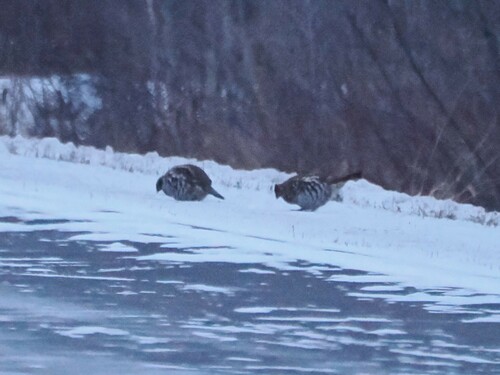 エリマキライチョウ
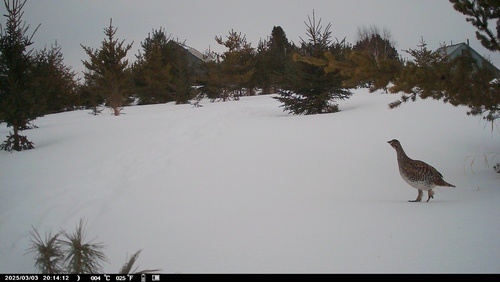 ホソオライチョウ
要点
The most reliable field mark between Ruffed Grouse and Sharp-tailed Grouse is the tail: Ruffed Grouse shows a broad, dark subterminal band near the tip of a rounded tail, while Sharp-tailed Grouse has a distinctly pointed tail with white outer feathers and lacks the broad band. Ruffed Grouse are compact, chunky birds with a short, crested head and variable brown or gray plumage, often seen in dense forests. In contrast, Sharp-tailed Grouse are larger, longer-bodied, and favor open prairies or grasslands. While both species can appear similar at a glance, especially in flight, careful attention to tail shape, habitat, and overall structure will reliably separate them.
識別のコツ
- Tail shape and pattern: Ruffed Grouse has a broad, dark subterminal band on a rounded tail; Sharp-tailed Grouse has a pointed tail with white outer feathers and no broad band. This is the single most reliable field mark in all seasons and ages.
- Overall structure: Ruffed Grouse is compact and chunky, with a short neck and tail, and a slight crest on the head. Sharp-tailed Grouse is longer, with a proportionally longer neck and tail, and lacks a crest.
- Plumage morphs: Ruffed Grouse comes in gray and brown morphs, with the gray morph showing more white below and the brown morph appearing more uniformly brown. Sharp-tailed Grouse does not show strong morph variation.
- Neck ruffs: Ruffed Grouse has dark ruffs on the sides of the neck (seen when displaying or alert); Sharp-tailed Grouse lacks these.
- Crest: Only Ruffed Grouse shows a crest, which may be raised or flattened; Sharp-tailed Grouse always has a smooth, rounded head.
- Sex differences: Both species are similar between sexes, but Ruffed Grouse females may have a broken tail band, and males tend to have a complete one. This is subtle and not always reliable in the field.
- Flight style: Ruffed Grouse explodes from cover with rapid, noisy wingbeats, usually low and direct through trees. Sharp-tailed Grouse takes off more steadily, often in flocks, flying higher and farther over open ground.
- Habitat: Dense woodland or forest edge strongly favors Ruffed Grouse; open prairie, grassland, or shrubland points to Sharp-tailed Grouse.
- Courtship display: If you see or hear a bird 'drumming' on a log, it is a Ruffed Grouse. If you see a group of birds displaying together on open ground (lekking), they are Sharp-tailed Grouse.
- Bill and face: Ruffed Grouse has a shorter, stubbier bill and a more rounded head profile; Sharp-tailed Grouse has a slightly longer bill and a more elongated head.
- Underparts: Ruffed Grouse (especially gray morph) can show more white and barring below, while Sharp-tailed Grouse is more uniformly barred and lacks strong contrast.
- Tail in flight: In flight, look for the pointed, white-edged tail of Sharp-tailed Grouse vs. the rounded, banded tail of Ruffed Grouse.
- Size: If seen side by side, Sharp-tailed Grouse is noticeably larger and heavier, but this is subtle unless you have direct comparison.
- Vocalizations: Ruffed Grouse does not call much, relying on drumming; Sharp-tailed Grouse is more likely to be heard vocalizing, especially in spring.
- Seasonal context: In winter, Ruffed Grouse may be seen bursting from snow cover in forests; Sharp-tailed Grouse forms winter flocks in open country.
大きさ
Sharp-tailed Grouse is substantially heavier (average adult mass 885 g [wikidata]) than Ruffed Grouse (typically 450–750 g [wikipedia]), and also longer in body and wingspan. Ruffed Grouse is a medium-sized, chunky bird (40–50 cm long, 50–64 cm wingspan) with a compact, short-tailed look. Sharp-tailed Grouse is longer, bulkier, and less compact, with a proportionally longer neck and tail, giving it a more elongated profile both perched and in flight.
羽色
Tail pattern is the most diagnostic plumage feature for all ages and seasons: Ruffed Grouse has a broad, dark subterminal band near the tip of a rounded tail, with the rest of the tail barred and brownish-gray or brown depending on morph. Sharp-tailed Grouse has a pointed tail with conspicuous white outer feathers and no broad dark band. Ruffed Grouse plumage is highly variable, with gray and brown morphs; the gray morph is paler below with more white, while the brown morph is overall richer brown with a grayish tail. Both sexes are similarly marked, but females may have a broken tail band. Ruffed Grouse also shows a crest and dark ruffs on the neck sides. Sharp-tailed Grouse lacks a crest and has a more uniform, barred appearance, without the neck ruffs or strong morph variation. Juvenile and immature plumages are not described in detail for either species, but the tail pattern remains diagnostic.
行動
Ruffed Grouse is typically solitary or in small family groups, spending most of its time quietly on the ground in dense woodland, often bursting into explosive flight when flushed. Its courtship display is a unique nonvocal 'drumming' performed by males on logs. Sharp-tailed Grouse is more social, especially during the breeding season when males gather in leks on open ground to display. In flight, Ruffed Grouse is rapid and direct, often low through trees, while Sharp-tailed Grouse flies with slower, steadier wingbeats over open country.
生息環境
Habitat is a strong separator: Ruffed Grouse is a bird of dense deciduous or mixed forests, often with thick undergrowth, and is rarely found in open country. Sharp-tailed Grouse prefers open prairies, grasslands, and shrublands, sometimes with scattered trees but generally avoiding dense forest. If you encounter a grouse in thick woods, it is almost certainly a Ruffed Grouse; in open grassland, Sharp-tailed Grouse is far more likely.
声
Ruffed Grouse is famous for its nonvocal 'drumming' display: a series of accelerating, deep wingbeats performed by males, which can be heard at a distance but is not a true call. Sharp-tailed Grouse, by contrast, is highly vocal on leks, with a variety of cackles, coos, and bubbling sounds, but these are most often heard during the breeding season and are not described in detail in the provided notes.