

クビワキンクロ 対 メジロガモ
Aythya collaris 対 Aythya nyroca
クビワキンクロとメジロガモのクイズ
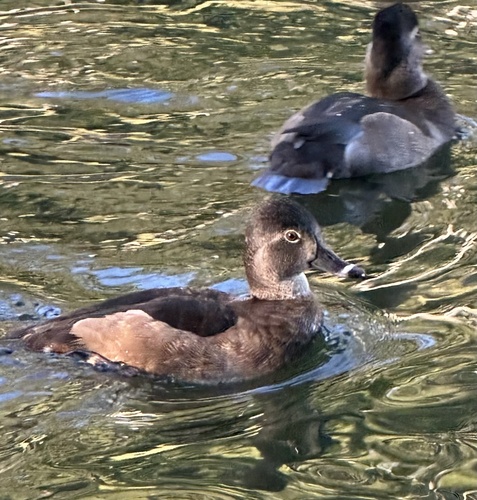 クビワキンクロ
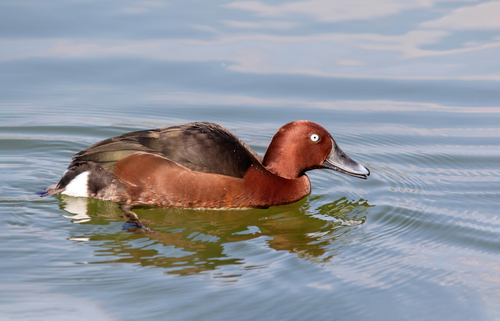 メジロガモ
要点
The most reliable field mark to separate Ring-necked Duck from Ferruginous Duck is the pattern and color contrast on the bill and head: adult male Ring-necked Ducks show two distinct white rings on a gray bill and a sharply angular black head, while Ferruginous Duck males have a plain dark bill and a rich chestnut head. In flight, Ferruginous Duck shows a striking white belly and underwing patch, contrasting with its dark chestnut body, while Ring-necked Duck has a white line on the wings but lacks the extensive white underparts. Females of both species are duller, but Ring-necked females have a more angular head and a pale band on the bill, while Ferruginous females are browner with a dark bill and white undertail coverts. Both are medium-sized diving ducks, but Ring-necked Duck is notably heavier and bulkier.
識別のコツ
- Bill pattern (adults): Ring-necked Duck males show two bold white rings on a gray bill; Ferruginous Duck has a plain dark bill. Females of Ring-necked Duck have a subtle pale band on the bill, Ferruginous females do not. This is visible at close range or in good light.
- Head shape: Ring-necked Duck has a distinctly angular, peaked head, especially noticeable in males. Ferruginous Duck has a more rounded head profile.
- Head and body color (males): Ring-necked Duck males are black and gray with a white breast; Ferruginous Duck males are deep chestnut throughout the head, breast, and flanks, with a white undertail.
- Eye color: Male Ferruginous Duck has a yellow eye, while female Ring-necked Duck has brown eyes with a white eye-ring. Ferruginous Duck females have a dark eye with no ring.
- Flight pattern (all ages): Ferruginous Duck shows a striking white belly and underwing patch in flight, contrasting with the dark chestnut body. Ring-necked Duck shows a white line on the wings but lacks the extensive white underparts.
- Undertail coverts: Ferruginous Duck (both sexes) has pure white undertail coverts, often visible when the bird is swimming or during courtship display. Ring-necked Duck lacks this feature.
- Breast and flank contrast: Ring-necked Duck males show a sharp contrast between the black back and white breast; Ferruginous Duck is more uniformly chestnut with less contrast except for the white undertail.
- Female plumage: Female Ring-necked Duck is grayish-brown with a pale band on the bill and a white eye-ring; Ferruginous Duck female is dull brown with a dark bill and white undertail, lacking the eye-ring.
- Size and structure: Ring-necked Duck is heavier and bulkier, with a more robust chest and neck. Ferruginous Duck is lighter and more compact.
- Behavioral cues: Ferruginous Duck males may display by curling the tail to show a white undertail patch; Ring-necked Duck does not show this behavior.
- Habitat context: If seen in North America, Ring-necked Duck is far more likely; Ferruginous Duck is a rare vagrant. In the Palearctic, Ferruginous Duck is the expected species.
- Voice: Only Ring-necked Duck female is described as making a trrr sound; Ferruginous Duck's voice is not distinctive in the notes.
- Mixed flocks: Ferruginous Duck may be found in mixed flocks with other Aythya species, but is less social than Ring-necked Duck.
- Courtship behavior: Ferruginous Duck males often curl their tails to display a white undertail triangle, a useful behavioral mark in the breeding season.
- Pitfalls: The rarely visible cinnamon neck ring of Ring-necked Duck is not a reliable field mark; focus instead on bill pattern, head shape, and underpart contrast.
大きさ
Ring-necked Duck is the larger and heavier of the two, with an average body mass of about 707.5 g compared to Ferruginous Duck's 551.5 g [wikidata]. This difference is often visible in the field: Ring-necked Ducks appear stockier and more robust, especially in the chest and neck. Ferruginous Duck is more compact and lighter-bodied. However, both are within the typical size range for medium Aythya ducks, so size alone is not always diagnostic unless seen side by side.
羽色
For adults, the male Ring-necked Duck is mostly black and gray with a white breast, white wing line, and two white rings on the gray bill. Its head is black with a noticeable angular shape. The cinnamon neck ring is rarely visible. The female is grayish-brown with a dark back, a subtle pale band on the bill, and a white eye-ring. Ferruginous Duck males are deep chestnut on the head, breast, and flanks, with a pure white undertail and a white belly and underwing patch visible in flight. Their bill is dark and plain, and the eye is yellow. Females are duller brown, with a dark eye and white undertail coverts. In flight, Ferruginous Duck's white belly and underwing stand out, while Ring-necked Duck shows a white line on the wing but not the same underpart contrast. Juvenile and immature plumages are not described in detail for either species, but the strong underwing and belly contrast in Ferruginous Duck is a key flight mark for all ages.
行動
Both species are diving ducks, but Ferruginous Duck is less social than other Aythya, though it can form large flocks in winter, often mixed with other diving ducks. Ring-necked Duck is also gregarious in migration and winter. Ferruginous Duck males may display by curling the tail to show a white undertail patch. Both species feed by diving and dabbling, but Ferruginous Duck is noted for feeding at night as well as by day.
生息環境
Ring-necked Duck is native to North America and is commonly found on freshwater ponds and lakes, especially in wooded or boreal regions. Ferruginous Duck is native to the Palearctic, breeding in a variety of wetland habitats, often in more open or marshy areas, and sometimes forms colonies on islands or protected sites. Both prefer freshwater, but their ranges do not overlap except as rare vagrants.
声
Ring-necked Duck females make a trrr-like noise. No distinctive vocalization is described for Ferruginous Duck in the provided notes, so voice is not a strong field mark for separation.