

ビセイインコ 対 セキセイインコ
Psephotus haematonotus 対 Melopsittacus undulatus
ビセイインコとセキセイインコのクイズ
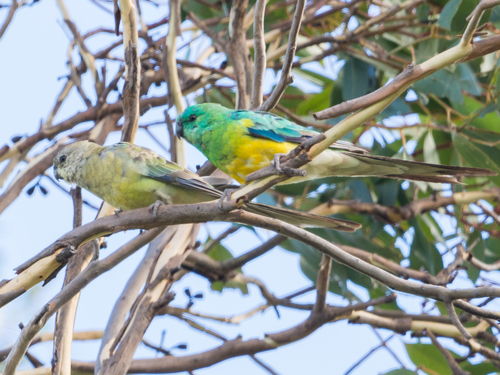 ビセイインコ
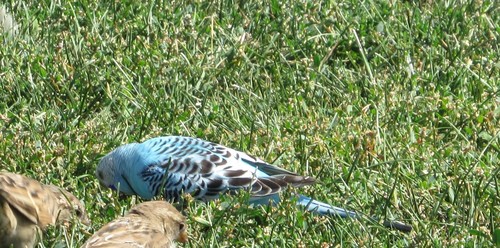 セキセイインコ
要点
The most reliable field mark between Red-rumped Parrot and Budgerigar is the presence of a red rump (lower back and rump) in adult male Red-rumped Parrots, which Budgerigars never show. For immature birds or females, focus on the upperwing pattern in flight: juvenile and female Red-rumped Parrots have a distinct off-white underwing bar, while Budgerigars lack this and instead show yellow flashes in the outer tail and wing only when spread. Budgerigars are smaller, with a more compact build and a unique black scalloped pattern on the back and wings, while Red-rumped Parrots are longer and slimmer with plainer upperparts. Both species can be greenish, but the combination of structure, rump color, and wing pattern is diagnostic in the field.
識別のコツ
- Red rump (adult male Red-rumped Parrot only): Look for a bright brick-red patch on the lower back and rump. Budgerigars never show any red in this area. This is the single most reliable field mark for adult males.
- Underwing bar (juvenile/female Red-rumped Parrot): In flight or when stretching, juvenile and female Red-rumped Parrots show a distinct off-white underwing bar. This is absent in Budgerigars of all ages. Immature male Red-rumped Parrots retain this bar until about 2 years old.
- Upperwing and back pattern: Budgerigars have bold black scalloped (wavy) markings on the back and wings, edged with yellow. Red-rumped Parrots have plain green or olive upperparts with no black scalloping.
- Tail flashes: Budgerigars show yellow flashes in the outer tail and wings, but only when the wings are outstretched or in flight. Red-rumped Parrots lack these yellow flashes.
- Cheek patches: Budgerigars have blue-violet cheek patches and a series of three black throat spots on each side. Red-rumped Parrots lack these features.
- Bill color: Both species have greyish bills, but Red-rumped Parrot bills are darker in males and lighter in females and immatures. Budgerigar bills are olive-grey; not usually a strong field mark but can help in close views.
- Cere color (Budgerigar only): In Budgerigars, the cere (fleshy area above the bill) is blue in adult males, brownish or white in females, and pinkish in juveniles. Red-rumped Parrots do not show a colored cere.
- Size and shape: Red-rumped Parrots are longer, slimmer, and have a more elongated tail. Budgerigars are smaller, stockier, and have a shorter, blunter tail.
- Sexual dimorphism: Red-rumped Parrots are strongly sexually dimorphic; males are much brighter and have the red rump, while females are duller. Budgerigars show less sexual dimorphism in plumage, with differences mainly in cere color.
- Juvenile head pattern: Young Budgerigars have black stripes down to the cere, which fade with age. Juvenile Red-rumped Parrots do not show this pattern.
- Habitat context: In open woodland or grassy parkland in southeastern Australia, especially near water, suspect Red-rumped Parrot. In arid open country or large, noisy flocks, suspect Budgerigar.
- Flock size and behavior: Budgerigars are often in large, tight flocks, especially in flight. Red-rumped Parrots are more often in pairs or small groups.
- Perched posture: Budgerigars perch upright, often high and close together, and may appear more active and restless. Red-rumped Parrots perch more horizontally and are calmer.
- Flight style: Budgerigars have rapid, undulating flight and often wheel in tight flocks. Red-rumped Parrots have a more direct, less erratic flight.
- Pitfall – captive birds: Escaped or feral Budgerigars may show a range of colors, but wild-type birds are always green with black scalloping. Red-rumped Parrots in captivity retain their wild-type plumage.
大きさ
Red-rumped Parrots are noticeably larger and slimmer, averaging about 28 cm in length and weighing 45–77 grams [wikipedia], while wild Budgerigars are smaller at around 18 cm long and 30–40 grams [wikipedia]. The difference is especially apparent in direct comparison or when seen perched side by side. Budgerigars also have a proportionally shorter tail and a more compact, stubby appearance, while Red-rumped Parrots are more elongated with a longer, sleeker tail.
羽色
- Juvenile/immature birds in flight: Juvenile and female Red-rumped Parrots show a clear off-white underwing bar, visible in flight and when wings are spread. This bar is also present in immature males until about 2 years old. Budgerigars never show this underwing bar; instead, their flight feathers are greenish-black with yellow fringes, and yellow flashes are only visible in the outer tail and wing when spread.
- Adult males: Red-rumped Parrot males are bright emerald-green with yellow underparts, blue highlights on the wings, and a brick-red rump (diagnostic). Budgerigars are light green with black scalloped markings on the back and wings, yellow face and forehead, blue-violet cheek patches, and no red rump.
- Adult females: Red-rumped Parrot females are dull olive-green with pale underparts and a lime-green rump, lacking the bright colors and red rump of the male. Budgerigar females are similar to males but can be told by cere color; both sexes retain the black scalloped back and wing pattern.
- Juveniles: Young Red-rumped Parrots resemble females but with a red rump and light blue-green face in males. Young Budgerigars have blackish stripes down to the cere and more extensive black on the back and wings, which fade as they mature.
行動
Red-rumped Parrots are often seen feeding quietly on the ground in pairs or small flocks, sometimes perching in trees but typically less gregarious than Budgerigars. Budgerigars are highly social, often forming large, noisy flocks, especially when flying between feeding and watering sites. Budgerigars tend to perch high and close together, and may appear more restless, frequently shifting position and calling. Red-rumped Parrots are more likely to be seen in pairs or family groups, with a calmer demeanor.
生息環境
Red-rumped Parrots are found in open woodlands, grassy areas, and parklands, especially in southeastern Australia, often near water and in the Murray-Darling Basin [wikipedia]. Budgerigars are native to arid and semi-arid regions across much of Australia, favoring open grasslands and scrub, and are less likely in wooded areas. In the wild, Budgerigars are often seen in large flocks in drier, more open country, while Red-rumped Parrots prefer areas with scattered trees and more vegetation.