

アカエリヒレアシシギ 対 トウネン
Phalaropus lobatus 対 Calidris ruficollis
アカエリヒレアシシギとトウネンのクイズ
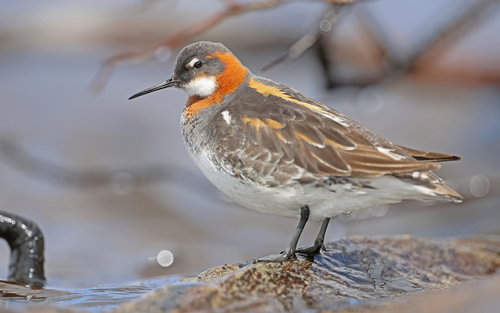 アカエリヒレアシシギ
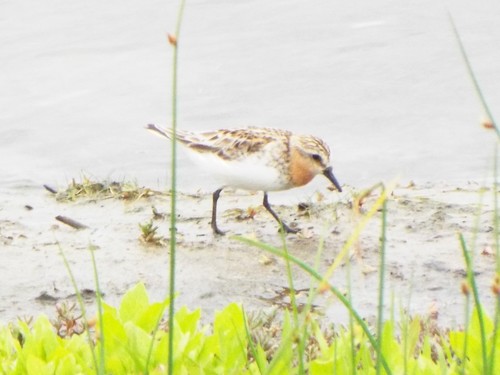 トウネン
要点
The most reliable field mark between Red-necked Phalarope and Red-necked Stint is the phalarope's unique structure and behavior: it has lobed toes, a very fine straight bill, and often swims in small circles, even on open water—unlike the stint, which is a typical sandpiper with dark legs, a fine but less needle-like bill, and never swims. In flight or at rest, Red-necked Phalarope shows a prominent white wing stripe (all ages), while Red-necked Stint lacks this and instead shows a plain wing. Juvenile and non-breeding birds can be confusing, but the phalarope always has a black eyepatch and a more contrasting head pattern, while the stint is plainer-faced. Size is similar, but the phalarope is slightly heavier and longer. Context is key: phalaropes are often found on water, sometimes far offshore, while stints stick to mudflats and shorelines.
識別のコツ
- White wing stripe (all ages): Red-necked Phalarope always shows a strong white wing stripe in flight and at rest; Red-necked Stint never does. This is a key mark for birds in flight or when wings are spread.
- Lobed toes: Only the phalarope has lobed toes, visible if you see the feet well (rare in the field, but diagnostic if seen).
- Bill shape: Phalarope's bill is very fine, straight, and needle-like; stint's bill is fine but slightly stouter and tapers less sharply. Bill length is similar, but the phalarope's looks more delicate.
- Face pattern: Phalarope always has a distinct black eyepatch (even in winter and juvenile plumage); stint has a plain face with only a faint dark line through the eye, never a bold patch.
- Swimming behavior: Phalarope often swims, sometimes spinning in circles; stint never swims and always forages by walking or running on land.
- Habitat context: Phalarope is often seen on open water, sometimes far from shore; stint is always on mudflats, beaches, or the water's edge.
- Breeding plumage (female phalarope): Look for a rich chestnut neck and upper breast, black face, and white throat in phalarope; stint has an orange breast and a white V on the back, but a plain face.
- Juvenile upperparts: Stint juveniles have a more contrasting mantle with weak white lines down the back; phalarope juveniles are greyer above with a black eyepatch and lack the stint's back pattern.
- Primary projection: Stint has a longer primary projection (wing tips extend well beyond the tail), giving a longer-winged look; phalarope's wings are proportionally shorter.
- Leg color: Both have dark legs, but the stint's are often blacker; leg color is not a strong separator here.
- Size and shape: Phalarope is slightly heavier and longer, with a more elongated neck and body; stint is more compact and round-bodied.
- Call: Phalarope's 'whit' is sharp and clean; stint's 'stit' is hoarser. Use only if heard well.
- Group behavior: Stints are highly gregarious, often in large flocks with other small waders; phalaropes are more often solitary or in small groups, especially on water.
- Feeding style: Phalarope picks at the water's surface, often in spinning motion; stint probes and picks rapidly along the substrate.
- Seasonal context: If seen far offshore or on deep water, it's almost certainly a phalarope. On coastal mudflats, especially outside the Arctic, it's likely a stint.
大きさ
Red-necked Phalarope is slightly larger and heavier (body mass ~37 g) than Red-necked Stint (~26 g), and typically measures about 18 cm in length versus the stint's 13–17 cm. However, both are among the smallest waders, and size overlap is considerable in the field. The phalarope may look more elongated due to its longer neck and bill, but the difference is subtle unless seen side-by-side.
羽色
- Juvenile and non-breeding birds: Red-necked Phalarope (all ages) shows a strong white wing stripe in flight and at rest, and a distinct black eyepatch on a pale face; upperparts are grey and brown with a buffy wash below in juveniles. Red-necked Stint juveniles have a more contrasting mantle with weaker white lines down the back, but lack any wing stripe; their face is plain, with a dark line through the eye but not a bold eyepatch.
- Breeding plumage: Female Red-necked Phalarope is dark grey above with a rich chestnut neck and upper breast, black face, and white throat; males are similar but duller. Red-necked Stint in breeding plumage has an unstreaked orange breast bordered below by dark marks, a white V on the back, and a plain face.
- Winter plumage: Phalarope is grey above, white below, always with a black eyepatch; Stint is plain grey above and white below, with a less contrasting face and no eyepatch. Both lose most rufous tones outside breeding season, but the phalarope's facial pattern remains distinctive.
行動
Red-necked Phalarope is unique among waders for its habit of swimming buoyantly, often spinning in tight circles to stir up prey—behavior never shown by Red-necked Stint. Phalaropes are comfortable on open water, including at sea, and may be seen floating or feeding well away from shore. Red-necked Stint is strictly a shorebird, feeding by picking along mudflats and sandy edges, moving quickly and rarely venturing into deeper water. In mixed flocks, stints are fast, restless foragers, while phalaropes are more deliberate and often solitary or in small groups.
生息環境
Red-necked Phalarope breeds in Arctic wetlands but is most often seen on migration or in winter on open water, including far offshore on tropical oceans—an unusual habitat for a wader. Red-necked Stint breeds in northeast Russia and winters on coastal mudflats and sandy shores in Southeast Asia and Australasia, always remaining near land. If you see a small wader swimming or far from land, it's almost certainly a phalarope; on mudflats or beaches, especially in mixed flocks, it's likely a stint.
声
Red-necked Phalarope gives a sharp, high 'whit' or 'twit' call. Red-necked Stint has a hoarse 'stit' call. Both are high-pitched but the phalarope's call is cleaner and more piercing, while the stint's is rougher. However, calls are not always diagnostic unless heard well.
アカエリヒレアシシギ · トウネン · 苦手な鳥