

ナンベイオオバン 対 ハジロオオバン
Fulica armillata 対 Fulica leucoptera
ナンベイオオバンとハジロオオバンのクイズ
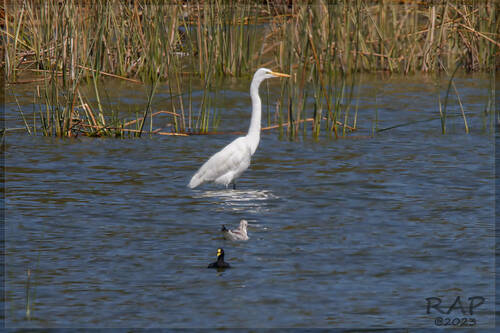 ナンベイオオバン
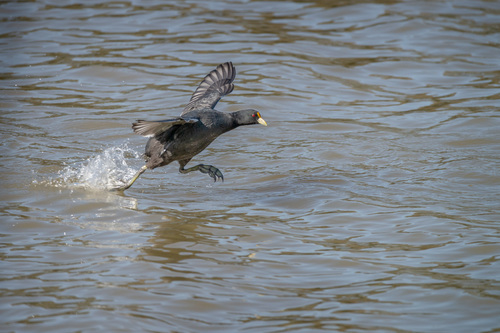 ハジロオオバン
要点
The most reliable field mark for separating Red-gartered Coot from White-winged Coot is the presence of bold white tips to the secondaries on the White-winged Coot, visible in flight and sometimes at rest—this mark is absent in Red-gartered Coot of all ages. Both species share similar slaty-gray body plumage with blacker heads and white undertail coverts, but the bill and shield coloration, as well as leg color and size, are key differences at close range. Red-gartered Coots show a distinctive red patch between the yellow bill and shield and a red 'garter' above the ankle, while White-winged Coots have a yellow to greenish-yellow bill and shield, with greenish legs and no red. Juvenile and immature birds are similar, but the white in the wing remains a strong clue for White-winged Coot. Red-gartered is also noticeably heavier and bulkier.
識別のコツ
- White wing panel (all ages): Look for broad white tips to the secondaries in flight or when the wing is spread—present only in White-winged Coot, absent in Red-gartered Coot.
- Bill and shield color (adult): Red-gartered Coot has a yellow bill and shield with a conspicuous red patch between them; White-winged Coot has a yellow to greenish-yellow bill and shield, sometimes with an orange tinge but never with a red patch.
- Leg color (adult): Red-gartered Coot shows orange-yellow to yellow legs with a pale red 'garter' above the ankle; White-winged Coot has pale sea green to yellow-green legs and feet, with blackish toes and joints, and lacks any red garter.
- Size and bulk: Red-gartered Coot is significantly larger and heavier; use this when birds are together or with familiar coots for scale.
- Juvenile/immature confusion: Both species' young are drab gray-brown with mottled white heads/necks, but the white wing panel remains a key mark for White-winged Coot at all ages.
- Undertail coverts: Both species have white undertail coverts; this is not a separator.
- Head and neck color: Both have blacker heads and necks than the rest of the body in adults; not a separator.
- Bill color in immatures: Red-gartered Coot immatures have paler bills, White-winged Coot immatures have dusky olive bills—this is subtle and unreliable at distance.
- Leg color in immatures: Red-gartered immatures have olive legs/feet; White-winged immatures have greenish gray legs/feet—again, subtle and not always visible.
- Flock size/context: Large, dense flocks (hundreds to thousands) are more typical of White-winged Coot, especially outside the breeding season.
- Habitat overlap: Both species can occur together on freshwater wetlands; do not rely on habitat alone for ID.
- Vocalizations: If you hear loud, cackling, or laughing calls, suspect White-winged Coot, but do not use voice as the sole separator.
- Red 'garter' on leg: Only Red-gartered Coot shows a red patch above the ankle; check for this if legs are visible.
- Shield size: White-winged Coot's shield is smaller and less conspicuous than Red-gartered's, which is larger and highlighted by the red patch.
- When in doubt: If you cannot see the wing panel or leg details, use a combination of bill/shield color and overall size, but beware of overlap in poor light or with distant birds.
大きさ
Red-gartered Coot is substantially larger and heavier, with an average mass of 1040 g compared to the White-winged Coot's 656 g. In the field, Red-gartered often looks bulkier and longer (43–51 cm vs. 35–43 cm). This size difference is most apparent when the two species are side by side, but can be subtle at a distance or when seen alone.
羽色
- Juvenile and Immature: Both species have drab gray-brown or dark gray plumage with mottling on a white head and neck, making them similar at a glance. However, only White-winged Coot shows broad white tips to the secondaries (the 'white wing'), visible in flight and sometimes at rest, even in young birds.
- Adult: Both have slaty gray bodies, blacker heads/necks, and white undertail coverts. Red-gartered Coot adults have a yellow bill and shield with a red patch between them, and a red 'garter' above the ankle on orange-yellow to yellow legs. White-winged Coot adults have a yellow to greenish-yellow bill and shield (sometimes orange-tinged), greenish legs and feet, and blackish toes/joints. The white wing panel remains diagnostic for White-winged Coot at all ages.
- Immature bills/legs: Red-gartered immatures have paler bills and olive legs/feet; White-winged immatures have dusky olive bills and greenish gray legs/feet. These differences are subtle and can overlap.
行動
Both species are aquatic and often seen swimming or feeding on the surface of water. White-winged Coot is notably gregarious outside the breeding season, forming large flocks, sometimes thousands strong, especially on large marshes. Red-gartered Coot is less frequently described in such large aggregations. Both feed mainly on aquatic vegetation, but White-winged Coot is more likely to graze on land away from water.
生息環境
Both species overlap widely in southern South America, frequenting freshwater lagoons, ponds, marshes, and river backwaters. White-winged Coot has a slightly broader range, occurring in the Falkland Islands and as a vagrant in Peru, and is more likely to be found on saltwater near shore. Both prefer areas with grassy or bare shores and abundant aquatic plants. Habitat alone is not a reliable separator where both occur.
声
White-winged Coot is described as very vocal, producing a variety of loud, hollow cackling and clucking calls, some reminiscent of human laughter, and a distinctive 'huc' call from aggressive males. No distinctive vocal differences are described for Red-gartered Coot in the available notes, so voice is not a strong field separator based on current information.