

ムラサキハマシギ 対 チシマシギ
Calidris maritima 対 Calidris ptilocnemis
ムラサキハマシギとチシマシギのクイズ
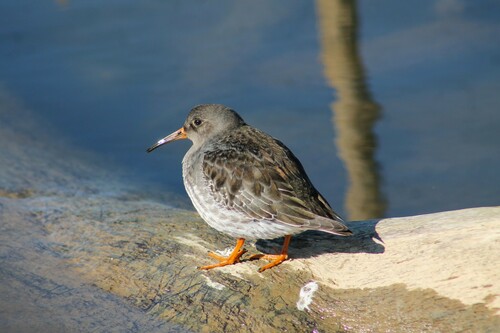 ムラサキハマシギ
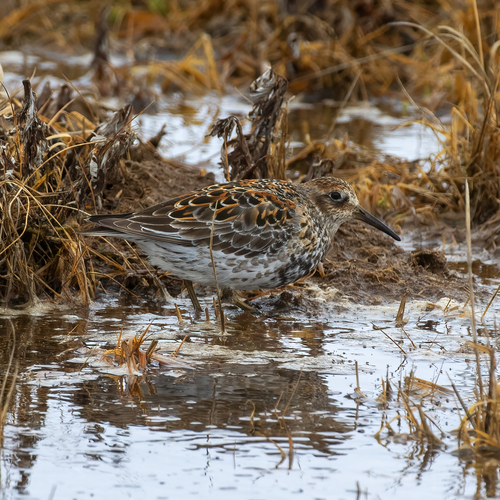 チシマシギ
要点
The most reliable field mark to separate Purple Sandpiper from Rock Sandpiper is the presence of a bold black belly patch in breeding-plumaged nominate Rock Sandpipers (from the Pribilof Islands); other subspecies and non-breeding birds of both species are extremely similar. Both have short yellow legs, dark bills with yellow bases, and dark upperparts with a purplish gloss. Habitat and range are often the best clues: Purple Sandpiper winters on rocky Atlantic coasts, while Rock Sandpiper winters on rocky Pacific coasts. Subtle differences in size and local abundance may help, but field separation outside the Pribilof breeding season is challenging and often not possible without range context.
識別のコツ
- Breeding-plumaged nominate Rock Sandpiper (Pribilof Islands) shows a bold black belly patch—if you see this, it's diagnostic for that subspecies and season. Other subspecies and all Purple Sandpipers lack this mark.
- Non-breeding and immature birds of both species are extremely similar in all observable field marks, including upperwing and tail pattern, bill, and leg color.
- Short yellow legs and medium-thin dark bill with yellow base are shared by both; do not use these alone for ID.
- Upperpart color and purplish gloss are not reliable for separation, as both species show these features.
- Bill length and shape are similar and not a useful field mark in direct comparison.
- Size is not a practical field mark: Rock Sandpiper averages slightly heavier, but the difference is too subtle for field use.
- Flight views do not reveal diagnostic differences: both species have similar wing and tail patterns across all ages and seasons.
- Habitat and range are often the best clues: Purple Sandpiper is found on rocky Atlantic coasts in winter; Rock Sandpiper on rocky Pacific coasts. Use location as a primary filter.
- Behavioral differences are minimal: both species forage on rocks and may be seen feeding in shallow water; Rock Sandpiper may swim more often, but this is not exclusive.
- Flock composition: If you see a flock with Ruddy Turnstones on the Atlantic coast, Purple Sandpiper is likely; on the Pacific, expect Rock Sandpiper.
- Breeding context: If observed in arctic Alaska, Kamchatka, or the Aleutians in summer, it's Rock Sandpiper; in arctic Canada, Greenland, or northern Europe, it's Purple Sandpiper.
- Vocalizations are not described as diagnostic in available sources; do not rely on calls for separation.
- If in doubt and outside the Pribilof Islands in breeding season, use range and habitat context—plumage alone is rarely sufficient.
- Beware of vagrancy: Both species are rare vagrants outside their normal ranges, so always consider location and season when making an identification.
- When faced with a silent, non-breeding bird on a rocky shore, range is your best tool—plumage and structure will not reliably separate these two except in the specific case of the Pribilof Rock Sandpiper in breeding plumage.
大きさ
Rock Sandpiper averages slightly heavier (79.0 g) than Purple Sandpiper (about 72 g), but both are very similar in length (20–22 cm) and wingspan (42–46 cm) [wikidata]. In the field, this size difference is negligible and not a reliable separation point, especially in mixed flocks or at a distance.
羽色
- Juvenile/immature and non-breeding birds: Both species are nearly indistinguishable in these plumages, sharing dark upperparts with a subtle purplish gloss, white underparts, grey-smeared breast, black rump, and short yellow legs. No age-specific upperwing or flight pattern differences are noted in the sources for these ages.
- Adult breeding plumage: The key distinction is in the nominate Rock Sandpiper (Pribilof Islands), which shows a bold black belly patch. Other Rock Sandpiper subspecies and Purple Sandpiper lack this feature and look extremely similar. Bill color and pattern, upperpart gloss, and leg color are not reliably different between the two.
- Flight views: No diagnostic differences in upperwing or tail pattern are described for any age or season.
行動
Both species are hardy, gregarious shorebirds that forage on rocky coasts, often in small flocks. Rock Sandpiper may form larger wintering flocks and is noted for sometimes feeding up to its breast in water or even swimming, but this behavior is not exclusive and may overlap with Purple Sandpiper. Both are approachable and often seen in close proximity to the waterline.
生息環境
Habitat and range are the most practical field clues. Purple Sandpiper breeds in arctic/subarctic Eurasia and northeastern North America, wintering on rocky Atlantic coasts (e.g., eastern North America, northern Europe). Rock Sandpiper breeds in arctic/subarctic Alaska and northeast Asia (Chukotka, Kamchatka), wintering on rocky Pacific coasts (Alaska, Pacific Russia). If you are on the Atlantic coast in winter, Purple Sandpiper is expected; on the Pacific coast, Rock Sandpiper is the default. Overlap is virtually nonexistent outside rare vagrancy.