

キイロヤマミソサザイ 対 クリムネマユミソサザイ
Troglodytes ochraceus 対 Pheugopedius rutilus
キイロヤマミソサザイとクリムネマユミソサザイのクイズ
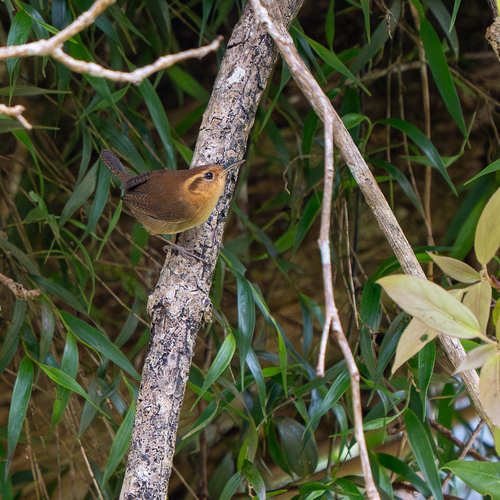 キイロヤマミソサザイ
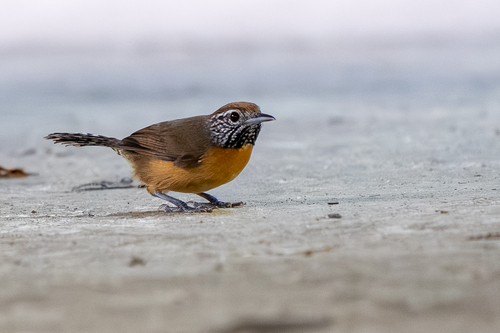 クリムネマユミソサザイ
要点
The most reliable field mark to separate Ochraceous Wren from Rufous-breasted Wren is the underparts: Ochraceous Wren shows mostly buffy brown to buffy white underparts with a yellowish buff supercilium, while Rufous-breasted Wren has a striking bright chestnut breast and a white supercilium bordered above by black. Rufous-breasted Wren is also noticeably larger and heavier-bodied, with a bolder, more contrasting facial pattern. Juveniles of Rufous-breasted Wren are duller and have less distinct facial markings, but still lack the ochraceous tones of Ochraceous Wren. Both species overlap in range in Central America, so careful attention to plumage and structure is essential.
識別のコツ
- Underparts color: Ochraceous Wren shows mostly buffy brown to buffy white underparts with no bright chestnut; Rufous-breasted Wren has a vivid chestnut breast and duller chestnut flanks with a grayish white belly center. This is the most consistent field mark for all ages.
- Facial pattern: Rufous-breasted Wren has a white supercilium with a black border above, plus a face and throat speckled black and white. Ochraceous Wren has a yellowish buff supercilium extending to the nape, with no black border or facial speckling.
- Size and structure: Rufous-breasted Wren is noticeably larger and heavier (about 14 cm, 13.5–18.5 g) than Ochraceous Wren (9.5–10 cm, 8–10.5 g). In the field, Rufous-breasted Wren appears bulkier and longer-tailed.
- Tail pattern: Both species have brown tails with dark barring, but Rufous-breasted Wren's tail is gray-brown with heavy dark brown bars, while Ochraceous Wren's tail is brown with blackish bars. This is subtle and best used in combination with other marks.
- Crown and back color: Ochraceous Wren has a rich medium brown crown and back with a rufous cast to the rump; Rufous-breasted Wren's upperparts are warm brown, sometimes more reddish depending on subspecies.
- Bill: Some subspecies of both species have heavier bills, but this is not a reliable field mark unless you have close views and know the local forms.
- Juvenile plumage: Juvenile Rufous-breasted Wrens are duller and have less distinct facial markings, but still lack the ochraceous tones and yellowish buff supercilium of Ochraceous Wren.
- Supercilium color: Ochraceous Wren's supercilium is yellowish buff and extends to the nape; Rufous-breasted Wren's is white with a black border above and does not extend as far.
- Breast pattern: Only Rufous-breasted Wren shows a bright, sharply demarcated chestnut breast; Ochraceous Wren's breast is more uniform buffy brown.
- Face and throat: Rufous-breasted Wren's face and throat are speckled black and white, a unique pattern not found in Ochraceous Wren.
- Flank color: Ochraceous Wren's flanks are darker buffy brown; Rufous-breasted Wren's flanks are chestnut or, in some subspecies, duller or olive-brown.
- Range and context: Both species overlap in Costa Rica, Panama, and Colombia, so range alone does not separate them. Rufous-breasted Wren is also found in Trinidad, Tobago, and Venezuela.
- Flight views: No distinctive upperwing or flight pattern marks are described for either species; rely on size, underparts, and facial pattern in flight.
- Sex differences: No sexual dimorphism is noted for either species; all field marks apply to both sexes.
- Subspecies variation: Some Rufous-breasted Wren subspecies have more spotting or richer colors, but the chestnut breast and facial pattern remain diagnostic.
大きさ
Rufous-breasted Wren is significantly larger, measuring about 14 cm in length and weighing 13.5–18.5 g, compared to Ochraceous Wren's 9.5–10 cm and 8–10.5 g. In the field, Rufous-breasted Wren appears bulkier and longer-tailed, while Ochraceous Wren is noticeably smaller and more delicate. This size difference is often apparent even without direct comparison, especially when seen perched or foraging.
羽色
-
Juveniles/immatures: Juvenile Rufous-breasted Wrens are duller overall than adults, with less distinct facial markings, but still show a hint of the chestnut breast and lack the ochraceous (yellow-buff) tones of Ochraceous Wren. Ochraceous Wren juveniles are not specifically described, but adults and immatures are similar, with no bold chestnut or black-and-white facial pattern.
-
Adults: Ochraceous Wren has a rich medium brown crown and back, rufous-tinged rump, brown tail with blackish bars, and a bold yellowish buff supercilium extending to the nape. Underparts are mostly buffy brown to buffy white, with darker buffy brown flanks and lower belly. Rufous-breasted Wren has warm brown upperparts, a gray-brown tail with heavy dark bars, a white supercilium bordered above by black, a face and throat speckled black and white, and a bright chestnut breast with a grayish white belly center. The facial pattern and rufous breast are unique among similar wrens. Subspecies variation in Rufous-breasted Wren can add spotting or richer colors, but the overall pattern remains distinctive.
行動
Both species are typical wrens, often skulking in dense vegetation and moving actively through tangles. Rufous-breasted Wren, being larger, may appear more robust and deliberate in its movements, while Ochraceous Wren is smaller and more agile. No major behavioral differences are noted in the sources that would reliably separate them in the field.
生息環境
Both species occur in overlapping regions of Central and northern South America, including Costa Rica, Panama, and Colombia. Rufous-breasted Wren has a broader range, extending to Trinidad and Tobago and Venezuela. Habitat preferences are not detailed here, but both are generally found in forested or semi-open woodland areas. Local abundance may differ, so consulting eBird for your exact location can help, but habitat alone is not diagnostic.