

アフリカキヌバネドリ 対 テンニンチョウ
Apaloderma narina 対 Vidua macroura
アフリカキヌバネドリとテンニンチョウのクイズ
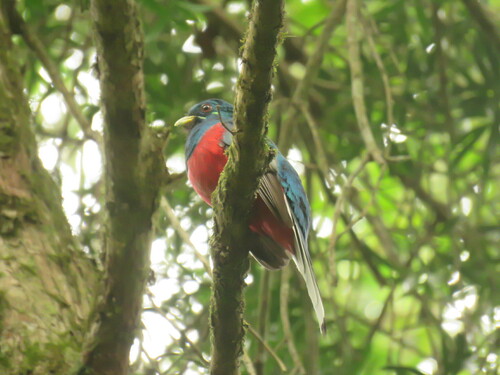 アフリカキヌバネドリ
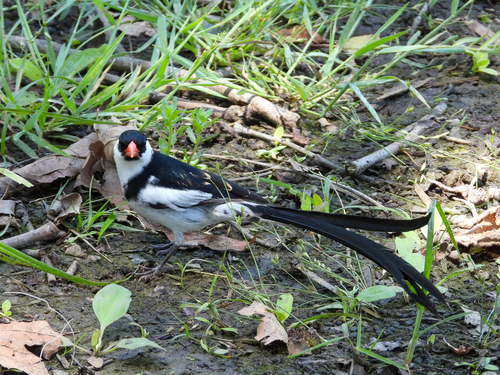 テンニンチョウ
要点
The most reliable field mark is the male Pin-tailed Whydah’s extremely long, black, pennant-like tail, which is never matched by Narina Trogon. For immature birds, note that juvenile Narina Trogon shows distinct white tips to the tertials (inner wing), a feature not present in any whydah. Narina Trogon is a medium-sized, green-and-red forest bird with a heavy bill and white-fringed undertail, while Pin-tailed Whydah is a much smaller, seed-eating songbird with a red bill and, in breeding males, a strikingly long tail. Females and immatures of both can be confusing at a distance, but structure, bill color, and habitat are strong clues.
識別のコツ
- Tail shape and length: Breeding male Pin-tailed Whydah has extremely long, black, ribbon-like tail streamers (up to 20 cm), never matched by Narina Trogon. Female and non-breeding whydahs lack this, but still have a short, squared tail.
- Juvenile/immature wing pattern: Juvenile Narina Trogon shows distinct white tips to the tertials (inner wing feathers), a unique mark not present in any whydah. Use this in flight or perched views of young birds.
- Bill shape and color: Narina Trogon has a heavy, broad bill; color varies but often dark with green gape/eye flanges in males. Pin-tailed Whydah has a short, conical, bright red bill (all ages/sexes except juveniles, which are greyish-billed).
- Body structure: Trogon is robust, with a large head, thick neck, and broad tail. Whydah is slender, finch-like, with a small head and dainty body.
- Plumage—adult males: Narina Trogon males are green above, bright red below, with metallic tail gloss and white-fringed undertail. Pin-tailed Whydah males are black above, white below, with a red bill and long black tail.
- Plumage—females/non-breeding males: Narina Trogon females are greenish above, brown-faced, blue-skinned around the eyes, and dull red below. Whydah females are streaked brown above, whitish below, with buff and black face pattern and red bill.
- Undertail pattern: Narina Trogon (all ages/sexes) shows white-tipped/fringed outer tail feathers when perched, creating a white undertail effect. Whydah undertail is never white-fringed.
- Habitat context: Trogon in forest/woodland; whydah in open country, grassland, gardens. Habitat alone is often decisive.
- Behavior: Trogon is still and upright, often midstory; whydah is active, perches high, and (in breeding season) performs hovering displays.
- Vocalization: Trogon gives a low, grating hoot; whydah sings rapid, high-pitched squeaks and churrs from exposed perches.
- Feeding: Trogon hunts insects and small vertebrates, rarely on the ground. Whydah is a ground-feeding seed-eater, often seen with finches.
- Group size: Trogons are solitary or in pairs; whydahs may be in small groups, especially near host finches.
- Facial skin: Male Narina Trogon has green bare skin at gape and eye flanges; female has blue skin around eyes. Whydah lacks bare facial skin.
- Seasonal marks: Whydah’s long tail is present only in breeding males; in non-breeding season, males resemble females and lack tail streamers.
- Pitfalls: Female/immature whydahs and trogons can both appear dull and greenish/brownish, but bill color (red in whydah, dark in trogon) and habitat are reliable separators.
大きさ
Narina Trogon is much larger and heavier (body mass ~61g) than Pin-tailed Whydah (~15.8g) [wikidata]. The trogon is 32–34 cm long, with a robust, chunky build and broad tail. The whydah is only 12–13 cm long (excluding the tail), with breeding males reaching up to 33 cm including the tail streamers, but the body remains small and finch-like. Even when the whydah’s tail rivals the trogon’s length, the whydah’s body is much more petite and delicate.
羽色
- Immature/Juvenile birds: Juvenile Narina Trogon has distinct white tips to the tertials (inner wing feathers), a unique mark not shown by any age or sex of Pin-tailed Whydah. Immature whydahs are plain, with streaked brown upperparts and a greyish bill, lacking any white tertial tips.
- Adult males: Narina Trogon males are vivid green above with a metallic blue-green tail gloss, bright red underparts, and a green gape/eye flange, with a white-fringed undertail. Pin-tailed Whydah breeding males are black above (back and crown), white below and on the face (except crown), with a bright red bill and extremely long black tail streamers. Their wings are dark brown with white patches.
- Adult females/non-breeding males: Narina Trogon females are duller, with brown face and chest, blue skin around the eyes, and duller red below. Pin-tailed Whydah females and non-breeding males are streaked brown above, whitish below with buff flanks, a buff and black face pattern, and a red bill. Both lack the long tail.
- Undertail: Narina Trogon (all ages/sexes) shows white-tipped/fringed outer tail feathers when perched, creating a white undertail effect. Whydah undertail is never white-fringed.
行動
Narina Trogon is typically quiet and still, often perching upright in forest midstory, sometimes fluffing breast feathers in display. It forages for insects and small vertebrates, rarely seen on open ground. Pin-tailed Whydah is active, often seen in open habitats, perching conspicuously, and in breeding season, males perform elaborate hovering flight displays to show off their tails. Whydahs are seed-eaters, often feeding on the ground or in low vegetation. Social behavior differs: whydahs may be seen in small groups, especially near host finches, while trogons are usually solitary or in pairs.
生息環境
Narina Trogon is a forest and woodland specialist, found in dense, often humid forests from lowlands to highlands across sub-Saharan Africa. It avoids open country. Pin-tailed Whydah prefers open habitats—grasslands, savannahs, scrubs, parks, and gardens—and is rarely found in deep forest. If you see the bird in thick forest, it is much more likely to be a trogon; in open fields or suburban areas, a whydah is far more probable.
声
Narina Trogon males give a low, grating, repeated hoot, mostly for territory or mate attraction. Pin-tailed Whydah sings from high perches, producing rapid squeaking and churring notes. The whydah’s song is much higher-pitched and more complex than the trogon’s simple hoot.
アフリカキヌバネドリ · テンニンチョウ · 苦手な鳥