

Mediterranean Short-toed Lark 対 カンムリヒバリ
Alaudala rufescens 対 Galerida cristata
Mediterranean Short-toed Larkとカンムリヒバリのクイズ
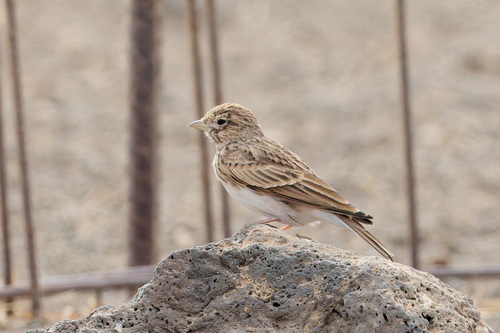 Mediterranean Short-toed Lark
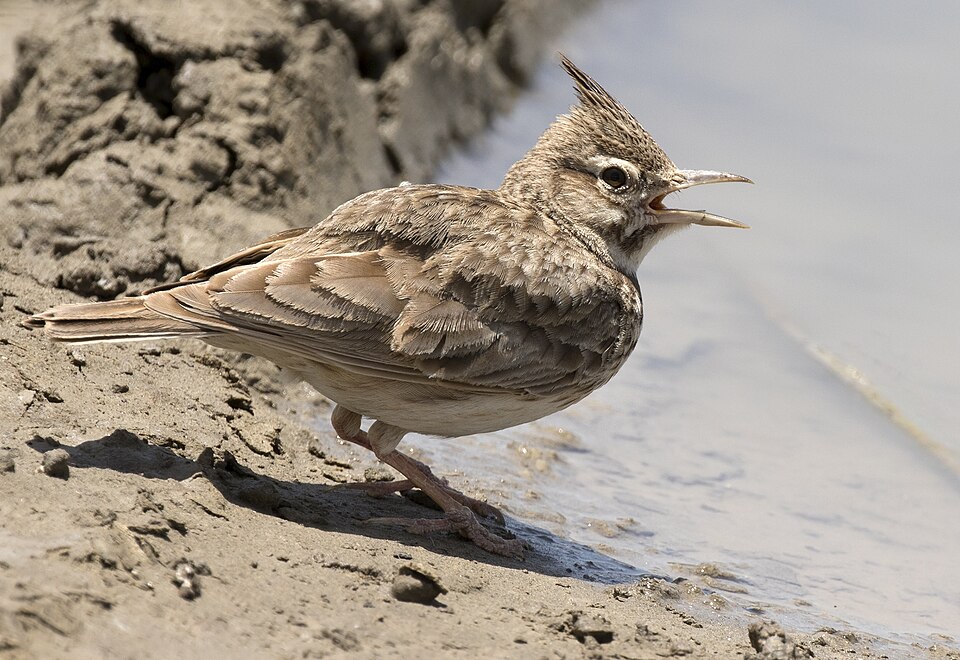 カンムリヒバリ
要点
The most reliable field mark to separate Mediterranean Short-toed Lark from Crested Lark is the presence of a prominent crest on the latter, which is always visible when perched or alert, while Mediterranean Short-toed Lark lacks any crest and has a noticeably smaller, rounder head. Juvenile Crested Larks show more spots on their back, but even adults are bulkier and longer than the more compact, streakier Mediterranean Short-toed Lark. Bill shape is also key: Mediterranean Short-toed Lark has a short, stubby, less-conical bill, while Crested Lark's bill is longer and more robust. In flight, Crested Lark shows reddish underwings, a feature absent in Mediterranean Short-toed Lark. Both are brownish larks with pale underparts, but careful attention to head shape, bill, and especially the crest will prevent confusion.
識別のコツ
- Crest: Crested Lark always shows a prominent, pointed crest, especially when alert or singing; Mediterranean Short-toed Lark never shows a crest. This is the single most reliable field mark at any distance or age.
- Head Shape: Mediterranean Short-toed Lark has a smaller, rounder head, while Crested Lark’s head is bulkier and more angular due to the crest.
- Bill Shape: Mediterranean Short-toed Lark has a short, stubby, less-conical bill; Crested Lark’s bill is longer, more robust, and slightly decurved. Bill shape is especially helpful when the crest is not fully raised.
- Size: Crested Lark is noticeably larger and bulkier (17 cm vs. 13–14 cm), with a heavier body and longer wingspan. Size difference is obvious in direct comparison but less so at a distance or with lone birds.
- Upperparts Streaking (Juveniles): Juvenile Crested Larks have more spots on their back than adults, but Mediterranean Short-toed Lark of all ages is more finely and extensively streaked across the breast.
- Breast Pattern: Mediterranean Short-toed Lark shows fine, extensive streaking across the breast; Crested Lark’s breast is less streaked and appears paler overall.
- Underwing Color in Flight: Crested Lark shows reddish underwings in flight, a feature absent in Mediterranean Short-toed Lark. This is a key mark when birds flush or are seen overhead.
- Tail: Crested Lark has a short tail with light brown outer feathers; Mediterranean Short-toed Lark’s tail is not specifically described as diagnostic, but is proportionally shorter and less contrasting.
- Supercilium: Mediterranean Short-toed Lark has a pale supercilium (eyebrow line) that can be visible at close range; Crested Lark’s facial pattern is less marked, dominated by the crest.
- Neck Patches: Mediterranean Short-toed Lark lacks dark neck patches, which can help separate it from some Calandrella larks, but is not a mark for Crested Lark.
- Song Flight and Behavior: Crested Lark often sings from the ground or high in the air, displaying its crest; Mediterranean Short-toed Lark is less conspicuous and does not perform such prominent song flights.
- Plumage Tone: Both species are brown above and pale below, but Mediterranean Short-toed Lark is generally duller and less contrasting, with more streaking.
- Habitat Context: Crested Lark is more likely in disturbed ground, wastelands, and urban edges; Mediterranean Short-toed Lark prefers open, dry, often sandy or stony ground away from heavy human activity.
- Voice: Mediterranean Short-toed Lark’s song is richer and more varied, but this is subtle and best used by experienced listeners; Crested Lark’s song is a liquid, warbling series of phrases.
- Pitfalls: Beware of confusing Mediterranean Short-toed Lark with Calandrella larks, but the lack of crest and fine breast streaking help separate it from Crested Lark. Bill and head shape are critical when the crest is not obvious.
大きさ
Crested Lark is significantly larger, reaching about 17 cm in length and weighing 37–55 g, with a wingspan of 29–38 cm [wikipedia]. Mediterranean Short-toed Lark is smaller, at 13–14 cm long [wikipedia]. In the field, Crested Lark appears bulkier with a proportionally larger head and body, while Mediterranean Short-toed Lark is more compact and daintier overall.
羽色
Juvenile Crested Larks have more spots on their back than adults, but all ages show a distinct, pointed crest that is always visible, especially when alert or singing [wikipedia]. Mediterranean Short-toed Lark never shows a crest and has a more rounded, smaller head. Both species are brown above and pale below, but Mediterranean Short-toed Lark is generally duller with finer, more extensive streaking across the breast. Crested Lark’s plumage is described as downy but sparse and appears whitish, with a short tail and light brown outer tail feathers. In flight, Crested Lark shows reddish underwings, a useful mark in all ages; Mediterranean Short-toed Lark lacks this feature. Mediterranean Short-toed Lark also has a pale supercilium and lacks any dark neck patches, while Crested Lark’s facial pattern is plainer but dominated by the crest.
行動
Crested Lark often sings from the ground or high in the air, displaying its crest during song or territorial displays. Its flight is undulatory, and it may be seen foraging openly on wasteland or roadsides. Mediterranean Short-toed Lark is less conspicuous, typically foraging on the ground in open, dry habitats, and does not display a crest or perform such prominent song flights. Both species feed on seeds and insects, but Crested Lark is noted for its adaptability to urban edges and disturbed ground.
生息環境
Mediterranean Short-toed Lark is found in and around the Mediterranean Basin, favoring open, dry, and often sandy or stony ground, from the Canary Islands and Iberian Peninsula through North Africa to the Middle East [wikipedia]. Crested Lark is widespread across Eurasia and northern Africa, often found in wastelands, agricultural fields, and on the outskirts of towns. It is more tolerant of human-altered environments than Mediterranean Short-toed Lark.
声
Mediterranean Short-toed Lark has a richer, more varied and imitative song compared to its relatives [wikipedia], but direct comparison to Crested Lark is limited in the notes. Crested Lark's song is a liquid, warbling series of phrases (whee-whee-wheeoo or twee-tee-too), delivered either from the ground or high in the air, but not during ascent as in skylark. Both are songbirds, but Crested Lark’s song is more likely to be heard from a prominent perch or during display flights.