

ヌマヒメウソ 対 ヒメコメワリ
Sporophila palustris 対 Sporophila angolensis
ヌマヒメウソとヒメコメワリのクイズ
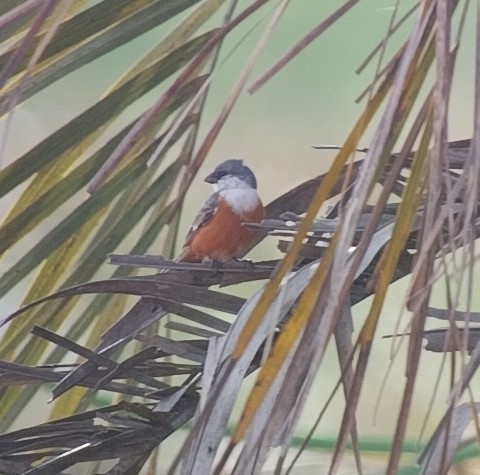 ヌマヒメウソ
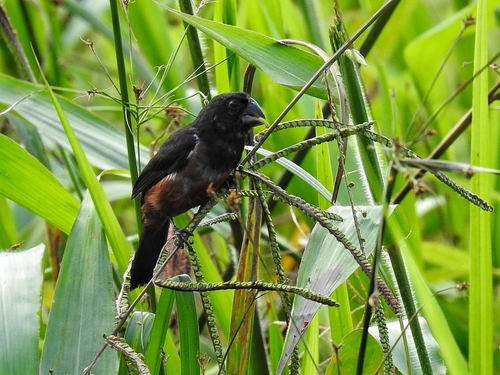 ヒメコメワリ
要点
The most reliable field mark to separate Marsh Seedeater from Chestnut-bellied Seed-Finch is the male's head and underparts pattern: Marsh Seedeater males have a white face and throat with a gray crown and nape, while Chestnut-bellied Seed-Finch males are entirely black above with a deep chestnut belly. Both species show a white patch at the base of the primaries on the closed wing in adult males, but the pattern and extent differ. Females and juveniles are trickier: Marsh Seedeater females are paler and more ochraceous below, while Chestnut-bellied Seed-Finch females are richer brown above and cinnamon below. Bill size and shape also help—Seed-Finch has a much deeper, heavier bill. Marsh Seedeater is much rarer and more localized, while Seed-Finch is widespread.
識別のコツ
- Adult male head pattern: Marsh Seedeater males have a white face and throat with a contrasting gray crown and nape; Chestnut-bellied Seed-Finch males are entirely black on the head and upperparts. This is the fastest field check for adult males.
- Adult male underparts: Marsh Seedeater males have white breast and dark brown to cinnamon belly; Chestnut-bellied Seed-Finch males have a deep chestnut belly, flanks, and undertail coverts, sharply separated from the black upperparts.
- Female/juvenile color tone: Marsh Seedeater females and juveniles are paler, with ochraceous underparts and a more delicate look; Seed-Finch females are richer brown above and cinnamon below, appearing bulkier.
- Bill size and shape: Chestnut-bellied Seed-Finch has a much deeper, heavier bill with a very broad base, obvious even at a distance. Marsh Seedeater's bill is smaller and more slender, with a rounded culmen. This works for all ages and sexes.
- Wing patch (adult males): Both species show a white patch at the base of the primaries on the closed wing, but it is larger and more obvious in Marsh Seedeater. In Seed-Finch, the patch is smaller and less conspicuous. Females of Seed-Finch lack this patch entirely.
- Tail color: Marsh Seedeater males have a blackish tail; females have a darker gray-brown tail. Seed-Finch males have a black tail; females have a warm brown tail. Tail color is subtle but can help with good views.
- Bill color (females): Marsh Seedeater females have a brown upper mandible and pale yellowish lower mandible; Seed-Finch females have a blackish bill. This is a subtle but useful check at close range.
- Size and structure: Seed-Finch is bulkier and heavier, with a more powerful jizz and a larger head and bill. Marsh Seedeater is daintier and lighter.
- Habitat and range: If you are outside the small range of Marsh Seedeater (mainly southern Brazil, Uruguay, Paraguay, northern Argentina), it is almost certainly Seed-Finch. Marsh Seedeater is rare and highly localized to marshy grasslands.
- Group context: Marsh Seedeater is usually found in pairs or small groups in marshes; Seed-Finch is more widespread and may be found in a wider variety of open habitats.
- Juvenile confusion: Juvenile Marsh Seedeaters look like females—pale brown above, ochraceous below, small bill. Juvenile Seed-Finches are richer brown and bulkier, with a heavier bill.
- Underwing coverts: Seed-Finch of both sexes has white underwing coverts, but this is rarely visible in the field. Marsh Seedeater does not have this mark.
- Leg color: Both have black or dark legs, not a useful separator.
- Iris color: Both have black irises; not diagnostic.
- Vocalizations: Not described in the sources; do not rely on song for separation in this pair.
大きさ
Chestnut-bellied Seed-Finch is noticeably larger and heavier: 10.6–12.4 cm long and 11.4–14.5 g, compared to Marsh Seedeater's 10.5–11.5 cm and 7.5–9 g. The Seed-Finch also has a much deeper-based, more powerful bill, which is evident even at a distance. Marsh Seedeater is one of the smallest Sporophila, appearing daintier and more delicate overall.
羽色
- Juveniles and females: Both are brownish above and paler below, but Marsh Seedeater females and juveniles are generally paler, with ochraceous underparts and a smaller, less robust bill. Chestnut-bellied Seed-Finch females are richer, warmer brown above and have cinnamon underparts, with a more massive bill and darker wings/tail.
- Adult males: Marsh Seedeater males have a white face and throat, gray crown/nape/back, and dark brown to cinnamon lower underparts. Chestnut-bellied Seed-Finch males are glossy black above (head, back, wings, tail) with a deep chestnut belly and flanks. Both show a white patch at the base of the primaries on the closed wing, but this is more extensive and obvious in Marsh Seedeater, while in Seed-Finch it is smaller and less conspicuous.
- Wings in flight: Both adult males show white at the base of primaries, but the pattern is more prominent in Marsh Seedeater. Females lack this white patch in Seed-Finch, while Marsh Seedeater females may show pale feather edges but not a strong white panel.
行動
No strong behavioral differences are noted in the sources, but Marsh Seedeater is more likely to be found in small, scattered groups or pairs in open marshy grassland, while Chestnut-bellied Seed-Finch may be more conspicuous and widespread, often in more varied open habitats. Both are typical Sporophila in foraging style, feeding on seeds and perching upright.
生息環境
Marsh Seedeater is highly localized and Endangered, restricted to marshy grasslands in Argentina, Brazil, Paraguay, and Uruguay. It is now very rare and declining due to habitat loss. Chestnut-bellied Seed-Finch is widespread across South America (except Chile and Uruguay), found in a broad range of open and semi-open habitats, including edges, fields, and second growth. If you are outside the small range of Marsh Seedeater, Seed-Finch is far more likely.