

マダガスカルチュウヒダカ 対 マダガスカルカッコウハヤブサ
Polyboroides radiatus 対 Aviceda madagascariensis
マダガスカルチュウヒダカとマダガスカルカッコウハヤブサのクイズ
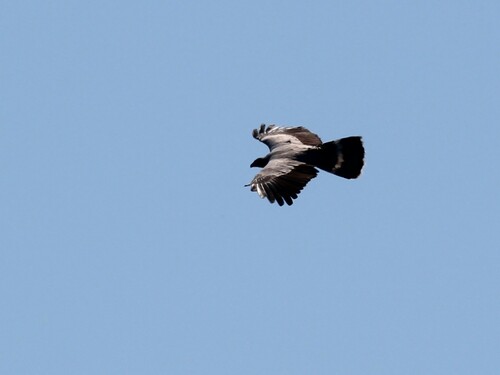 マダガスカルチュウヒダカ
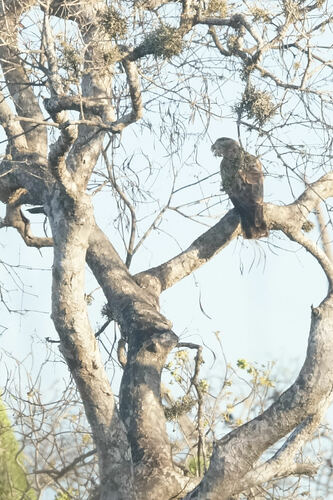 マダガスカルカッコウハヤブサ
要点
The most reliable field mark to separate Madagascar Harrier-Hawk from Madagascar Cuckoo-Hawk is the tail pattern: Harrier-Hawk shows a single broad grey band bisecting a black tail, while Cuckoo-Hawk has two narrow pale bars and a pale tip on a brown tail. In flight or perched, Harrier-Hawk appears larger and greyer with a distinct grey hood and dense barring below, whereas Cuckoo-Hawk is browner above with a paler head, off-white rump, and heavy brown streaks on the breast. Juvenile Cuckoo-Hawks are darker with white-tipped feathers, a feature not shown by Harrier-Hawk. Both are medium-sized raptors endemic to Madagascar, but their structure and plumage details are consistently different.
識別のコツ
- Tail pattern (all ages): Look for a single broad grey band bisecting a black tail on Madagascar Harrier-Hawk; Cuckoo-Hawk shows two narrow pale bars and a pale tip on a brown tail. This is often visible in flight and when perched.
- Upperparts color (adults): Harrier-Hawk is grey above with blackish flight feathers, while Cuckoo-Hawk is dark brown above, paler on the head, and has an off-white rump.
- Underparts pattern (adults): Harrier-Hawk shows dense, regular dark barring on the white underparts, especially breast, belly, and underwing coverts. Cuckoo-Hawk has heavy brown streaks on the breast and sides, with streaks becoming finer on the flanks, not barring.
- Head and face (adults): Harrier-Hawk has a grey hood and a conspicuous yellow face; Cuckoo-Hawk's head is paler brown with no hood, and the face is less striking.
- Crest (adults, perched): Cuckoo-Hawk often shows a short crest projecting from the rear crown when perched, absent in Harrier-Hawk.
- Juvenile Cuckoo-Hawk: Juveniles are darker overall with obvious white tips to the upperpart feathers, creating a scaly look above. Harrier-Hawk juveniles are not described as showing this feature.
- Underwing pattern (flight): Harrier-Hawk's underwing coverts are densely barred, matching the underparts, while Cuckoo-Hawk's underwing coverts are heavily barred with brown and the flight feathers show broad dark bands.
- Bill and legs: Harrier-Hawk has a yellow bill with a black tip and yellow legs, which can be seen at close range; these features are not specified for Cuckoo-Hawk.
- Structure: Harrier-Hawk is bulkier, with longer, broader wings and a longer tail that almost matches the wing length when folded. Cuckoo-Hawk is more compact, with a shorter tail and wings.
- Size impression: Harrier-Hawk appears larger and more elongated, especially in flight. Cuckoo-Hawk is smaller and more accipiter-like.
- Rump color: Cuckoo-Hawk has an off-white rump, contrasting with the rest of the upperparts; Harrier-Hawk's rump is not described as contrasting.
- Perched jizz: Harrier-Hawk sits upright and looks long-winged and long-tailed; Cuckoo-Hawk often appears shorter-tailed and may show its crest.
- Flight jizz: Harrier-Hawk's flight is likely more buoyant and soaring due to its long wings, while Cuckoo-Hawk may look more direct and accipiter-like.
- Facial skin: The yellow face of Harrier-Hawk is a strong mark at close range; Cuckoo-Hawk lacks this feature.
- Sexes: Both species have similar plumage in males and females, so sex is not a useful field mark.
大きさ
Both species are medium-sized raptors, but the Madagascar Harrier-Hawk is bulkier and has longer, broader wings that nearly reach the tail tip when folded. The Madagascar Cuckoo-Hawk is slightly smaller and more compact, with a length of about 300 mm (12 in) and a wingspan of 850 mm (33 in) [wikipedia]. There is no direct measurement for Harrier-Hawk in the provided notes, but its proportions are notably larger and more elongated in the field.
羽色
- Juvenile/immature birds: Juvenile Madagascar Cuckoo-Hawks are darker than adults, with white tips to the upperpart feathers, making the contrast against the dark back obvious. This is not seen in Harrier-Hawk juveniles (no juvenile description provided, but adults are not described as showing this pattern).
- Adults: Madagascar Harrier-Hawk is grey above with blackish flight feathers and a black tail with a single broad grey band. Underparts are white with dense dark barring on the breast, belly, and underwing coverts. The upper breast and throat are grey, forming a hood, and the face is yellow. Madagascar Cuckoo-Hawk adults are dark brown above, paler on the head, with an off-white rump. Underparts are white with heavy brown streaks on the breast and sides, becoming finer on the flanks. The tail is brown with two narrow pale bars and a pale tip. Underwing coverts are heavily barred with brown, and the flight feathers have broad dark bands below. A short crest is visible at rest on the Cuckoo-Hawk.
行動
No direct behavioral differences are detailed in the notes. Both are raptors, but Harrier-Hawk's longer wings and tail may give it a more buoyant, soaring flight compared to the more compact Cuckoo-Hawk, which may appear more accipiter-like and is often noted for its short crest when perched.