

Long-tailed Woodcreeper 対 シロアゴコオニキバシリ
Deconychura longicauda 対 Dendrocincla merula
Long-tailed Woodcreeperとシロアゴコオニキバシリのクイズ
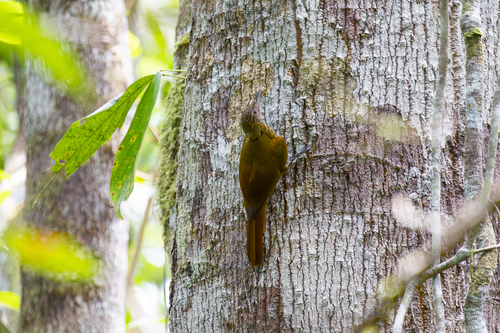 Long-tailed Woodcreeper
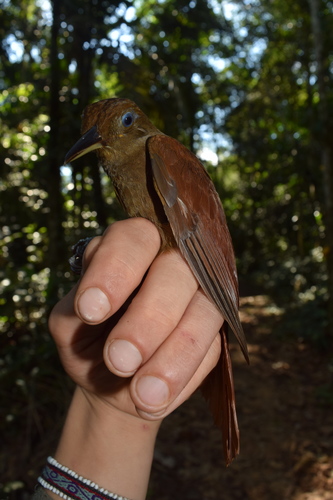 シロアゴコオニキバシリ
要点
The most reliable field mark to separate Long-tailed Woodcreeper from White-chinned Woodcreeper is the presence of a narrow white or yellowish vertical stripe on the chin and throat of the White-chinned, which is absent in Long-tailed. Both are medium-sized woodcreepers with similar structure and overlapping ranges, but Long-tailed is slimmer, lighter, and shows more extensive buff streaking on the head and breast. Juvenile plumage is not strongly distinctive between the two, but subtle differences in streaking and head color may help. Careful attention to the throat pattern, overall coloration, and structure is key, especially in mixed flocks or poor light.
識別のコツ
- Throat Mark (All Ages): White-chinned Woodcreeper always shows a narrow white or yellowish vertical stripe on the chin and throat—this is absent in Long-tailed Woodcreeper. Even in poor light, look for this pale throat mark as your first check.
- Head and Breast Streaking (Adult/Immature): Long-tailed Woodcreeper has fine buff streaks on the crown, nape, and breast, giving a subtly streaked appearance. White-chinned is less streaked, with a more uniform dark olive-brown breast.
- Overall Color Tone (Adult): Long-tailed is olive-brown above, with rufous-chestnut wings and tail; White-chinned is darker reddish brown with redder wings/tail. Subtle but visible in good light.
- Belly and Flanks (Adult): Long-tailed has plain olive-brown belly and flanks, contrasting with its streaked breast. White-chinned's underparts are more uniformly dark, grading to rufous at the undertail.
- Underwing Color (Adult): Long-tailed shows cinnamon rufous underwing coverts and flight feather undersides; White-chinned has paler chestnut underwing coverts. This is subtle and rarely diagnostic in the field.
- Iris Color (Adult): Long-tailed has brown irises; White-chinned varies by subspecies (brown/reddish brown or gray/bluish). Not always visible but can help with close views.
- Bill Structure: Long-tailed has a slim, medium-length, straight bill; White-chinned's bill is shortish and straight. The difference is subtle and not always reliable in the field.
- Leg Color: Long-tailed's legs/feet are brown; White-chinned's are more variable (bluish, olive, gray, or brownish). Only useful at very close range.
- Juvenile Plumage: Juvenile Long-tailed is darker on the head with fewer pale breast streaks, but otherwise similar to adults. Juvenile White-chinned is not described as distinct, so do not rely on age for separation.
- Size and Structure: Long-tailed is slimmer and lighter (24 g) compared to the heavier, bulkier White-chinned (28–54 g). This is most apparent with experience or direct comparison.
- Song: If heard, Long-tailed's high, descending, plaintive song is distinctive. Lack of song or a different vocalization may suggest White-chinned, but absence of evidence is not evidence of absence.
- Habitat Sensitivity: Long-tailed is more sensitive to habitat fragmentation and prefers continuous forest; White-chinned can be found in a wider range of forest types. Context may help if habitat is known.
- Geographic Range: If in Bolivia, Colombia, Ecuador, Peru, or Venezuela, you are only likely to encounter White-chinned. In the Guianas and northern Brazil, both are possible—use field marks.
- Mixed-species Flocks: Both join mixed flocks, so do not use flocking behavior as a separator.
- Pitfalls: In poor light, the throat mark on White-chinned can be overlooked, and Long-tailed's streaking may be missed. Always try to confirm both the throat pattern and overall color/streaking before making an identification.
大きさ
Long-tailed Woodcreeper is distinctly lighter, with a typical body mass around 24 g [wikidata], while White-chinned Woodcreeper is heavier (males 28–54 g, females 29–54 g) [wikipedia]. Both species are similar in length (16–21 cm), but Long-tailed is slimmer overall. The difference in bulk is most apparent when seen side-by-side or with experience; White-chinned appears more robust, especially in the larger subspecies (notably D. m. merula and D. m. obidensis).
羽色
- Juvenile/immature plumage: Both species' juveniles resemble adults, but Long-tailed Woodcreeper juveniles have a slightly darker head and fewer pale streaks on the breast compared to adults. No distinctive juvenile wing pattern is described for either species, so age is not a strong separator in flight.
- Adult plumage: Long-tailed Woodcreeper is mostly olive-brown with a darker, finely buff-streaked crown and nape, buff-streaked breast, plain olive-brown belly/flanks, and rufous-chestnut wings and tail. The underwing is cinnamon rufous. White-chinned Woodcreeper is darker reddish brown above, with redder wing coverts, flight feathers, and tail, and a diagnostic narrow white/yellowish vertical stripe on the chin and throat. Its breast is dark olive-brown, becoming dark rufous at the undertail. Underwing coverts are pale chestnut. Iris color varies (brown to reddish brown in some subspecies, gray/bluish in others). Some subspecies show paler or redder tones, but the throat mark is consistent.
行動
Both species forage by hitching up trunks and vines, mostly gleaning arthropods. Long-tailed Woodcreeper is noted for foraging singly, in pairs, or in mixed-species flocks from the understory to the canopy (3–20 m), and is highly sensitive to habitat modification. White-chinned Woodcreeper's foraging behavior is similar, but there is less detail on its vertical range. Neither species is described as forming long-term pair bonds. In the field, their behavior is very similar and not a strong separator.
生息環境
Both species occur in humid primary forest and mature secondary forest in the Amazon and Guiana Shield regions. Long-tailed Woodcreeper is found in Brazil (north of the Amazon and east of the Rio Negro), French Guiana, Guyana, and Suriname, and is considered fairly common to common except in Suriname. White-chinned Woodcreeper has a broader range, including Bolivia, Brazil, Colombia, Ecuador, French Guiana, Guyana, Peru, Suriname, and Venezuela. Both favor forest interior but can be found at edges; Long-tailed is more sensitive to habitat fragmentation.
声
Long-tailed Woodcreeper gives a high, distinctly descending, clear, plaintive song: 'pee-pue-tue-tuh---'. It is most vocal at dawn and dusk, and responds strongly to playback. No vocal description is provided for White-chinned Woodcreeper in the notes, so song is not a reliable separator unless Long-tailed's distinctive descending pattern is heard.