

ハイバネシャコ 対 ヨーロッパウズラ
Scleroptila afra 対 Coturnix coturnix
ハイバネシャコとヨーロッパウズラのクイズ
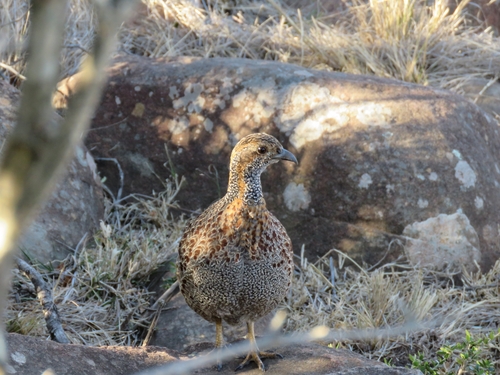 ハイバネシャコ
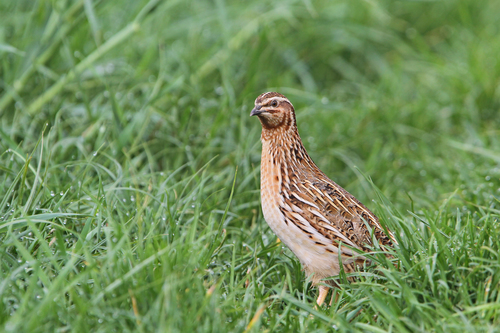 ヨーロッパウズラ
要点
The most reliable field mark to separate Grey-winged Francolin from Common Quail is overall structure and size: Grey-winged Francolin is noticeably larger and bulkier, with a more upright stance and proportionally shorter wings and tail, while Common Quail is compact, round-bodied, and distinctly small with long, pointed wings. In flight, Common Quail's wings look long and pointed, fitting its migratory lifestyle, while Grey-winged Francolin's wings are broader and less pointed. Plumage differences are subtle at a distance, but Common Quail shows a bold white eyestripe and, in males, a white chin, which Grey-winged Francolin lacks. Habitat and context can also help: Grey-winged Francolin is a resident of South African and Lesotho grasslands, while Common Quail is a Palearctic migrant, only present in southern Africa during the non-breeding season.
識別のコツ
- Size and structure: Grey-winged Francolin is much larger and bulkier than Common Quail. Use this as your first check, especially if you have a sense of scale from nearby objects or other birds.
- Wing shape in flight: Common Quail shows long, pointed wings in flight, reflecting its migratory habits. Grey-winged Francolin has broader, rounder wings and a heavier flight style. This is visible in both adults and immatures.
- Facial pattern: Look for the bold white eyestripe on Common Quail, visible in both sexes, and the white chin in males. Grey-winged Francolin lacks these strong facial contrasts and has a plainer face.
- Body shape and posture: Common Quail is compact, round-bodied, and sits low to the ground. Grey-winged Francolin is more upright and elongated in stance.
- Plumage streaking: Common Quail is heavily streaked brown above, providing strong camouflage. Grey-winged Francolin is less streaked and has more uniform greyish wings.
- Tail: Common Quail has a very short tail, often hidden under the wings. Grey-winged Francolin's tail is proportionally longer and more visible.
- Habitat and altitude: If you are in high-altitude grassland in Lesotho or South Africa, Grey-winged Francolin is more likely. In cultivated fields or lowland grasslands, especially outside the breeding season, Common Quail is possible.
- Behavior when flushed: Common Quail flushes with rapid, direct flight and quickly drops back into cover. Grey-winged Francolin takes off more heavily and may fly further, often calling in flight.
- Vocalizations: Listen for the repeated three-note call of Common Quail. If you hear this, you can be confident of the ID, as Grey-winged Francolin does not give this call.
- Group size: Grey-winged Francolin is often seen in small groups, while Common Quail is usually solitary or in pairs, especially outside migration.
- Sex differences: Only male Common Quail has a white chin; both sexes have the white eyestripe. Grey-winged Francolin does not show such strong sexual dimorphism in the face.
- Seasonal context: Common Quail is present in southern Africa mainly in the non-breeding (austral summer) season. Grey-winged Francolin is resident year-round.
- Perched views: If you see a bird perched on a rock or mound in open grassland, it is more likely to be Grey-winged Francolin; Common Quail rarely perches in the open.
- Flight jizz: The heavier, slower, and more labored flight of Grey-winged Francolin contrasts with the rapid, direct, low flight of Common Quail.
- Abundance: In southern Africa, Grey-winged Francolin is a local resident, while Common Quail is an uncommon migrant, so check local eBird reports for likelihood.
大きさ
Common Quail is much smaller, measuring 16–18 cm in length with a wingspan of 32–35 cm and weighing 70–140 g [wikipedia]. Grey-winged Francolin is larger and heavier, with a bulkier build and a more upright posture (exact measurements not provided, but easily apparent in the field). The size difference is usually obvious when seen side by side or with experience, and is a key separation point.
羽色
- Juvenile/immature/first-winter flight views: There are no detailed age-specific upperwing patterns described for either species in the sources, but Common Quail's long, pointed wings are distinctive in all plumages, while Grey-winged Francolin shows broader, more rounded wings.
- Adult plumage: Common Quail is streaked brown overall with a bold white eyestripe and, in males, a white chin. Grey-winged Francolin lacks these strong facial contrasts and instead has more uniform greyish wings and a less distinct face pattern.
- Sex differences: Female Common Quail is slightly heavier and lacks the white chin of the male, but both sexes retain the white eyestripe. Grey-winged Francolin does not show such strong sexual dimorphism in facial pattern.
- Perched views: Common Quail is compact and round, with cryptic streaking and a short tail. Grey-winged Francolin appears larger, more upright, and less streaked, with a plainer face.
行動
Common Quail is secretive, often only detected by its call, and prefers to run rather than fly when disturbed. When flushed, it flies low with rapid, direct wingbeats, showing long, pointed wings. Grey-winged Francolin is more likely to be seen walking in the open, often in small groups, and flushes with a heavier, slower flight, showing broader wings and a more labored takeoff. Francolins are generally less skulking than quails and may perch on rocks or low mounds.
生息環境
Grey-winged Francolin is a resident of high-altitude grasslands and open country in Lesotho and South Africa. It is typically found in montane or submontane grassland, often above 1,500 meters. Common Quail is a migrant, breeding in the Palearctic and wintering in Africa, including southern Africa. In Africa, it favors cultivated fields, grasslands, and open country, but is less tied to high-altitude grasslands than the francolin. Habitat overlap is possible in winter, but context and altitude can help separate them.
声
Common Quail has a distinctive call: three repeated chirps in quick succession, often heard but rarely seen. This call is a key field mark and is not matched by Grey-winged Francolin. Francolins have a variety of calls, but none match the quail's repeated three-note phrase. If you hear the classic quail call, it is diagnostic for Common Quail.