

ヨーロッパヤマウズラ 対 ウズラクイナ
Perdix perdix 対 Crex crex
ヨーロッパヤマウズラとウズラクイナのクイズ
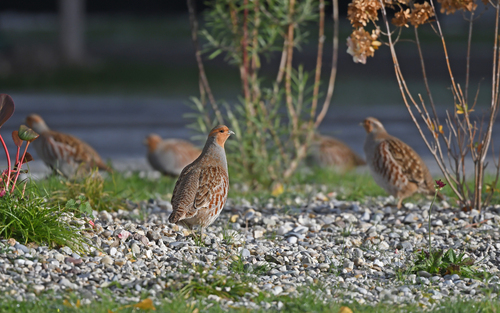 ヨーロッパヤマウズラ
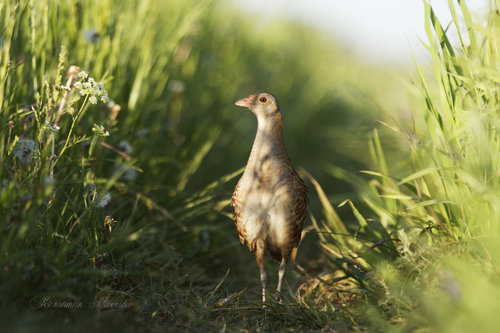 ウズラクイナ
要点
The most reliable field mark to separate Grey Partridge from Corncrake is the wing and flight pattern: Grey Partridge shows short, rounded wings and a whirring, low, direct flight, while Corncrake has longer, less rounded wings with chestnut panels and dangles its legs in flight. Juvenile and adult Corncrakes both show a distinctive chestnut wing pattern and barred flanks, while young Grey Partridges are plain yellow-brown and lack strong markings. Structurally, Corncrake is slimmer with a longer bill and legs, and is rarely seen in the open, while Grey Partridge is more compact and often flushes from cover. Voice is also distinctive: Grey Partridge gives a harsh 'kieerr-ik' or 'rick rick rick', while Corncrake's call is a loud, repeated 'krek krek'.
識別のコツ
- Flight pattern and wing shape: Grey Partridge flies with short, rounded wings and a rapid, whirring flight, usually low and direct; Corncrake has longer, less rounded wings, shallower wingbeats, and a weaker, fluttery flight with legs trailing behind. This is the most reliable field separation, especially when birds are flushed.
- Chestnut wing panels (Corncrake): In all plumages, Corncrake shows chestnut wing coverts and a white leading edge to the inner wing in flight. Grey Partridge never shows this pattern; its wings are uniformly brownish-grey.
- Barred flanks and undertail (Corncrake): Corncrake adults and juveniles have strong chestnut and white barring on the flanks and undertail, visible when perched or in flight. Grey Partridge has plain or lightly streaked flanks, never barred.
- Face and underparts: Grey Partridge has a rufous face and throat, grey breast, and a distinctive dark belly patch (smaller or absent in females). Corncrake has a blue-grey face, neck, and breast, with a pale brown eye-stripe and white belly.
- Juvenile confusion: Young Grey Partridges are plain yellow-brown, lacking strong markings; juvenile Corncrakes already show chestnut wing panels and barred flanks, though their underparts are buff-brown rather than grey.
- Bill and legs: Corncrake has a longer, flesh-toned bill and longer, pale grey legs, often visible when the bird is running or in flight. Grey Partridge has a shorter, stubbier bill and legs that are less conspicuous.
- Body shape: Grey Partridge is compact, rounded, and robust, with a short neck and tail. Corncrake is slimmer, more elongated, and appears longer-necked and longer-legged.
- Behavior: Grey Partridge is often seen in groups, feeding at field edges or flushed from cover. Corncrake is secretive, rarely seen, and prefers to run rather than fly, only flushing when pressed.
- Habitat: Grey Partridge is more likely in open farmland and field margins; Corncrake requires tall grass or hayfields and is rarely seen in the open.
- Voice: Grey Partridge gives a harsh 'kieerr-ik' or 'rick rick rick' when flushed; Corncrake's call is a loud, mechanical 'krek krek', usually heard at night or dawn/dusk.
- Sex differences: Female Grey Partridge is slightly duller than the male, with a smaller belly patch; female Corncrake is warmer-toned above and has a duller eye-stripe, but these differences are subtle and rarely useful in the field.
- Seasonal variation: Corncrake's upperparts become darker and underparts less grey outside breeding season, but chestnut wing panels and barred flanks remain. Grey Partridge shows little seasonal change.
- Group size: Grey Partridge is often in coveys, especially outside the breeding season; Corncrake is solitary or paired.
- In-hand marks: The 'cross of Lorraine' on Grey Partridge's tertiary coverts (two bars in females, one in males) is only visible in hand and not a field mark.
- Common pitfalls: A flying Corncrake may superficially resemble a gamebird, but the chestnut wing panels, barred flanks, and trailing legs are diagnostic. Young Grey Partridge can look plain, but never shows the Corncrake's chestnut or barring.
大きさ
Grey Partridge is slightly larger and heavier, with adults measuring 29–31 cm in length and weighing 320–455 g (some subspecies up to 600 g), and a wingspan of 45–48 cm. Corncrake is 27–30 cm long, with a wingspan of 42–53 cm, but is much lighter (males average 165 g, females 145 g). In the field, Grey Partridge appears more robust and rounded, while Corncrake is slimmer and more elongated, especially in the neck and legs.
羽色
- Juveniles: Young Grey Partridges are mostly yellow-brown and lack the adult's face and underpart markings, appearing plain and warm-toned. Juvenile Corncrakes are similar to adults but have a yellower tone to the upperparts and buff-brown underparts instead of grey; both show chestnut wing markings and barred flanks, which are never present in young Grey Partridge.
- Adults: Grey Partridge adults are greyish overall with a rufous face, chestnut streaks on the flanks, and a dark belly patch (smaller in females). The 'cross of Lorraine' pattern on the wing coverts (two bars in females, one in males) is only visible in hand. Corncrake adults have brown-black upperparts streaked with buff/grey, chestnut wing coverts, blue-grey face and underparts, and strong chestnut-and-white barring on the flanks and undertail. The Corncrake's chestnut wing panels and barred flanks are visible in flight and on perched birds, while Grey Partridge lacks these features.
- Flight: Grey Partridge shows short, rounded wings and uniform coloration; Corncrake in flight shows longer, less rounded wings with chestnut panels and a white leading edge to the inner wing, as well as dangling legs.
行動
Grey Partridge is often seen in small groups, feeding openly at field edges or flushed from cover, flying low and directly for short distances. When disturbed, it explodes from cover with a whirring flight. Corncrake is secretive and rarely seen; it prefers to run through dense grass and only flies when forced, showing a weak, fluttery flight with legs trailing. Corncrake is solitary or in pairs, and is much less likely to be seen in the open.
生息環境
Grey Partridge favors open farmland, field margins, and grassy areas, often near cereal crops. It is typically found in agricultural landscapes and is more likely to be seen in the open. Corncrake breeds in tall grasslands and hayfields, avoiding open ground, and is much more secretive, usually detected by voice rather than sight. Their habitats can overlap in agricultural areas, but Corncrake is strictly tied to dense, tall grass or hay.
声
Grey Partridge gives a harsh, high-pitched 'kieerr-ik' and a repeated 'rick rick rick' when flushed. Corncrake's call is a loud, repetitive 'krek krek', often heard at night or dawn/dusk, and is much more mechanical and far-carrying than any Grey Partridge vocalization.
ヨーロッパヤマウズラ · ウズラクイナ · 苦手な鳥