

クサシギ 対 アオアシシギ
Tringa ochropus 対 Tringa nebularia
クサシギとアオアシシギのクイズ
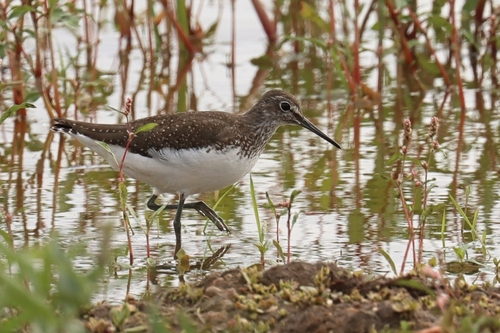 クサシギ
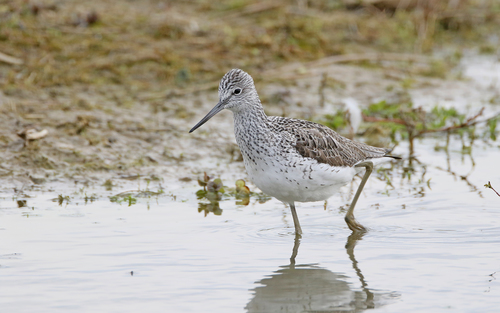 アオアシシギ
要点
The most reliable field mark separating Green Sandpiper from Common Greenshank is the flight pattern: Green Sandpiper shows a strikingly white rump and dark wings both above and below, while Common Greenshank displays a white wedge up the back but not a white rump. Greenshank is also much larger and longer-legged, with a noticeably longer, slightly upturned bill. When perched, Green Sandpiper appears compact and plump with a short bill and dark green legs, while Greenshank is more elongated and elegant. Both species can show brownish upperparts and pale underparts, but their structure and flight patterns are distinctive if seen well.
識別のコツ
- White rump in flight (all ages): Green Sandpiper always shows a bright white rump and dark wings above and below when flying—this is the single most reliable separation from Greenshank, which never shows a white rump.
- White wedge vs white rump: Greenshank shows a white wedge up the back in flight, but the rump itself is not white. This can be subtle if the bird is distant or the view is brief.
- Size and structure: Greenshank is much larger, with a long neck, long legs, and a long, slightly upturned bill. Green Sandpiper is compact, short-billed, and plump, with shorter, dark green legs.
- Bill shape: Greenshank's bill is long and slightly upturned, with a grey base, while Green Sandpiper's bill is short, straight, and dark green.
- Leg color: Both have greenish legs, but Greenshank's are longer and often appear paler or brighter green, while Green Sandpiper's are darker green and shorter.
- Breast and back pattern: Green Sandpiper has a greyish head and breast with white underparts and white spotting on the back (most in breeding adults, less in winter/immatures). Greenshank's breast is coarsely patterned in breeding plumage, and its back is brown or grey-brown with less contrast.
- Perched jizz: Green Sandpiper appears squat and hunched, often with a slightly raised rear end. Greenshank stands taller and more upright, with a longer neck and legs.
- Feeding behavior: Greenshank often wades in deeper water, sometimes up to its belly, while Green Sandpiper prefers shallower margins and is less likely to be seen in open water.
- Habitat context: If seen in a densely vegetated, wooded stream or small muddy pool, Green Sandpiper is more likely. In open marshes or estuaries, especially with other large waders, Greenshank is more probable.
- Flight call: Listen for the sharper, clearer three-note whistle of Green Sandpiper versus the softer, flutier 'teu-teu-teu' of Greenshank. This is subtle and best used with experience.
- Group size: Green Sandpiper is usually solitary or in very small numbers, while Greenshank may be found in loose groups, especially on migration.
- Seasonal variation: Green Sandpiper's white spotting is most extensive in breeding adults, less so in winter and young birds, but the white rump is always present. Greenshank's plumage is browner in breeding, greyer in winter, but the white wedge in flight remains consistent.
- Potential confusion: Both species can show brownish upperparts and pale underparts, but the combination of structure, bill, and flight pattern should resolve most confusion.
- When in doubt: If you see a white rump in flight, it's a Green Sandpiper. If you see a large, long-legged wader with a white wedge up the back but no white rump, it's a Greenshank.
- Immature birds: Juvenile Green Sandpipers may show less white spotting on the back, but the rump pattern in flight is still diagnostic. Juvenile Greenshank do not develop a white rump.
大きさ
Common Greenshank is more than twice as heavy as Green Sandpiper (173g vs 80g) and appears much larger in the field. Greenshank has longer legs and a longer, slightly upturned bill, giving it a lankier, more elegant look compared to the compact, short-billed Green Sandpiper. These differences are obvious when the two are side by side, but even singly, Greenshank's size and proportions stand out among waders.
羽色
In all ages and seasons, Green Sandpiper in flight shows a brilliant white rump and dark wings both above and below—a unique and diagnostic feature. Juvenile and non-breeding Green Sandpipers have less extensive white spotting on the back compared to breeding adults, but the white rump remains consistent. Common Greenshank, in contrast, never shows a white rump; instead, it has a white wedge up the back in flight, with the rest of the upperparts and rump remaining brownish or grey-brown. On the ground, Green Sandpiper is plump with a dark greenish-brown back and wings, greyish head and breast, and white underparts, with dark green legs and a short bill. Greenshank is brown in breeding plumage and grey-brown in winter, with long greenish legs and a long, slightly upturned bill with a grey base. Both species have some spotting or patterning on the back, but Greenshank's breast pattern is coarser and darker in breeding plumage, and its overall coloration is paler and less contrasting than Green Sandpiper.
行動
Green Sandpiper often appears solitary and can be seen bobbing its tail, especially when flushed. It tends to be more secretive, frequently found along wooded streams, small pools, or muddy margins, and is quick to take flight when disturbed, flashing its white rump. Common Greenshank is more likely to be seen in open wetlands, often wading in deeper water, and may be found in small groups. Its longer legs allow it to forage in deeper water than Green Sandpiper, and it moves with a more deliberate, upright gait.
生息環境
Green Sandpiper favors wooded streams, small ponds, and muddy margins, often in more enclosed or forested settings. It is less likely to be found in open, exposed wetlands. Common Greenshank prefers open marshes, estuaries, and the edges of larger bodies of water, where it can wade in deeper areas thanks to its long legs. While there is some overlap, Greenshank is generally associated with more open and extensive wetland habitats than the more secretive Green Sandpiper.
声
Both species give a three-note whistle in flight, but there are subtle differences. Green Sandpiper's call is a clear, sharp three-note whistle, often heard as it flushes. Common Greenshank's call is a rapid series of three short, fluty notes, syllabized as 'teu-teu-teu.' The tone of Greenshank's call is softer and more musical, while Green Sandpiper's is sharper and more abrupt. However, calls can be hard to separate without experience.