

ミドリコムシクイ 対 キムネイロムシクイ
Camaroptera brachyura 対 Apalis flavida
ミドリコムシクイとキムネイロムシクイのクイズ
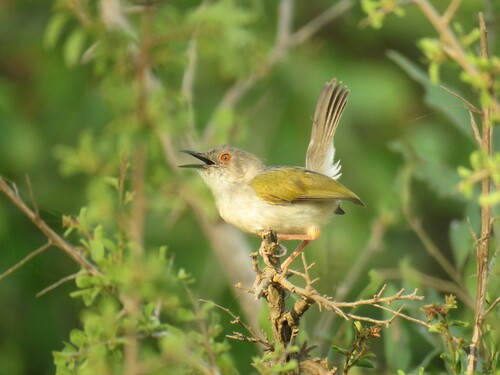 ミドリコムシクイ
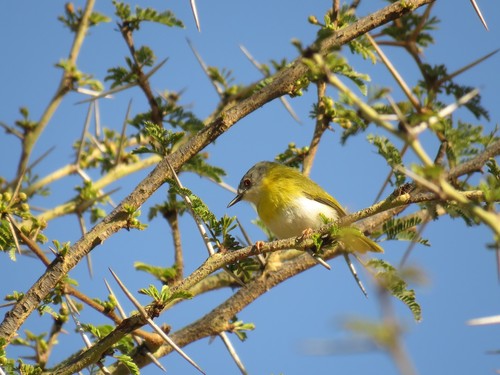 キムネイロムシクイ
要点
The most reliable field mark between Green-backed Camaroptera and Yellow-breasted Apalis is the underpart color: Green-backed Camaroptera shows whitish-grey underparts (with juveniles paler yellowish on the breast), while Yellow-breasted Apalis has a distinctly yellow breast. Both are small, active warblers in dense cover, but Camaroptera is slightly heavier and appears more olive-green above, whereas Apalis is lighter and named for its yellow underparts. Juvenile Camaroptera may show some yellowish on the breast, but never the clear, extensive yellow of Apalis. Both species are similar in size and structure, so focus on underpart color and upperpart tone for separation.
識別のコツ
- Underpart color is the single most reliable field mark: Green-backed Camaroptera has whitish-grey underparts (adults), while Yellow-breasted Apalis shows a clear yellow breast (adults and immatures).
- Juvenile Camaroptera can show a pale yellow wash on the breast, but this is never as bright or extensive as the yellow of Apalis. If the yellow is faint and limited, suspect Camaroptera; if strong and obvious, Apalis.
- Upperparts differ: Camaroptera is green above with olive wings, while Apalis lacks this greenish tone and appears less olive overall.
- No distinctive wing or flight pattern marks are described for either species at any age, so do not rely on upperwing panels or trailing edges.
- Both are small and slim, but Camaroptera is slightly heavier (10.0g vs 8.2g), though this is rarely useful in the field.
- Sexes are similar in both species, so do not expect sexual dimorphism to help.
- Behavior is similar: both are active in dense cover, but Camaroptera is especially skulking and low to the ground. If the bird is persistently low and hidden, Camaroptera is more likely.
- Nest-building clue: Camaroptera binds leaves together for its nest; if you see this behavior, it's diagnostic.
- Habitat overlap is high: both occur in dense bush and thickets, so do not use habitat alone unless you note Camaroptera's preference for the lowest, densest cover.
- No strong vocal differences are described in the provided notes, so do not rely on calls or song for separation here.
- If you see a bird with a green back and olive wings, and underparts that are not clearly yellow, it's almost certainly Camaroptera.
- If the breast is distinctly yellow and the bird lacks a green back, it's Apalis.
- In poor light, beware that Camaroptera juveniles can look yellower than adults, but never as bright as Apalis.
- If you are unsure, prioritize underpart color and upperpart tone over size or behavior.
- Recent taxonomic changes mean some field guides may lump or split these species differently; always check the latest regional checklist if in doubt.
大きさ
Green-backed Camaroptera is marginally heavier (10.0g) than Yellow-breasted Apalis (8.2g) [wikidata], but this difference is subtle in the field. Both are very small, slim warblers, and size alone is not a reliable separator. If seen side by side, Camaroptera may look slightly more robust, but overlap is considerable.
羽色
- Juvenile/immature: Green-backed Camaroptera juveniles are paler yellow on the breast, but this is usually a faint wash and never as bright or extensive as the yellow of Yellow-breasted Apalis. No distinctive upperwing or flight marks are described for either species at any age.
- Adult: Green-backed Camaroptera has green upperparts, olive wings, and whitish-grey underparts; both sexes are similar. Yellow-breasted Apalis (adult) is named for its yellow breast, which is the key field mark. Camaroptera's underparts are always more greyish or off-white, never truly yellow except for a faint juvenile wash. Apalis lacks the green upperparts of Camaroptera, appearing less olive overall.
行動
Both species are active, insectivorous warblers that skulk in dense vegetation. Green-backed Camaroptera is especially known for staying low in thick cover and is rarely seen in the open. Both may be seen moving quickly through bushes, but Camaroptera is more likely to bind leaves together for nesting, a behavior not noted for Apalis. In general, behavior is not a strong separator between these two unless nest-building is observed.
生息環境
Both species inhabit dense, bushy areas in sub-Saharan Africa. Green-backed Camaroptera is typically found low in dense cover, often in thickets or undergrowth. Yellow-breasted Apalis also prefers similar habitats, so habitat alone is not a reliable separator unless the birds are seen at different heights (Camaroptera tends to stay lower).