

Motmot

ソウゲンライチョウ 対 ハリモミライチョウ

Tympanuchus cupido 対 Canachites canadensis

ソウゲンライチョウとハリモミライチョウのクイズ
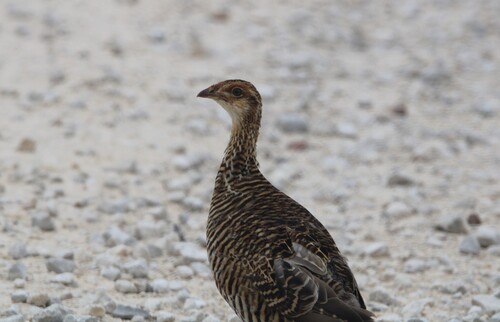
ソウゲンライチョウ (Tympanuchus cupido) ソウゲンライチョウ
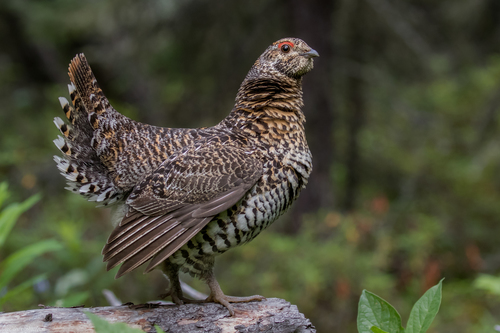
ハリモミライチョウ (Canachites canadensis) ハリモミライチョウ

メディア

読み込み中…

要点

The most reliable field mark to separate Greater Prairie-Chicken from Spruce Grouse is the combination of overall body structure and head/face features: Greater Prairie-Chicken is a much larger, stockier bird with a rounded tail and, in males, prominent orange air sacs and elongated head feathers, while Spruce Grouse is smaller, slimmer, and has a shorter tail; male Spruce Grouse show a red eyebrow comb but lack the Prairie-Chicken's neck adornments. In flight, both are chicken-like, but Greater Prairie-Chicken appears bulkier with broader, rounder wings and a more obvious rounded tail. Female and juvenile Spruce Grouse are more cryptic and can be confused with other grouse, but the Prairie-Chicken's unique head and neck features (in males) and larger size are strong clues. Habitat is a major separator: Prairie-Chicken is now restricted to open grasslands, while Spruce Grouse is found in dense boreal conifer forests.

識別のコツ

  1. Size and bulk: Greater Prairie-Chicken is much larger and heavier than Spruce Grouse; if the bird appears chicken-sized or larger, especially with a robust body and thick neck, Prairie-Chicken is likely. Spruce Grouse is more compact and lighter.
  2. Tail shape: Prairie-Chicken has a short, rounded tail; Spruce Grouse has a shorter, squarer tail, with females showing a pale band at the tip (Prairie-Chicken lacks this band).
  3. Head and neck features (males): Male Prairie-Chicken has orange combs over the eyes, elongated dark head feathers, and orange inflatable neck sacs (especially visible during display); male Spruce Grouse has a red eyebrow comb but no neck sacs or elongated head feathers.
  4. Female/juvenile confusion: Female and juvenile Spruce Grouse are mottled brown or gray with barred underparts and a dark tail with a pale tip; they lack any head or neck adornments. Female Prairie-Chicken is larger, with a plain face and lacks the Spruce Grouse's tail band.
  5. Plumage contrast (males): Male Spruce Grouse is gray above, black below, with white spots on the sides and a red eyebrow comb; male Prairie-Chicken is barred brown and buff with orange facial and neck features.
  6. Flight style: Prairie-Chicken appears heavy and direct in flight, with broad, rounded wings and a rounded tail; Spruce Grouse is lighter, with a fluttery, short-distance flight between trees.
  7. Perching behavior: Spruce Grouse is often seen perched in conifers, sometimes high in the trees; Prairie-Chicken is almost always on the ground in open areas.
  8. Habitat context: Prairie-Chicken is found only in open grasslands or prairies; Spruce Grouse is strictly in boreal conifer forests. If you are in dense spruce or pine woods, it is Spruce Grouse.
  9. Display behavior: Prairie-Chicken males display on leks with booming calls and inflated neck sacs; Spruce Grouse males may perform wing-clap displays but never inflate neck sacs.
  10. Vocalizations: Loud, resonant booming is diagnostic of Prairie-Chicken; Spruce Grouse is mostly silent, with only subtle mechanical sounds.
  11. Bill and face: Prairie-Chicken has a thicker, more robust bill and a plain face (female) or orange comb (male); Spruce Grouse has a finer bill and, in males, a red eyebrow comb.
  12. Abundance and range: Prairie-Chicken is now rare and highly localized, mostly in managed prairies; Spruce Grouse is widespread in boreal forests across Canada and the northern US.
  13. Seasonal confusion: During winter, Prairie-Chicken may form flocks in open fields; Spruce Grouse remains in forested habitat year-round.
  14. Juvenile confusion: Juvenile Spruce Grouse resemble females and may be confused with other grouse, but the tail pattern (pale band) and habitat are clues.
  15. Common pitfalls: Female Prairie-Chicken could be confused with female Spruce Grouse at a distance, but size, tail shape, and habitat are strong separators. Always consider context and multiple marks together.

大きさ

Greater Prairie-Chicken is significantly larger: adults are about 43 cm (17 in) long, with a wingspan of 69.5–72.5 cm (27.4–28.5 in) and weigh 700–1,200 g (25–42 oz) [wikipedia]. Spruce Grouse is smaller, at 38–43 cm (15–17 in) long, wingspan 55–57 cm (21.5–22.6 in), and males weigh 550–650 g (19–23 oz), females 450–550 g (16–19 oz) [wikipedia]. The Prairie-Chicken is not only longer but much bulkier and heavier, with a more robust build and rounder wings and tail.

羽色

No distinctive juvenile or immature upperwing pattern is described for either species in the sources. For adults, male Greater Prairie-Chicken is unmistakable with orange combs over the eyes, elongated dark head feathers, and orange inflatable neck sacs (visible when displaying); females are plainer but still larger and more robust than Spruce Grouse. Spruce Grouse males are mostly gray above and black below, with white spots on the sides and a red eyebrow comb, lacking any neck sacs or elongated head feathers. Female Spruce Grouse are mottled brown or gray with barred underparts and a dark tail with a pale terminal band; they lack the Prairie-Chicken's head/neck features. Juvenile Spruce Grouse resemble females. Tail pattern is a useful check: Prairie-Chicken has a short, rounded tail, while Spruce Grouse has a shorter, squarer tail with a pale band at the tip in females.

行動

Greater Prairie-Chicken is primarily terrestrial, seen walking or running in open grasslands and displaying on leks with dramatic booming and neck sac inflation (males). Spruce Grouse, in contrast, is more arboreal than most grouse, often perching in conifer trees, moving about in the branches, and is generally more confiding and less wary. In flight, Prairie-Chicken is heavy and direct, with strong, rounded wingbeats and a short, rounded tail; Spruce Grouse is lighter, often flying short distances between trees, with a more fluttery flight and less showy display (except for the wing-clap display in some males).

生息環境

Habitat is a key separator: Greater Prairie-Chicken is now restricted to remnant patches of open prairie and grassland in central North America and is absent from forests. Spruce Grouse is strictly a bird of boreal coniferous forests (taiga), especially spruce, pine, and fir, across Canada and the northern US. You will not find Prairie-Chicken in dense woods or Spruce Grouse in open prairie.

声

Greater Prairie-Chicken males are famous for their deep, booming display calls, produced with their inflated neck sacs, and also give cackles and clucks. Spruce Grouse is among the most silent grouse, with only a few soft calls and non-vocal sounds (wing claps, drumming, tail whoosh) used mainly in display or alarm. If you hear a loud, resonant booming, it is Greater Prairie-Chicken; Spruce Grouse is unlikely to be heard except for subtle mechanical sounds.

より良い説明を送る

比較と同じ項目を使ってください。文章はすぐに公開されます。

The most reliable field mark to separate Greater Prairie-Chicken from Spruce Grouse is the combination of overall body structure and head/face features: Greater Prairie-Chicken is a much larger, stockier bird with a rounded tail and, in males, prominent orange air sacs and elongated head feathers, while Spruce Grouse is smaller, slimmer, and has a shorter tail; male Spruce Grouse show a red eyebrow comb but lack the Prairie-Chicken's neck adornments. In flight, both are chicken-like, but Greater Prairie-Chicken appears bulkier with broader, rounder wings and a more obvious rounded tail. Female and juvenile Spruce Grouse are more cryptic and can be confused with other grouse, but the Prairie-Chicken's unique head and neck features (in males) and larger size are strong clues. Habitat is a major separator: Prairie-Chicken is now restricted to open grasslands, while Spruce Grouse is found in dense boreal conifer forests.

  1. Size and bulk: Greater Prairie-Chicken is much larger and heavier than Spruce Grouse; if the bird appears chicken-sized or larger, especially with a robust body and thick neck, Prairie-Chicken is likely. Spruce Grouse is more compact and lighter.
  2. Tail shape: Prairie-Chicken has a short, rounded tail; Spruce Grouse has a shorter, squarer tail, with females showing a pale band at the tip (Prairie-Chicken lacks this band).
  3. Head and neck features (males): Male Prairie-Chicken has orange combs over the eyes, elongated dark head feathers, and orange inflatable neck sacs (especially visible during display); male Spruce Grouse has a red eyebrow comb but no neck sacs or elongated head feathers.
  4. Female/juvenile confusion: Female and juvenile Spruce Grouse are mottled brown or gray with barred underparts and a dark tail with a pale tip; they lack any head or neck adornments. Female Prairie-Chicken is larger, with a plain face and lacks the Spruce Grouse's tail band.
  5. Plumage contrast (males): Male Spruce Grouse is gray above, black below, with white spots on the sides and a red eyebrow comb; male Prairie-Chicken is barred brown and buff with orange facial and neck features.
  6. Flight style: Prairie-Chicken appears heavy and direct in flight, with broad, rounded wings and a rounded tail; Spruce Grouse is lighter, with a fluttery, short-distance flight between trees.
  7. Perching behavior: Spruce Grouse is often seen perched in conifers, sometimes high in the trees; Prairie-Chicken is almost always on the ground in open areas.
  8. Habitat context: Prairie-Chicken is found only in open grasslands or prairies; Spruce Grouse is strictly in boreal conifer forests. If you are in dense spruce or pine woods, it is Spruce Grouse.
  9. Display behavior: Prairie-Chicken males display on leks with booming calls and inflated neck sacs; Spruce Grouse males may perform wing-clap displays but never inflate neck sacs.
  10. Vocalizations: Loud, resonant booming is diagnostic of Prairie-Chicken; Spruce Grouse is mostly silent, with only subtle mechanical sounds.
  11. Bill and face: Prairie-Chicken has a thicker, more robust bill and a plain face (female) or orange comb (male); Spruce Grouse has a finer bill and, in males, a red eyebrow comb.
  12. Abundance and range: Prairie-Chicken is now rare and highly localized, mostly in managed prairies; Spruce Grouse is widespread in boreal forests across Canada and the northern US.
  13. Seasonal confusion: During winter, Prairie-Chicken may form flocks in open fields; Spruce Grouse remains in forested habitat year-round.
  14. Juvenile confusion: Juvenile Spruce Grouse resemble females and may be confused with other grouse, but the tail pattern (pale band) and habitat are clues.
  15. Common pitfalls: Female Prairie-Chicken could be confused with female Spruce Grouse at a distance, but size, tail shape, and habitat are strong separators. Always consider context and multiple marks together.

Greater Prairie-Chicken is significantly larger: adults are about 43 cm (17 in) long, with a wingspan of 69.5–72.5 cm (27.4–28.5 in) and weigh 700–1,200 g (25–42 oz) [wikipedia]. Spruce Grouse is smaller, at 38–43 cm (15–17 in) long, wingspan 55–57 cm (21.5–22.6 in), and males weigh 550–650 g (19–23 oz), females 450–550 g (16–19 oz) [wikipedia]. The Prairie-Chicken is not only longer but much bulkier and heavier, with a more robust build and rounder wings and tail.

No distinctive juvenile or immature upperwing pattern is described for either species in the sources. For adults, male Greater Prairie-Chicken is unmistakable with orange combs over the eyes, elongated dark head feathers, and orange inflatable neck sacs (visible when displaying); females are plainer but still larger and more robust than Spruce Grouse. Spruce Grouse males are mostly gray above and black below, with white spots on the sides and a red eyebrow comb, lacking any neck sacs or elongated head feathers. Female Spruce Grouse are mottled brown or gray with barred underparts and a dark tail with a pale terminal band; they lack the Prairie-Chicken's head/neck features. Juvenile Spruce Grouse resemble females. Tail pattern is a useful check: Prairie-Chicken has a short, rounded tail, while Spruce Grouse has a shorter, squarer tail with a pale band at the tip in females.

Greater Prairie-Chicken is primarily terrestrial, seen walking or running in open grasslands and displaying on leks with dramatic booming and neck sac inflation (males). Spruce Grouse, in contrast, is more arboreal than most grouse, often perching in conifer trees, moving about in the branches, and is generally more confiding and less wary. In flight, Prairie-Chicken is heavy and direct, with strong, rounded wingbeats and a short, rounded tail; Spruce Grouse is lighter, often flying short distances between trees, with a more fluttery flight and less showy display (except for the wing-clap display in some males).

Habitat is a key separator: Greater Prairie-Chicken is now restricted to remnant patches of open prairie and grassland in central North America and is absent from forests. Spruce Grouse is strictly a bird of boreal coniferous forests (taiga), especially spruce, pine, and fir, across Canada and the northern US. You will not find Prairie-Chicken in dense woods or Spruce Grouse in open prairie.

Greater Prairie-Chicken males are famous for their deep, booming display calls, produced with their inflated neck sacs, and also give cackles and clucks. Spruce Grouse is among the most silent grouse, with only a few soft calls and non-vocal sounds (wing claps, drumming, tail whoosh) used mainly in display or alarm. If you hear a loud, resonant booming, it is Greater Prairie-Chicken; Spruce Grouse is unlikely to be heard except for subtle mechanical sounds.

変更を破棄しますか?

保存していない編集があります。今離れると失われます。

ソウゲンライチョウ · ハリモミライチョウ · 苦手な鳥