

ヒバリ 対 タイワンヒバリ
Alauda arvensis 対 Alauda gulgula
ヒバリとタイワンヒバリのクイズ
 ヒバリ
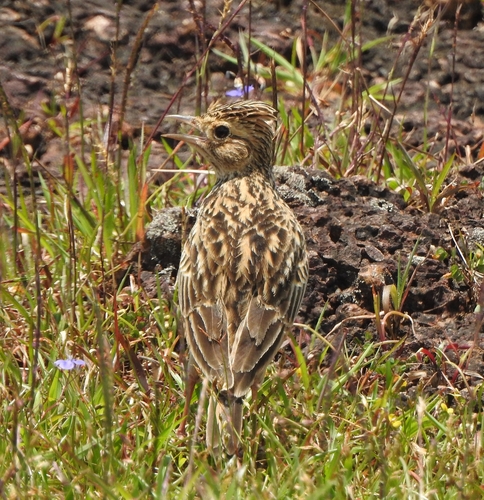 タイワンヒバリ
要点
The most reliable field mark to separate Eurasian Skylark from Oriental Skylark in flight is the presence or absence of a white trailing edge to the wings: Eurasian Skylark (all ages) shows a distinct white rear edge to the wing, while Oriental Skylark lacks this feature. Oriental Skylark is also smaller, with a noticeably longer and more pointed bill, and has buff-toned outer tail feathers rather than the Eurasian's whiter ones. Both species are brown and streaked above with a short crest, but Eurasian Skylark appears bulkier with broader wings and a longer tail. These differences are most apparent when observing birds in flight or side-by-side, but can be subtle on perched birds or distant views.
識別のコツ
- White trailing edge to wing (flight): Eurasian Skylark of all ages shows a clear white rear edge to the wing in flight; Oriental Skylark lacks this feature. This is the single most reliable mark, especially for birds in flight or distant views.
- Outer tail feather color: Eurasian Skylark has white outer tail feathers, especially obvious when flying away. Oriental Skylark's outer tail feathers are more buff-toned, which is less striking.
- Bill shape: Oriental Skylark has a longer, more pointed bill, while Eurasian Skylark's bill is shorter and blunter. This is best appreciated at close range or with good views.
- Size and structure: Eurasian Skylark is larger and bulkier, with broader wings and a longer tail. Oriental Skylark is smaller, more compact, with a shorter tail and wings. These differences are subtle unless birds are seen together.
- Wing shape: Eurasian Skylark (especially males) has broader wings, aiding in its hovering display. Oriental Skylark's wings are shorter and narrower.
- Crest: Both species have a short crest that can be raised or lowered; this is not a reliable separator.
- Plumage tone: Oriental Skylark is generally more yellow-brown above, sometimes more heavily streaked (especially in some subspecies), but this is variable and not always diagnostic.
- Flight behavior: Eurasian Skylark often hovers high in the air while singing for prolonged periods; Oriental Skylark's song flight is less persistent and lower.
- Perched jizz: Eurasian Skylark appears bulkier and longer-tailed when perched; Oriental Skylark is more compact.
- Habitat: Both species favor open grassland, so habitat is not a reliable separator where ranges overlap. Use with caution.
- Song: Eurasian Skylark's song is longer and more elaborate, delivered from higher and for longer periods. Oriental Skylark's song is shorter and less complex, but this is only useful if the full song is heard.
- Subspecies variation (Oriental Skylark): Some Oriental Skylark subspecies are paler or more heavily streaked, but these differences are subtle and not reliable for field separation from Eurasian Skylark.
- Sex differences: Eurasian Skylark males have broader wings than females, but both sexes share the key field marks above. Oriental Skylark sexes are similar.
- Juvenile/immature confusion: The white trailing edge to the wing in Eurasian Skylark is present in all ages, making it a dependable mark even for young birds.
- Pitfalls: Dull light, distant views, or birds facing toward the observer can obscure key features (e.g., tail and wing edges). Always try to see the bird in flight from behind or the side for best separation.
大きさ
Eurasian Skylark is larger overall, measuring 18–19 cm in length, while Oriental Skylark is smaller at 15.5–18 cm. Eurasian Skylark also appears bulkier and has broader wings, especially in males, which is an adaptation for prolonged hovering. Oriental Skylark is lighter (24–30 g) and more compact, with a shorter tail and wings. Bill structure is also a clue: Oriental Skylark has a longer, more pointed bill, whereas Eurasian's is shorter and blunter. These size and structure differences are most apparent when both species are seen together, but may be subtle in isolation or at a distance.
羽色
- Juvenile/immature and adult flight: Eurasian Skylark of all ages shows a white trailing edge to the wings in flight, a key feature absent in Oriental Skylark. Oriental Skylark's wings lack this white rear edge, and its outer tail feathers are more buff than white. Both species have streaked brown upperparts and pale underparts, but Oriental Skylark is generally more yellow-brown and can be more heavily streaked above in some subspecies. Eurasian Skylark's tail is edged with white, especially noticeable when the bird is flying away, while Oriental Skylark's tail edges are buffier. Both have a short crest, but this is not a strong separator. Subtle differences in plumage tone, streaking, and bill length exist among Oriental Skylark subspecies, but these are rarely diagnostic in the field except in direct comparison.
行動
Both species are ground-dwelling larks of open country, but Eurasian Skylark is especially known for its prolonged, high, hovering song flights, sometimes lasting several minutes and delivered from heights of 50–100 meters or more. Oriental Skylark also sings in flight but is less spectacular in its display and does not hover as persistently or as high. Eurasian Skylark's broader wings aid in this hovering behavior, and males may be seen circling or rising high while singing. Perched behavior is similar, with both species often seen on the ground or low perches.
生息環境
Eurasian Skylark is widespread across Europe and the Palearctic, favoring open farmland, heath, and grassland. Oriental Skylark is found in the Sino-Indian region and parts of central Asia, also preferring open grasslands. Both species overlap in habitat type (open, grassy areas), so habitat alone is not a reliable separator where ranges overlap. Contextual clues may help in regions where only one species is expected.
声
Eurasian Skylark is famous for its long, bubbling, warbling song delivered in extended hovering flight, sometimes lasting up to 20 minutes. Oriental Skylark also sings in flight, but its song is generally shorter and less elaborate. Song dialects and frequency changes in Eurasian Skylark have been noted, but these are not practical field marks for separation from Oriental Skylark. Both species have similar call types, so voice is not a strong separator unless the full song is heard and compared.