

Eastern Woodhaunter 対 キムネミドリカザリドリ
Automolus subulatus 対 Pipreola aureopectus
Eastern Woodhaunterとキムネミドリカザリドリのクイズ
 Eastern Woodhaunter
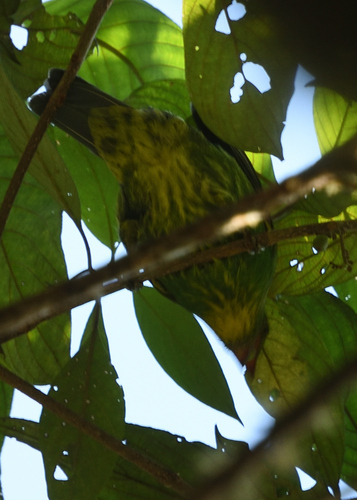 キムネミドリカザリドリ
要点
The most reliable field mark is the strong sexual dimorphism of the Golden-breasted Fruiteater: adult males show a vivid yellow breast and green upperparts, while females have green underparts with yellow streaks—both very different from the streaked brown and chestnut tones of the Eastern Woodhaunter, which shows no sex differences. Juvenile Woodhaunters are less streaked but still brownish, never green or yellow. Structure also helps: Woodhaunter has a short, heavy bill and chestnut tail, while Fruiteater is more compact with a small, colorful bill and green tail. Both species can occur in mixed flocks, but Woodhaunter is a ground/understory forager, while Fruiteater is usually higher up and feeds on fruit. Range is a last resort: Fruiteater is only in Colombia and Venezuela, while Woodhaunter is widespread in the Amazon basin.
識別のコツ
- Sexual dimorphism: Only Fruiteater shows strong sex differences: males are bright yellow and green, females are green with yellow streaks. Woodhaunter sexes are identical (brown and streaked).
- Overall color: Fruiteater (both sexes) is predominantly green above, with yellow on the underparts (male: solid yellow, female: streaked). Woodhaunter is brown above with chestnut rump/tail and golden-buff streaks, never green or yellow.
- Breast pattern: Fruiteater males have a clear, bright yellow breast; females have green underparts with yellow streaks. Woodhaunter has a dull brown breast with blurry golden-buff streaks that fade toward the belly.
- Tail and rump: Woodhaunter shows a rich chestnut rump and tail, visible both perched and in flight. Fruiteater's tail is green, matching the back.
- Bill color: Fruiteater has a striking orange or orange-red bill; Woodhaunter's bill is blackish above, paler below, never orange.
- Iris color: Fruiteater's iris is orange-yellow; Woodhaunter's is always dark brown.
- Wing pattern: Fruiteater has small white tips on tertials (subtle, best seen at close range). Woodhaunter's wings are rufescent brown with no white.
- Juvenile confusion: Juvenile Woodhaunter is paler below and less streaked, but still brownish, not green. No age of Fruiteater is brown or streaked like Woodhaunter.
- Foraging behavior: Woodhaunter is active, probing and 'burrowing' in debris, often low in the forest. Fruiteater is more likely to be seen quietly perched or moving in pairs, higher up, feeding on fruit.
- Range: Fruiteater is only in Colombia and Venezuela; Woodhaunter is widespread in the Amazon basin. Outside Fruiteater's range, default to Woodhaunter.
- Habitat: Woodhaunter prefers dense understory and mid-levels of lowland forest; Fruiteater is more a mid-level montane forest bird.
- Size impression: Fruiteater is heavier and more compact, but both are similar in length; use structure and plumage over size.
- No seasonal change: Both species have little to no seasonal plumage change; use age and sex differences instead.
- Mixed flocks: Both join mixed-species flocks, so flocking behavior is not diagnostic.
- Voice: Not described in the notes; do not rely on vocalization for separation here.
大きさ
Both species are similar in length (Woodhaunter: 17–18 cm; Fruiteater: 16.5–17.5 cm), but Fruiteater is noticeably heavier (46–50 g vs. Woodhaunter's 25–38 g) [wikipedia][avonet]. In the field, Fruiteater may appear more compact and robust, while Woodhaunter is lankier with a proportionally heavier bill. However, size alone is not a safe separator unless both species are seen side-by-side.
羽色
- Juveniles: Juvenile Woodhaunter is paler below and less distinctly streaked than adults, but still brownish overall with some streaking and chestnut in the tail and rump. Juvenile Fruiteater is not described, but both sexes of Fruiteater (even females) are green above and below, with females showing yellow streaks on the underparts—never brown or chestnut.
- Adult males: Golden-breasted Fruiteater males have a grass-green head, back, and tail, with a bright yellow throat and breast (lemon-yellow lower breast blending to green on the flanks). Woodhaunter adults are brown above with golden-buff streaks on the crown and back, chestnut rump and tail, and a dull streaked brown breast fading to a tawny belly.
- Adult females: Fruiteater females are green above and below, with yellow streaks on the underparts. Woodhaunter females are identical to males (no sexual dimorphism), always brownish and streaked, never green or yellow.
- Wings: Fruiteater wings have small white tips on the tertials (subtle), while Woodhaunter's wings are rufescent brown with no white. Both have dark wings in flight, but Woodhaunter's chestnut tail and rump are distinctive.
- Bill and iris: Fruiteater has an orange or orange-red bill and orange-yellow iris; Woodhaunter has a black to dusky bill (paler below) and dark brown iris.
行動
Woodhaunter forages singly or in mixed flocks, usually in the forest understory or mid-levels, actively probing among dead leaves, epiphytes, and debris along branches—sometimes 'burrowing' into clumps. Fruiteater forages in pairs or mixed flocks, typically in the mid-levels, and feeds on fruit, not insects. Fruiteater is more likely to be seen perched quietly, while Woodhaunter is more active and methodical in its movements.
生息環境
Woodhaunter is found in the Amazon basin (Bolivia, Brazil, Colombia, Ecuador, Peru, Venezuela) and prefers forest understory to mid-levels, often near large branches and dense vegetation. Fruiteater is restricted to Colombia and Venezuela, usually in humid montane forests, and typically forages in the mid-levels. If seen in lowland Amazonian forest outside Colombia/Venezuela, it is almost certainly Woodhaunter.