

カンムリモリハタオリ 対 アカガシラモリハタオリ
Malimbus malimbicus 対 Anaplectes rubriceps
カンムリモリハタオリとアカガシラモリハタオリのクイズ
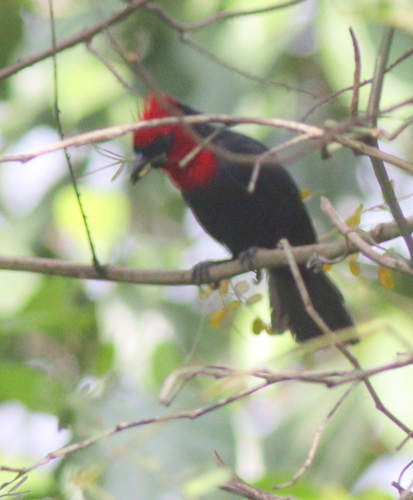 カンムリモリハタオリ
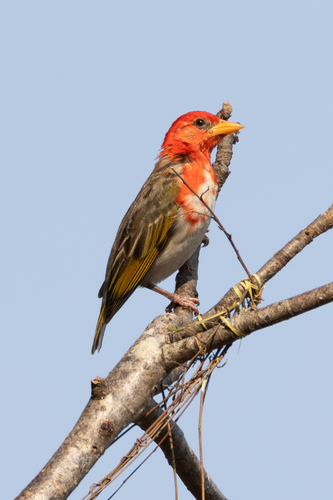 アカガシラモリハタオリ
要点
The most reliable field mark to separate Crested Malimbe from Red-headed Weaver is the head and underpart coloration: Crested Malimbe shows a striking black-and-red pattern with a prominent crest, while Red-headed Weaver males (especially northern races) have a bright red head and white belly, with females showing brown or yellow heads depending on region. Juvenile and immature plumages are not described in detail for either species, so focus on adult head and underpart color, as well as bill shape and flocking behavior. Both species are weavers, but their structure and social habits differ. Habitat overlap is possible in parts of Africa, but Red-headed Weaver is more widespread in drier savanna and woodland, while Crested Malimbe is a rainforest specialist.
識別のコツ
- Head and underpart color: Adult Crested Malimbe shows a bold black-and-red head pattern with a crest, while Red-headed Weaver males have a bright red head and white belly (northern races), with females showing brown or yellow heads. This is the most reliable mark in adults.
- Crest: Only Crested Malimbe has a noticeable crest on the head. Red-headed Weaver’s head is smoothly rounded.
- Underparts: Crested Malimbe’s underparts are extensively red or black, depending on sex/age, while Red-headed Weaver always has pale (white or yellowish) underparts.
- Bill shape: Red-headed Weaver has a longer, more pointed bill than Crested Malimbe, which has a typical malimbe bill (shorter, stouter).
- Female/immature confusion: Female Red-headed Weavers in the north have brown heads, which can look dull and might be confused with a non-breeding malimbe, but the pale underparts and lack of crest separate them. Southern female Red-headed Weavers have yellow heads and yellow wing accents, not matched by Crested Malimbe.
- Wing and flight pattern: No distinctive juvenile or immature wing or flight marks are described for either species, so do not rely on upperwing pattern for separation.
- Flocking and social behavior: Red-headed Weaver often occurs in small groups with one male and several females, sometimes foraging acrobatically. Crested Malimbe may be seen in small groups but is less likely to show the same social structure.
- Nest structure: Both species can build hanging nests with entrance tunnels, but this is more typical of malimbes. If you see a stick nest with a long tunnel, check plumage carefully.
- Foraging behavior: Red-headed Weaver is more likely to be seen hanging upside-down, prying open dead leaves, or feeding on nectar and insects in exposed situations. Crested Malimbe is more secretive and likely to stay in dense foliage.
- Habitat: In dense rainforest, Crested Malimbe is expected; in open woodland, savanna, or near villages, Red-headed Weaver is much more likely.
- Geographic range: If you are in eastern or southern Africa outside rainforest, Red-headed Weaver is the default. Crested Malimbe is restricted to the African tropical rainforest belt.
- Voice: No diagnostic vocal differences are described in the sources; do not rely on voice for separation.
- Jizz: Red-headed Weaver often looks more elongated and agile, especially when foraging, due to its longer bill and active behavior. Crested Malimbe appears stockier and more deliberate.
- Pitfalls: Be careful with female and immature Red-headed Weavers, especially northern brown-headed females, which can look dull and might be confused with a malimbe at a glance. Always check for crest and underpart color.
- Seasonal variation: No strong seasonal plumage changes are described for either species, but regional variation in Red-headed Weaver females (brown vs yellow heads) can cause confusion. Check your location and look for yellow accents in the south.
大きさ
Both species are medium-sized weavers, but direct size comparison is not detailed in the sources. Structure may be more helpful: Red-headed Weaver has a moderately long, pointed beak and short, strong claws, giving it a slightly more elongated and agile look, especially when foraging. Crested Malimbe’s proportions are typical for its genus, but no specific differences in length or mass are given.
羽色
No detailed juvenile or immature wing pattern is provided for either species, so focus on adult plumage. Adult Crested Malimbe has a bold black-and-red plumage with a distinctive crest on the head, and the red is typically on the underparts and/or face, depending on sex and age. Red-headed Weaver males (northern races) have a bright red head, white belly, and brown wings, while females vary: northern females have a brownish head, southern females have yellow heads and yellow wing accents. The Red-headed Weaver’s underparts are always pale (white or yellowish), contrasting with the Crested Malimbe’s more extensive red and black. Bill color and shape are also useful: Red-headed Weaver’s bill is long and pointed, while Crested Malimbe’s is more typical for a malimbe. No age-specific upperwing or flight marks are described for either species.
行動
Red-headed Weaver is often seen foraging acrobatically, hanging upside-down to probe bark and dead leaves for insects, and may be found alone or in small groups with a single male and several females. Its nest is made of dry sticks and often suspended from a tree, sometimes with a long entrance tunnel (a feature more typical of malimbes, which can cause confusion). Crested Malimbe’s behavior is less described, but as a rainforest malimbe, it is likely to forage in the canopy and may be seen in small groups. If you see the bird actively prying open leaves, hanging upside-down, or feeding on nectar, it is more likely to be a Red-headed Weaver.
生息環境
Crested Malimbe is a specialist of African tropical rainforests, rarely found outside dense, humid forest. Red-headed Weaver is much more widespread, found throughout the Afrotropics but especially common in eastern and southern Africa, in woodland, savanna, and even around human habitation. If you are in dense rainforest, Crested Malimbe is far more likely; in open woodland or savanna, Red-headed Weaver is the default.