

コウライキジ 対 セキショクヤケイ
Phasianus colchicus 対 Gallus gallus
コウライキジとセキショクヤケイのクイズ
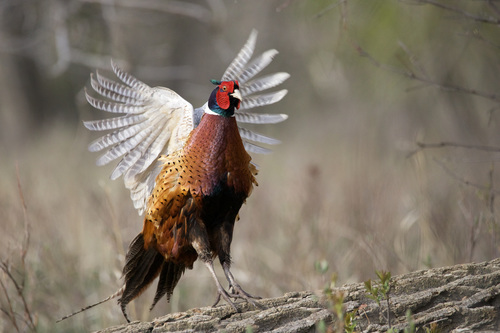 コウライキジ
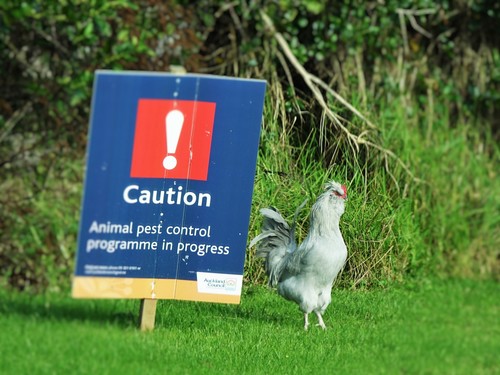 セキショクヤケイ
要点
The most reliable field mark to separate Common Pheasant from Red Junglefowl is the pheasant’s extremely long, pointed, and heavily barred tail, especially in males, which is nearly half the bird’s total length and is never matched by the junglefowl. Juvenile and female pheasants are overall duller, but still show a longer, more pointed tail than the compact, rounded-tailed Red Junglefowl. In flight, pheasants appear larger, heavier, and longer-tailed, while Red Junglefowl are more chicken-like, with shorter, curved tails and a more compact build. Males of both species are colorful, but the Common Pheasant’s combination of iridescent green head, red wattle, and (often) a white neck ring is distinctive, while Red Junglefowl males have golden hackles, a red comb, and iridescent green-black tails. Females and immatures of both are brown and cryptic, but the pheasant’s longer tail and more uniform patterning help distinguish them.
識別のコツ
- Tail length and shape: The single most reliable mark. Common Pheasant (all ages and sexes) has a much longer, pointed tail, often half the bird’s length; Red Junglefowl has a shorter, more rounded tail, even in males with long sickle feathers.
- Overall size and jizz: Pheasant is bulkier, longer, and heavier, with a more elongated look, especially when running or in flight. Junglefowl is more compact and chicken-like.
- Adult male head pattern: Pheasant males have an iridescent green head, red wattle, and often a white neck ring (though not always); junglefowl males have a red comb and wattle, no neck ring, and a golden or red hackle.
- Tail barring: Pheasant tails are heavily barred with black and pale bands; junglefowl tails are iridescent green-black, sometimes with a bluish or purplish sheen, and lack strong barring.
- Female/juvenile plumage: Both are brown, but pheasant females are larger, with a longer, pointed tail and more uniform mottling. Junglefowl hens are smaller, with a shorter, rounded tail and finer patterning on the breast.
- Flight style: Pheasants flush explosively and fly with noisy, whirring wingbeats, then glide on long tails. Junglefowl fly only short distances, usually to roost, and have a more direct, less showy flight.
- Legs and spurs: Junglefowl males have prominent spurs on the back of each leg; pheasant males may have spurs but these are less obvious in the field.
- Comb and wattles: Junglefowl males have a large, upright red comb and pronounced wattles; pheasant males have red wattles but no comb.
- Eclipse plumage: Only junglefowl males show a distinct eclipse plumage (June–October), with black on the back and scattered red-orange plumes; pheasant males do not have a comparable eclipse phase.
- Habitat context: Pheasant is found in open fields, farmland, and temperate zones; junglefowl prefers tropical forests and forest edge.
- Behavior: Pheasants are more likely to be seen in the open, running or flying; junglefowl are shy, stay close to cover, and often roost in trees.
- Vocalizations: Junglefowl males give a classic crow; pheasant males have a harsh, short, two-syllable call with wing-flapping.
- Subspecies and hybrids: Be aware that pheasant plumage is highly variable due to hybridization and captive releases; some individuals may lack a neck ring or have unusual coloration, but tail length and structure remain diagnostic.
- Seasonal variation: Junglefowl males change into eclipse plumage in summer/fall; pheasant males remain colorful year-round.
- Group structure: Junglefowl often in small flocks with one or a few males and several females; pheasants may be solitary or in loose groups, especially outside breeding season.
大きさ
Common Pheasant is notably larger and heavier than Red Junglefowl. While exact mass for pheasant is not listed, males average about 1.2 kg and females about 0.9 kg [wikipedia], compared to Red Junglefowl’s average of 672 g [wikidata] (with males up to 1.5 kg and females up to 1 kg [wikipedia]). Pheasants are also longer overall (males 60–89 cm, females 50–63 cm), mainly due to their extremely long tail (up to 50 cm in males), while Red Junglefowl reach up to 70 cm, but with a much shorter tail (longest tail feathers up to 28 cm in males). In the field, pheasants look bulkier and more elongated, especially when running or flying.
羽色
-
Juvenile and female plumage: Both are brown and cryptic, but female and juvenile Common Pheasant are larger and have a much longer, pointed tail compared to the shorter, rounded tail of Red Junglefowl hens. Pheasant females are more uniformly mottled brown, while Red Junglefowl hens may show more contrast and finer patterning, especially on the breast.
-
Adult male plumage: Common Pheasant males are highly variable but typically show a bottle-green head with red wattles, sometimes a white neck ring, and a coppery or golden barred body with a very long, barred tail. Red Junglefowl males have a golden or red hackle, a prominent red comb and wattle, and an iridescent green-black tail with long, curved sickle feathers, but the tail is never as long or as heavily barred as the pheasant’s. Junglefowl males also show a more chicken-like body shape and lack the pheasant’s iridescent green head and neck ring.
-
Eclipse plumage: Red Junglefowl males undergo a molt into eclipse plumage (June–October), with black feathers on the back and scattered red-orange plumes; females’ eclipse is similar to their normal plumage. Common Pheasant males do not have a comparable eclipse plumage.
-
Wing pattern in flight: No distinctive age-specific upperwing marks are described for either species, but the pheasant’s wings are broad and rounded with pale coverts and a strong contrast to the long tail, while junglefowl wings are shorter and the tail is less prominent.
行動
Common Pheasant is often seen walking or running in open fields, sometimes flushing with a noisy, whirring flight and gliding on long, pointed tails. They are less likely to perch in trees. Red Junglefowl are shy, more likely to be seen in small flocks, and often forage in cover. They regularly fly up into trees to roost at night, using short, direct flights. Males may be seen alone or in small groups, while females are usually in flocks. Junglefowl are more wary and less likely to be seen in the open for long periods.
生息環境
Common Pheasant is associated with open fields, farmland, and woodland edges, often in temperate regions. Red Junglefowl is a bird of tropical and subtropical forests, forest edges, and scrubby areas in South and Southeast Asia. If seen in dense forest or close to villages in Asia, Red Junglefowl is more likely; in open agricultural land or temperate climates, Common Pheasant is expected.
声
Red Junglefowl males give the classic 'cock-a-doodle-doo' crow, which is loud and far-carrying, especially at dawn. Common Pheasant males have a harsh, explosive crowing call, often described as a two-syllable 'kok-kok' or 'kor-kok', sometimes followed by wing-flapping. The pheasant’s call is shorter, raspier, and less musical than the junglefowl’s crow. Females of both species are generally quiet.