

カナダカケス 対 ミズイロアメリカムシクイ
Perisoreus canadensis 対 Setophaga cerulea
カナダカケスとミズイロアメリカムシクイのクイズ
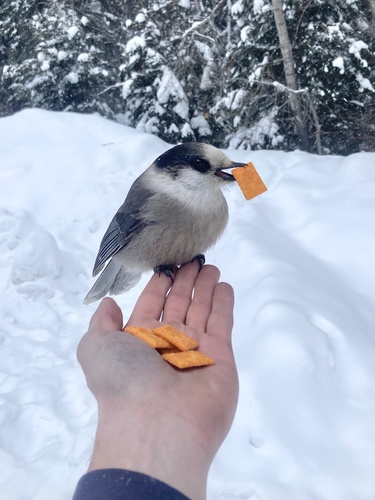 カナダカケス
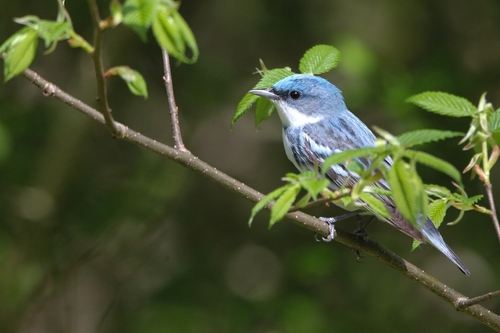 ミズイロアメリカムシクイ
要点
The most reliable field mark is size and structure: Canada Jay is a large, thickset corvid with a stout bill and long tail, while Cerulean Warbler is a tiny, slim songbird with a thin, pointed bill and short tail. Immature Canada Jays are uniformly dark grey, whereas all Cerulean Warblers (even juveniles) show two bold white wingbars and white tail spots. Adult male Cerulean Warblers are strikingly blue and white with a black necklace, unlike any Canada Jay. Habitat is also a strong clue: Canada Jay is found in boreal or subalpine forests, Cerulean Warbler in mature eastern hardwoods. If you see a chunky, pale-faced bird in the north woods, it's a Canada Jay; a small, blue-and-white bird high in a deciduous canopy is a Cerulean Warbler.
識別のコツ
- Size and shape: Canada Jay is over twice the length and many times the weight of Cerulean Warbler. If the bird looks robin-sized or larger, it's a jay; if it's sparrow-sized or smaller, it's a warbler.
- Bill structure: Canada Jay has a thick, short, all-black bill suited for omnivory; Cerulean Warbler has a thin, pointed bill ideal for insect gleaning. This is obvious even at a distance with binoculars.
- Tail: Canada Jay has a long, rounded, medium-grey tail with pale tips; Cerulean Warbler has a short tail with white spots visible in flight or when fanned.
- Wing pattern (all ages): Cerulean Warbler always shows two bold white wingbars and white tail spots, even in juveniles and females. Canada Jay never shows wingbars or tail spots at any age.
- Juvenile plumage: Young Canada Jays are uniformly dark grey, lacking any pale face, wingbars, or tail spots. Juvenile Cerulean Warblers are greenish above, yellowish below, with pale supercilium and always two white wingbars and white tail spots.
- Adult male plumage: Cerulean Warbler males are bright cerulean blue above, white below, with a black necklace and streaked flanks. Canada Jay is never blue, never streaked, and lacks any necklace or wingbars.
- Adult female/immature plumage: Cerulean Warbler females and immatures are greenish-blue above, yellowish below, with a pale eye-stripe and always two white wingbars. Canada Jay females look like males: grey above, pale below, white face, no wingbars or streaking.
- Facial pattern: Canada Jay has a white face with a dark nape/hood, giving a capped appearance. Cerulean Warbler females/immatures have a pale supercilium but no capped look; males have a plain blue crown.
- Leg color: Canada Jay always has black legs; Cerulean Warbler legs are black in adults, dark brown in juveniles, but this is rarely diagnostic in the field.
- Behavior: Canada Jay moves slowly, often perches in the open, and may approach people. Cerulean Warbler is restless, forages high in the canopy, and rarely sits still.
- Habitat: Canada Jay is found in boreal or subalpine coniferous forests, often far north or at high elevations. Cerulean Warbler is restricted to mature deciduous forests in the east during breeding season.
- Vocalizations: Canada Jay gives soft whistles and clicks, never buzzy or trilled. Cerulean Warbler sings a buzzy, accelerating song and a metallic "zzee" call—distinctive among warblers.
- Season/context: If seen outside the breeding season, Canada Jay is resident year-round in its range; Cerulean Warbler is a long-distance migrant and absent from North America in winter.
- Sociality: Canada Jay is often seen in small family groups; Cerulean Warbler is usually solitary or with mixed warbler flocks.
- Common pitfalls: Immature Canada Jays can look very plain and dark, but never show wingbars or tail spots. Cerulean Warbler, even in dull plumage, always shows some wing and tail pattern and is much smaller and slimmer.
大きさ
Canada Jay is much larger: 25–33 cm (10–13 in) long, with a 45 cm (18 in) wingspan and weighing 65–70 g (2.3–2.5 oz) [wikipedia]. Cerulean Warbler is tiny: 11 cm (4.3 in) long, 20 cm (7.9 in) wingspan, and weighs only 8–10 g (0.28–0.35 oz) [wikipedia]. The jay is over twice as long and many times heavier, with a thickset body, large head, and long, rounded tail. Cerulean Warbler is small, slim, and delicate, with a short tail and very fine bill.
羽色
-
Juvenile/immature birds: Canada Jay fledglings are uniformly dark grey all over, lacking any pale face or wing pattern. By contrast, all Cerulean Warblers (including juveniles and females) have two prominent white wingbars and white tail spots, plus a pale supercilium in females and young birds. This makes a juvenile Canada Jay look plain and sooty, while a young Cerulean Warbler always shows some pattern on the wings and face.
-
Adult males: Canada Jay adults are pale grey below, medium grey above, with a white face and dark nape; no blue, no streaking, and no wingbars. Cerulean Warbler adult males are deep cerulean blue above, white below, with a black necklace and dark streaks on flanks—very different from any jay.
-
Adult females: Canada Jay females look like males (grey and white, no wingbars, no blue). Cerulean Warbler females are greenish-blue above, yellowish below, with a pale eye-stripe and always two white wingbars and white tail spots.
-
Bill and legs: Canada Jay has a thick, short black bill and black legs. Cerulean Warbler has a thin, pointed bill (black in males, grayish in females/immatures) and black or brownish legs depending on age.
行動
Canada Jay is slow-moving, often tame, and spends much time perched or gliding between trees, sometimes approaching people for food. It forages by hopping along branches and is often seen in family groups. Cerulean Warbler is highly active, flitting rapidly among high branches, rarely still, and usually alone or with other small songbirds. It forages for insects in the canopy and is much less likely to be seen on or near the ground.
生息環境
Canada Jay is found in boreal coniferous forests across northern North America and in subalpine forests of the Rockies, often in remote, cold, or high-elevation areas [wikipedia]. Cerulean Warbler breeds in mature, tall, deciduous forests of eastern North America, especially in large tracts of hardwoods, and winters in subtropical forests on the eastern Andes [wikipedia]. The two species do not overlap in typical breeding habitat: seeing a bird in a spruce bog or subalpine fir forest points to Canada Jay; in a tall oak or maple canopy, Cerulean Warbler.
声
Canada Jay gives a variety of soft whistles, clicks, and chuckles, sometimes mimicking other species, but is generally quiet and not musical. Its calls are not buzzy or trilled. Cerulean Warbler males sing a buzzy, accelerating "zray zray zray zray zeeee" and give a metallic "zzee" call. Their song is distinctive among warblers and quite different from any jay vocalization. Cerulean Warbler is also more likely to sing persistently during the breeding season.
カナダカケス · ミズイロアメリカムシクイ · 苦手な鳥