

ムジミソサザイ 対 ムナジロモリミソサザイ
Cantorchilus modestus 対 Henicorhina leucosticta
ムジミソサザイとムナジロモリミソサザイのクイズ
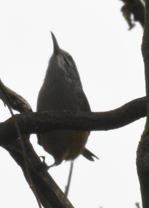 ムジミソサザイ
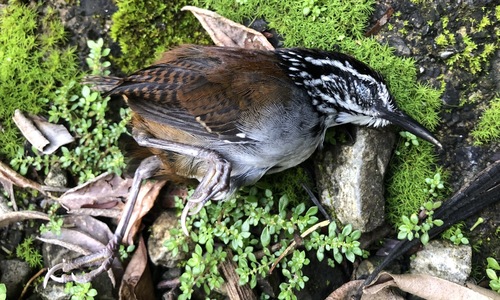 ムナジロモリミソサザイ
要点
The most reliable field mark to separate Cabanis's Wren from White-breasted Wood-Wren is the underpart coloration: Cabanis's Wren shows a white throat, pale grayish-buff chest, and buffy white belly with orange-buff flanks, while White-breasted Wood-Wren has clean white underparts that only become buff on the lower belly. In addition, Cabanis's Wren is larger and longer-tailed, with a rufous-brown back and orange-rufous rump, contrasting with the Wood-Wren's chestnut brown upperparts and much shorter tail. Both species have a pale supercilium, but the Wood-Wren's face is more boldly marked with black-and-white streaks. Immatures of both are duller, but the Wood-Wren juvenile is especially gray below. These differences are visible both perched and in brief flight views.
識別のコツ
- Underpart color: Cabanis's Wren shows a white throat, pale grayish-buff chest, and buffy white belly with orange-buff flanks; White-breasted Wood-Wren has clean white underparts, only becoming buff on the lower belly. This is visible in all ages but is most reliable in adults.
- Tail length and shape: Cabanis's Wren has a noticeably longer, rufescent brown tail with narrow dark bars, while White-breasted Wood-Wren has a very short tail barred with black. In the field, the Wood-Wren often looks almost tailless.
- Back and rump color: Cabanis's Wren has a rufous-brown back and orange-rufous rump, contrasting with the Wood-Wren's chestnut brown upperparts and darker crown. The rump color is a good check when seen well.
- Facial pattern: Both have a pale supercilium, but White-breasted Wood-Wren has black-and-white streaked sides of the head and neck, giving a more boldly marked face. Cabanis's Wren has a white supercilium, a gray-brown stripe behind the eye, and mottled gray-brown and gray-white cheeks.
- Size and structure: Cabanis's Wren is larger and longer-bodied (12.5–14 cm) compared to the compact, short-tailed White-breasted Wood-Wren (10 cm). This is best judged when both species are seen in the same area, but can be misleading if only one is present.
- Juvenile/immature plumage: Juvenile White-breasted Wood-Wren is especially gray below, lacking the warm buffy tones of Cabanis's Wren immatures. If you see a dull, grayish young wren with a short tail, suspect Wood-Wren.
- Tail barring: Both species have barred tails, but the Wood-Wren's tail is shorter and more strongly barred with black; Cabanis's Wren's tail is longer, rufescent brown, and more subtly barred.
- Supercilium: Both species show a pale supercilium, but it is more striking on Cabanis's Wren due to the contrast with its darker crown and less boldly marked face.
- Cheek pattern: Cabanis's Wren has mottled gray-brown and gray-white cheeks, while the Wood-Wren's cheeks are more crisply streaked black-and-white.
- Rump color: The orange-rufous rump of Cabanis's Wren is distinctive if seen, especially compared to the more uniform chestnut upperparts of the Wood-Wren.
- Flank color: Orange-buff flanks are a feature of Cabanis's Wren, while the Wood-Wren's flanks are not as distinctly colored.
- Geographic range: Both species overlap in Central America, but if you are outside this area, check range maps for local likelihood.
- Habitat: Both species use dense undergrowth and forest edges; habitat alone is not a strong separator in areas of overlap.
- Behavior: Both are skulking wrens, but Cabanis's Wren may appear more elongated and longer-tailed in movement.
- Voice: No diagnostic vocal differences are provided in the sources; use plumage and structure for separation.
大きさ
Cabanis's Wren is distinctly larger, measuring 12.5–14 cm in length and weighing 16–19 g, while White-breasted Wood-Wren is smaller at 10 cm and about 16 g. The size difference is most apparent in length, with Cabanis's Wren appearing noticeably longer-bodied and longer-tailed. In the field, Cabanis's Wren may look bulkier and more elongated, while the Wood-Wren is compact and short-tailed.
羽色
- Juveniles/immatures: Both species are duller than adults, but juvenile White-breasted Wood-Wren is especially gray on the underparts, lacking the warm buffy tones of Cabanis's Wren. Cabanis's Wren immatures are a duller version of the adult, but still show the basic pattern of white throat and orange-buff flanks.
- Adults: Cabanis's Wren has a dark gray-brown crown, rufous-brown back, orange-rufous rump, and a rufescent brown tail with narrow dark bars. Its underparts are white at the throat, pale grayish-buff on the chest, and buffy white on the belly, with orange-buff flanks. White-breasted Wood-Wren has chestnut brown upperparts, a darker crown, and a very short tail barred with black. Its underparts are clean white, becoming buff only on the lower belly. The face of the Wood-Wren is more boldly marked with black-and-white streaks on the sides of the head and neck, while Cabanis's Wren has a white supercilium and mottled gray-brown and gray-white cheeks.
行動
No strong behavioral differences are highlighted in the available sources. Both species are typical wrens, often skulking in dense vegetation and moving with quick, flicking motions. Cabanis's Wren may appear more elongated and longer-tailed when moving, while White-breasted Wood-Wren is more compact and short-tailed.
生息環境
Both species overlap in Central America, but Cabanis's Wren is found from southern Mexico through Central America to Costa Rica, while White-breasted Wood-Wren ranges from central Mexico south to northeastern Peru and Suriname. Both occur in lowland and foothill forests and edges, but local abundance may differ. In areas of overlap, habitat alone is not diagnostic.
ムジミソサザイ · ムナジロモリミソサザイ · 苦手な鳥