

ミナミコサメビタキ 対 シキチョウ
Muscicapa williamsoni 対 Copsychus saularis
ミナミコサメビタキとシキチョウのクイズ
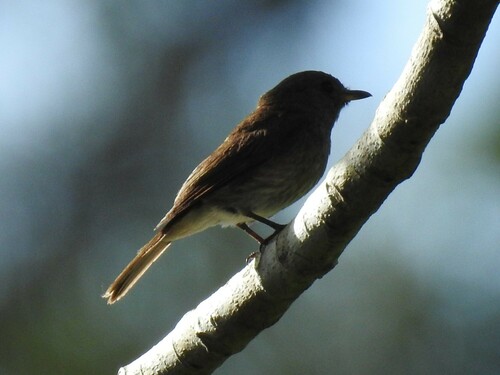 ミナミコサメビタキ
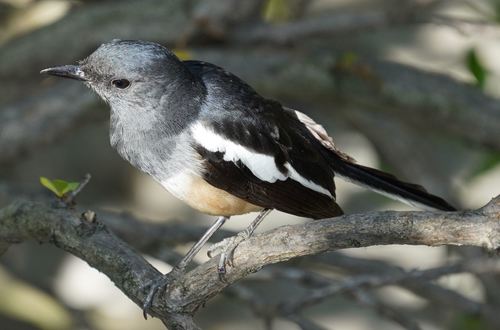 シキチョウ
要点
The most reliable field mark to separate Brown-streaked Flycatcher from Oriental Magpie-Robin is overall structure and tail: magpie-robins are noticeably larger, longer-tailed, and often cock their tails upright, while flycatchers are smaller, more compact, and never show this tail behavior. In plumage, magpie-robins (especially males) are strikingly black-and-white, while Brown-streaked Flycatchers are always drab brownish or rufescent, lacking any bold contrast. Juvenile magpie-robins have scaly brown upperparts, which could cause confusion with the flycatcher, but their size, tail, and posture remain distinctive. If you see a small, plain, brownish bird with a short tail, it's the flycatcher; a larger, long-tailed, black-and-white (or greyish) bird with a cocked tail is the magpie-robin.
識別のコツ
- Size and structure: Magpie-robins are much larger and heavier than Brown-streaked Flycatchers; if the bird appears chunky or close to a thrush in size, it's not a flycatcher. This is reliable in all ages and sexes.
- Tail length and shape: Magpie-robins have a long tail (almost half their length) which is often held cocked upright; flycatchers have a short tail, never cocked. This is a key field mark in all seasons.
- Tail behavior: Watch for tail movement: magpie-robins frequently flick and fan their tails, especially when foraging or displaying; flycatchers do not show this behavior.
- Plumage contrast (adult males): Male magpie-robins are glossy black above with a white shoulder patch and white underparts — a bold, high-contrast look. Brown-streaked Flycatchers are always plain brownish or rufescent, never black-and-white.
- Plumage contrast (females): Female magpie-robins are greyish-black above and greyish-white below, still showing a clear contrast; female flycatchers are plain brownish with little contrast.
- Juvenile confusion: Juvenile magpie-robins have scaly brown upperparts and head, which can look superficially like a drab flycatcher. Use size, tail length, and tail behavior to separate them.
- Wing and tail pattern: Magpie-robins show a white shoulder patch and white in the tail (sides), visible in most postures. Flycatchers lack any white in the wing or tail.
- Bill: Magpie-robins have a relatively heavier, slightly downcurved bill; flycatchers have a finer, more slender bill typical of insectivorous flycatchers. This is subtle but can help at close range.
- Perching posture: Magpie-robins often perch upright with the tail cocked; flycatchers perch more horizontally and subtly.
- Habitat context: In urban gardens, parks, or near buildings, magpie-robins are common and bold; flycatchers are rare in these settings. In dense forest, especially in the flycatcher's limited range, check carefully for the more retiring flycatcher.
- Song and calls: Not diagnostic with current notes, but magpie-robins are known for loud, melodious song from high perches; flycatchers are quieter and less conspicuous.
- Seasonal plumage: Brown-streaked Flycatcher becomes more rufescent in breeding season, but never approaches the bold contrast of magpie-robin.
- Sexual dimorphism: Magpie-robins show strong sexual dimorphism (males black-and-white, females greyish), but both sexes are more contrasting than the flycatcher.
- Flight style: Magpie-robins have a more bounding, thrush-like flight; flycatchers sally out for insects and return to the same perch.
- Pitfalls: The only likely confusion is a juvenile magpie-robin versus an adult flycatcher; always check size, tail length, and tail behavior to avoid mistakes.
大きさ
Oriental Magpie-Robin is substantially larger and heavier (body mass ~36g [wikidata]), and measures about 19 cm in length (including its long tail) [wikipedia]. Brown-streaked Flycatcher is smaller and lighter, with a more compact build (exact mass not available, but typical Muscicapa flycatchers are much lighter than magpie-robins). This size difference is usually obvious in the field, especially when both species are seen in the same area.
羽色
- Juveniles/immatures: Juvenile Oriental Magpie-Robins have scaly brown upperparts and head, which can look superficially similar to the drab flycatcher, but the magpie-robin's larger size, longer tail, and upright tail carriage are distinctive. Brown-streaked Flycatcher juveniles are not described in detail, but are not noted to have strong scaling or patterning.
- Adult males: Oriental Magpie-Robin males are bold black above with a white shoulder patch, white underparts, and white outer tail sides. Brown-streaked Flycatcher is never black-and-white; instead, it is rufescent in breeding season, becoming drabber brown at other times, always lacking strong contrast.
- Adult females: Female magpie-robins are greyish black above and greyish white below, still showing a clear pale/dark contrast and long tail. Brown-streaked Flycatcher females are plain brownish, lacking any sharp division between upperparts and underparts.
- Wing pattern: No strong wing pattern is described for either species, but magpie-robins have a white shoulder patch and white in the tail, while flycatchers lack these features.
行動
Oriental Magpie-Robin is often seen foraging on the ground or low branches, frequently flicking and cocking its long tail upright, especially when hopping. Males sing from high perches during the breeding season. Brown-streaked Flycatcher behaves more like a typical flycatcher: perching quietly, often sallying out to catch insects, and never cocking its tail. Its movements are more subtle and less conspicuous than the magpie-robin's active, upright jizz.
生息環境
Both species can occur in similar Southeast Asian forest and edge habitats, but Oriental Magpie-Robin is much more likely in urban gardens, parks, and human-altered landscapes, where it is common and conspicuous [wikipedia, ebird]. Brown-streaked Flycatcher is more restricted to forested areas in southern Myanmar, southern Thailand, northern peninsular Malaysia, and northeast Borneo [wikipedia]. If you are in a city or garden, magpie-robin is far more likely; in dense forest, especially in the flycatcher's limited range, check carefully.