

アメリカキバシリ 対 イワミソサザイ
Certhia americana 対 Salpinctes obsoletus
アメリカキバシリとイワミソサザイのクイズ
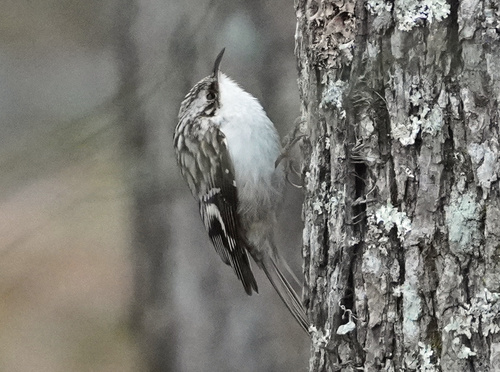 アメリカキバシリ
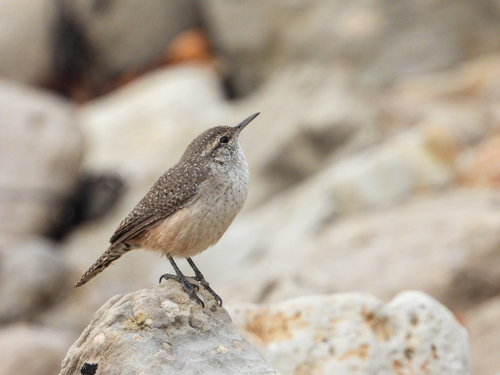 イワミソサザイ
要点
The most reliable field mark between Brown Creeper and Rock Wren is overall structure and foraging behavior: Brown Creeper is a tiny, slim, bark-colored bird that creeps upward on tree trunks, using its stiff tail for support, while Rock Wren is a larger, rounder, pale bird with a long bill and barred tail, typically seen hopping among rocks. Juvenile plumages are not strongly distinctive between these two, but Brown Creeper’s cryptic, bark-mimicking upperparts and white underparts contrast with Rock Wren’s gray-brown, spotted upperparts and pale gray, lightly speckled underparts. In flight, Brown Creeper is weak and fluttery, often hugging the trunk, whereas Rock Wren is more direct and bouncy. Habitat is a strong clue: Brown Creeper sticks to mature forests, while Rock Wren is found in open, rocky areas. Their vocalizations are also quite different, with Brown Creeper’s high, thin calls and Rock Wren’s varied, trilled songs.
識別のコツ
- Foraging behavior: Brown Creeper creeps upward in a spiral on tree trunks, using its stiff tail for support; Rock Wren hops or runs among rocks, never climbing vertically. If you see a bird moving up a tree trunk, it is almost certainly a Brown Creeper.
- Tail structure: Brown Creeper has a long, stiff, pointed tail used as a prop against bark; Rock Wren has a long, barred tail often held cocked, with zebra-striped undertail coverts. The tail of Brown Creeper is never barred.
- Bill shape: Brown Creeper’s bill is long, thin, and slightly downcurved, ideal for probing bark; Rock Wren’s bill is long and straight, sharp-tipped, but not as slender or curved.
- Plumage above: Brown Creeper is brown with light spotting, perfectly cryptic against tree bark; Rock Wren is gray-brown with small black and white spots, paler overall, and never as bark-like.
- Plumage below: Brown Creeper has clean white underparts; Rock Wren is pale gray below, with a speckled throat and sometimes a buff wash in juveniles.
- Supercilium (eyebrow): Rock Wren has a distinct pale gray line through the eye; Brown Creeper lacks a strong supercilium.
- Tail barring: Only Rock Wren shows a clearly barred tail and zebra-striped undertail coverts; Brown Creeper’s tail is plain.
- Juvenile plumage: Juvenile Rock Wrens are fluffier, with a buff wash and lack dark streaks on the underparts; juvenile Brown Creepers look like adults, with cryptic upperparts and white below.
- Flight style: Brown Creeper flies weakly, hugging trunks and making short, fluttery flights; Rock Wren flies more directly and bounces among rocks.
- Habitat: Brown Creeper is found in mature forests, especially with spruce, fir, or pine; Rock Wren is in open, rocky areas, never in dense forest.
- Vocalizations: Brown Creeper’s calls and song are very high-pitched and thin, often hard to hear; Rock Wren’s song is a varied, trilled burst, lower-pitched and more complex, with a variety of call types.
- Size: Rock Wren is nearly twice as heavy and has a much broader wingspan than Brown Creeper; in direct comparison, Brown Creeper is tiny and delicate.
- Perched posture: Brown Creeper clings vertically to bark, tail pressed against the trunk; Rock Wren perches horizontally on rocks or the ground, tail often cocked.
- Context: If you see a small bird on a tree trunk in deep forest, it is almost certainly a Brown Creeper; if it is on rocks in open country, it is a Rock Wren.
- Sex differences: Not strongly diagnostic in the field, but male Brown Creepers have slightly longer bills; female Rock Wrens are slightly heavier and have shorter bills and tails, but these are subtle and not reliable for field ID.
大きさ
Rock Wren is significantly larger and heavier than Brown Creeper. Rock Wren measures 12.5–15 cm in length with a wingspan of 22–24 cm and a body mass of about 16.5 g [wikidata], while Brown Creeper is smaller at 12–14 cm length, wingspan 17–20 cm, and a much lighter mass (5.7–8.5 g) [wikipedia]. In the field, Rock Wren appears bulkier and more robust, with a longer bill and tail, while Brown Creeper is tiny, slim, and delicate.
羽色
Juvenile plumages are not strongly diagnostic between these two, but some contrasts exist: juvenile Rock Wrens are slightly fluffier, with a more vibrant buff wash and lack the dark streaks and spots on the underparts seen in adults. Juvenile Brown Creepers resemble adults, with cryptic brown upperparts and white underparts. Adult Brown Creeper is brown above with light spotting, blending perfectly with tree bark, and has a white belly. Its long, thin, slightly downcurved bill and stiff, pointed tail are distinctive. Rock Wren adults have gray-brown upperparts with small black and white spots, a pale gray throat with speckling, a light brown rump, a light gray supercilium, and a long, barred tail with zebra-striped undertail coverts. The underparts are pale gray, never pure white as in Brown Creeper. In all ages, Rock Wren’s plumage is paler and less cryptic than Brown Creeper’s, and the tail barring is a useful mark for Rock Wren.
行動
Brown Creeper is almost always seen hitching its way up tree trunks in a spiral, using its stiff tail for support, and rarely perches horizontally. It forages by probing bark crevices with its slender, downcurved bill. In flight, it moves weakly from trunk to trunk, often dropping down and climbing up again. Rock Wren, on the other hand, is typically seen on or among rocks, hopping or running with a bouncy gait, tail often cocked. It does not climb vertically and is rarely seen on trees. Its foraging is more terrestrial, probing crevices and picking insects from rocky surfaces. In flight, Rock Wren is more direct and less fluttery than Brown Creeper.
生息環境
Habitat is a strong separator. Brown Creeper is strictly a forest bird, favoring mature stands of spruce, fir, or pine, and is rarely found away from large, intact woodland. It avoids edges and open areas. Rock Wren is found in open, rocky habitats—canyons, boulder fields, talus slopes, and arid hillsides—almost never in dense forest or on tree trunks. If you see a small bird on a tree trunk in mature forest, it is almost certainly a Brown Creeper; if it is among rocks in open country, it is a Rock Wren.
声
Brown Creeper gives very high-pitched, thin, short calls (see or swee) and a song of several high, quick notes (pee pee willow wee or see tidle swee), often hard for some people to hear. Its song is brief, with a cadence and few syllables. Rock Wren males sing a much more varied, trilled song, with bursts of repeated syllables and a repertoire of many types; their calls include tic-ear/spit-tee, rough trills, chatters, and aggressive k'chee notes. Rock Wren’s song is longer, more complex, and lower-pitched than Brown Creeper’s, and is often delivered from exposed rocks.