

Motmot

オオハリオアマツバメ 対 マレーアナツバメ

Hirundapus giganteus 対 Aerodramus germani

オオハリオアマツバメとマレーアナツバメのクイズ
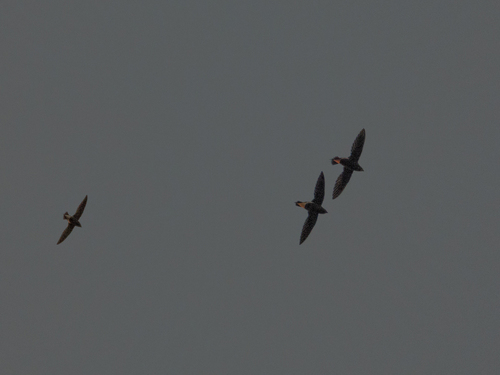
オオハリオアマツバメ (Hirundapus giganteus) オオハリオアマツバメ
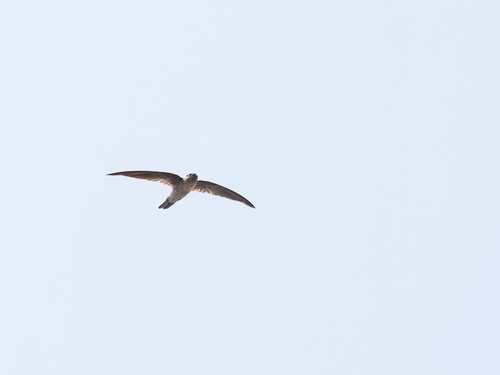
マレーアナツバメ (Aerodramus germani) マレーアナツバメ

メディア

読み込み中…

要点

オオハリオアマツバメとマレーアナツバメは、サイズと構造が非常に異なるため、良い視界があれば簡単に区別できます。オオハリオアマツバメは巨大で、バレル型の胸部を持ち、暗い色合いで、目を引く白い尾羽と側面を持っています。一方、マレーアナツバメははるかに小さく、細身で、目立つ白い斑点はありません。飛行中、オオハリオアマツバメの重く迅速な動きと目立つ尾羽の棘は、アナツバメのより繊細で三日月型の飛び方と鋭く対照的です。どちらの種にも年齢特有の上翼パターンは確認されていないため、サイズ、構造、尾羽と尻の白の有無に注目してください。距離がある場合や光が悪い場合には、サイズや白い斑点を判断するのが難しいため、間違いが最も起こりやすいです。

識別のコツ

  1. Size is the single most reliable field mark: オオハリオアマツバメはアナツバメにしては非常に巨大で、マレーアナツバメを圧倒します。小さなハヤブサとほぼ同じ大きさに見えるアナツバメを見たら、それはオオハリオアマツバメです。
  2. Body shape and jizz: オオハリオアマツバメはバレル型の胸部を持ち、重く筋肉質で、太い首と深い胸を持っています。アナツバメは細身で、流線型で繊細な外観です。
  3. White undertail patch (needletail): 尾の下と側面にある目立つ白い斑点はオオハリオアマツバメ特有で、マレーアナツバメには見られません。これは下から見ても、速い飛行中でも確認できます。
  4. Tail structure: オオハリオアマツバメの尾は短く、切れ込みがあり、明らかな棘の先端で終わります(そのため「needletail」と呼ばれます)。アナツバメの尾も短く、わずかに切れ込みがありますが、棘は決して見られません。
  5. Upperparts and rump: マレーアナツバメは、特にいくつかの亜種で、より淡いまたは白っぽい尻を示すことがありますが、これは背中にあり、尾羽ではありません。オオハリオアマツバメの背中は均一に暗い茶色です。
  6. Flight style: オオハリオアマツバメは力強く迅速な直線的な羽ばたきで飛び、ミサイルのように見えることがあります。アナツバメはよりふわふわとした、浮遊感のある、力強さの少ない飛行をし、しばしば群れで飛びます。
  7. Wing shape: オオハリオアマツバメの翼は広く、鎌型で、重い体に合っています。アナツバメの翼は長く、狭く、後方に傾いており、三日月のような外観を与えます。
  8. Bill and head: 両者ともに短いくちばしを持っていますが、オオハリオアマツバメの頭は相対的に大きく、頑丈です。
  9. Legs and feet: 両者ともに非常に短い脚を持ち、垂直な表面にしがみつくためだけに使用されます。これは巣の場所で見ない限り、有用なフィールドマークではありません。
  10. Plumage variation: マレーアナツバメは下部と尻の色にいくつかの亜種特有の変異を示しますが、オオハリオアマツバメの白い尾羽の大胆なコントラストには決して及びません。
  11. Vocalizations: 聞こえるのは主にマレーアナツバメで、特にコロニーで高音でガラガラとした鳴き声を発します。オオハリオアマツバメは飛行中は一般的に静かです。
  12. Habitat context: オオハリオアマツバメは森林の丘や崖の上にいることが多いです。アナツバメは都市部や開けた国を含む広範囲の生息地で一般的です。
  13. Flock size: アナツバメはしばしば大きな群れで餌を取りますが、オオハリオアマツバメは通常は孤独または小さなグループでいます。
  14. Pitfalls: 遠くから見ると、大きなアナツバメの群れが一羽の大きな鳥のように見えることがありますが、白い尾羽の斑点がないこととバレル型の形がないことからオオハリオアマツバメではないと判断できます。
  15. Age/sex: どちらの種にも区別を助ける年齢または性別特有のフィールドマークは記載されていません。

大きさ

オオハリオアマツバメは世界で最も大きなアナツバメの一つで、体重は約145g [wikidata]、全長は約23cm [wikipedia]です。マレーアナツバメははるかに小さく、典型的な全長は14cm、体重は15〜18g [wikipedia]です。オオハリオアマツバメは単に長いだけでなく、非常にがっしりとしており、バレル型で頑丈に見えますが、アナツバメは細身で軽量です。距離があっても、両種が一緒に見られるか、馴染みのあるアナツバメと比較されると、サイズの違いは劇的です。

羽色

行動

両種は非常に空中性が高く、地面に着地することはほとんどなく、垂直な表面にしがみつくことが多いです。オオハリオアマツバメは、アナツバメの中でも非常に速く力強い飛行で知られており、しばしば空中を突進する重い弾丸のような形に見えます。それに対して、マレーアナツバメは軽く、よりふわふわした飛行をし、長く狭い三日月型の翼を持ち、他のアナツバメやツバメと一緒に大きな群れで餌を取ることが多いです。オオハリオアマツバメの飛行は孤独または小さなグループであり、その速度と直接性は特徴的です。両種は短い脚を使って崖や洞窟の壁にしがみつきますが、これはフィールドで観察されることはほとんどありません。

生息環境

オオハリオアマツバメは、特に南インド、東南アジア、インドネシアやフィリピンの一部の崖や岩の突起の近くの丘の森林で繁殖します。最もよく森林の丘の上や繁殖崖の近くで見られます。マレーアナツバメは東南アジア全体に広がり、沿岸地域から山まで採餌し、特に石灰岩の洞窟や人工の巣の場所が提供される都市部の近くで一般的です。アナツバメは開けた国、森林の端、または都市部の上空で大きな群れで見られることが多いですが、オオハリオアマツバメは森林の丘や崖により関連しています。

声

オオハリオアマツバメには特有のフィールド音声は記載されていません。マレーアナツバメは繁殖コロニーで高音で泡立つような鳴き声を発し、洞窟でのエコロケーションに使用されるガラガラとした鳴き声も生成します。これらの鳴き声は巣の近くで最もよく聞かれ、飛行中や距離がある場合の区別には通常役立ちません。

より良い説明を送る

比較と同じ項目を使ってください。文章はすぐに公開されます。

Brown-backed Needletail and Germain's Swiftlet are extremely different in size and structure, making separation straightforward with good views. The needletail is massive, barrel-chested, and dark with a striking white undertail and flanks, while Germain's Swiftlet is much smaller, slender, and lacks any bold white patches. In flight, the needletail's heavy, rapid movement and prominent tail spines contrast sharply with the swiftlet's more delicate, crescent-winged jizz. No age-specific upperwing patterns are noted for either species, so focus on size, structure, and the presence or absence of white in the undertail and rump. Mistakes are most likely at distance or in poor light, where size and white markings may be hard to judge.

  1. Size is the single most reliable field mark: Brown-backed Needletail is enormous for a swift, dwarfing Germain's Swiftlet. If you see a swift that looks almost as big as a small falcon, it's a needletail.
  2. Body shape and jizz: Needletail is barrel-chested, heavy, and muscular, with a thick neck and deep chest. Swiftlet is slender, with a streamlined, delicate look.
  3. White undertail patch (needletail): The bold white patch under the tail and onto the flanks is unique to Brown-backed Needletail and never shown by Germain's Swiftlet. This is visible from below and in fast flight.
  4. Tail structure: Needletail's tail is short, notched, and ends in obvious spiny tips (hence 'needletail'). Swiftlet's tail is also short and slightly notched but never shows spines.
  5. Upperparts and rump: Germain's Swiftlet may show a paler or whitish rump, especially in some subspecies, but this is on the back, not the undertail. Needletail's back is uniformly dark brown.
  6. Flight style: Needletail flies with powerful, rapid, direct strokes and can appear almost like a missile. Swiftlet has a more fluttery, buoyant, and less forceful flight, often in flocks.
  7. Wing shape: Needletail's wings are broad and sickle-shaped, matching its heavy body. Swiftlet's wings are long, narrow, and swept-back, giving a crescent appearance.
  8. Bill and head: Both have short bills, but the needletail's head is proportionally larger and more robust.
  9. Legs and feet: Both have very short legs used only for clinging to vertical surfaces; this is not a useful field mark unless seen at a nest site.
  10. Plumage variation: Germain's Swiftlet shows some subspecific variation in underpart and rump color, but never approaches the bold contrast of the needletail's white undertail.
  11. Vocalizations: Only Germain's Swiftlet is likely to be heard, especially at colonies, with high-pitched and rattling calls. Needletail is generally silent in flight.
  12. Habitat context: Needletails are most likely over forested hills and cliffs; swiftlets are common over a wide range of habitats, including urban areas and open country.
  13. Flock size: Swiftlets often feed in large flocks; needletails are usually solitary or in small groups.
  14. Pitfalls: At great distance or in poor light, a large swiftlet flock may appear as a single large bird, but the lack of a white undertail patch and the absence of a barrel-chested shape should rule out needletail.
  15. Age/sex: No age- or sex-specific field marks are described for either species that aid in separation.

Brown-backed Needletail is one of the largest swifts in the world, with a body mass around 145 g [wikidata], and a length of about 23 cm [wikipedia]. Germain's Swiftlet is much smaller, with a typical length of 14 cm and a mass of 15–18 g [wikipedia]. The needletail is not just longer but vastly bulkier, appearing barrel-shaped and robust, while the swiftlet is slender and lightweight. Even at a distance, the size difference is dramatic if both species are seen together or compared to familiar swifts.

  • Juvenile/immature patterns: No distinctive age-specific upperwing or flight marks are described for either species in the sources, so all plumage comparisons apply to adults and immatures alike.
  • Brown-backed Needletail: Uniformly dark brown above and below, except for a bold white undertail patch that extends onto the flanks. Tail is notched but not forked, with prominent spiny tips. Subspecies H. g. indicus (India) shows white lores, but this is subtle and only relevant in its range.
  • Germain's Swiftlet: Upperparts are blackish-brown; underparts range from white to blackish-brown depending on subspecies, but never show a bold white undertail patch. The rump is often paler or whitish (especially in germani and amechanus), but this is on the back, not the undertail. Tail is short and slightly notched, lacking spiny tips. The overall look is more muted and lacks any strong contrast patches.
  • Key contrast: Needletail's white undertail/flanks is unique and diagnostic; swiftlet's paler rump is never as bold or in the same location.

Both species are highly aerial and rarely, if ever, land on the ground, instead clinging to vertical surfaces. Brown-backed Needletail is noted for its extremely fast, powerful flight, even among swifts, and often appears as a heavy, bullet-like shape hurtling through the air. Germain's Swiftlet, by contrast, has a lighter, more fluttery flight with long, narrow, crescent-shaped wings, and often feeds in large flocks with other swiftlets and swallows. The needletail's flight is solitary or in small groups, and its speed and directness are distinctive. Both species use their short legs for clinging to cliffs or cave walls, but this is rarely observed in the field.

Brown-backed Needletail breeds in hill forests, especially near cliffs or rocky outcrops in southern India, Southeast Asia, and parts of Indonesia and the Philippines. It is most often seen over forested hills or near breeding cliffs. Germain's Swiftlet is widespread in Southeast Asia, foraging from coastal areas to mountains, and is especially common near limestone caves or even urban areas where artificial nest sites are provided. Swiftlets are more likely to be seen in large flocks over open country, forest edge, or urban areas, while needletails are more associated with forested hills and cliffs.

No distinctive field vocalizations are described for Brown-backed Needletail. Germain's Swiftlet at breeding colonies gives high-pitched and burbling calls, and also produces a rattling call used for echolocation in caves. These calls are most often heard near nesting sites and are not typically useful for separation in flight or at a distance.

変更を破棄しますか?

保存していない編集があります。今離れると失われます。

オオハリオアマツバメ · マレーアナツバメ · 苦手な鳥