

Eilsegler vs Weißnestsalangane (Malaiensalangane)
Hirundapus giganteus gegen Aerodramus germani
Ein Quiz mit Eilsegler und Weißnestsalangane (Malaiensalangane) spielen
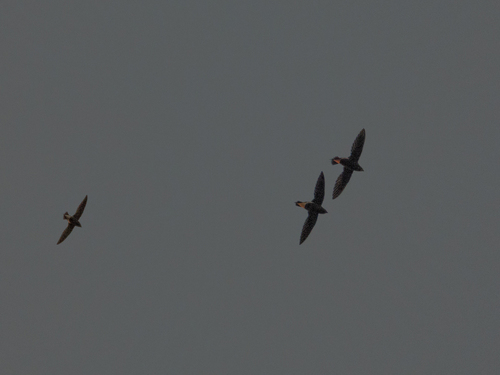 Eilsegler
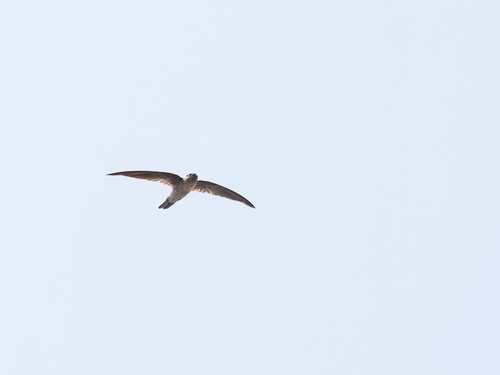 Weißnestsalangane (Malaiensalangane)
Kurz gesagt
Brown-backed Needletail and Germain's Swiftlet are extremely different in size and structure, making separation straightforward with good views. The needletail is massive, barrel-chested, and dark with a striking white undertail and flanks, while Germain's Swiftlet is much smaller, slender, and lacks any bold white patches. In flight, the needletail's heavy, rapid movement and prominent tail spines contrast sharply with the swiftlet's more delicate, crescent-winged jizz. No age-specific upperwing patterns are noted for either species, so focus on size, structure, and the presence or absence of white in the undertail and rump. Mistakes are most likely at distance or in poor light, where size and white markings may be hard to judge.
Bestimmungstipps
- Size is the single most reliable field mark: Brown-backed Needletail is enormous for a swift, dwarfing Germain's Swiftlet. If you see a swift that looks almost as big as a small falcon, it's a needletail.
- Body shape and jizz: Needletail is barrel-chested, heavy, and muscular, with a thick neck and deep chest. Swiftlet is slender, with a streamlined, delicate look.
- White undertail patch (needletail): The bold white patch under the tail and onto the flanks is unique to Brown-backed Needletail and never shown by Germain's Swiftlet. This is visible from below and in fast flight.
- Tail structure: Needletail's tail is short, notched, and ends in obvious spiny tips (hence 'needletail'). Swiftlet's tail is also short and slightly notched but never shows spines.
- Upperparts and rump: Germain's Swiftlet may show a paler or whitish rump, especially in some subspecies, but this is on the back, not the undertail. Needletail's back is uniformly dark brown.
- Flight style: Needletail flies with powerful, rapid, direct strokes and can appear almost like a missile. Swiftlet has a more fluttery, buoyant, and less forceful flight, often in flocks.
- Wing shape: Needletail's wings are broad and sickle-shaped, matching its heavy body. Swiftlet's wings are long, narrow, and swept-back, giving a crescent appearance.
- Bill and head: Both have short bills, but the needletail's head is proportionally larger and more robust.
- Legs and feet: Both have very short legs used only for clinging to vertical surfaces; this is not a useful field mark unless seen at a nest site.
- Plumage variation: Germain's Swiftlet shows some subspecific variation in underpart and rump color, but never approaches the bold contrast of the needletail's white undertail.
- Vocalizations: Only Germain's Swiftlet is likely to be heard, especially at colonies, with high-pitched and rattling calls. Needletail is generally silent in flight.
- Habitat context: Needletails are most likely over forested hills and cliffs; swiftlets are common over a wide range of habitats, including urban areas and open country.
- Flock size: Swiftlets often feed in large flocks; needletails are usually solitary or in small groups.
- Pitfalls: At great distance or in poor light, a large swiftlet flock may appear as a single large bird, but the lack of a white undertail patch and the absence of a barrel-chested shape should rule out needletail.
- Age/sex: No age- or sex-specific field marks are described for either species that aid in separation.
Größe
Brown-backed Needletail is one of the largest swifts in the world, with a body mass around 145 g [wikidata], and a length of about 23 cm [wikipedia]. Germain's Swiftlet is much smaller, with a typical length of 14 cm and a mass of 15–18 g [wikipedia]. The needletail is not just longer but vastly bulkier, appearing barrel-shaped and robust, while the swiftlet is slender and lightweight. Even at a distance, the size difference is dramatic if both species are seen together or compared to familiar swifts.
Gefieder
- Juvenile/immature patterns: No distinctive age-specific upperwing or flight marks are described for either species in the sources, so all plumage comparisons apply to adults and immatures alike.
- Brown-backed Needletail: Uniformly dark brown above and below, except for a bold white undertail patch that extends onto the flanks. Tail is notched but not forked, with prominent spiny tips. Subspecies H. g. indicus (India) shows white lores, but this is subtle and only relevant in its range.
- Germain's Swiftlet: Upperparts are blackish-brown; underparts range from white to blackish-brown depending on subspecies, but never show a bold white undertail patch. The rump is often paler or whitish (especially in germani and amechanus), but this is on the back, not the undertail. Tail is short and slightly notched, lacking spiny tips. The overall look is more muted and lacks any strong contrast patches.
- Key contrast: Needletail's white undertail/flanks is unique and diagnostic; swiftlet's paler rump is never as bold or in the same location.
Verhalten
Both species are highly aerial and rarely, if ever, land on the ground, instead clinging to vertical surfaces. Brown-backed Needletail is noted for its extremely fast, powerful flight, even among swifts, and often appears as a heavy, bullet-like shape hurtling through the air. Germain's Swiftlet, by contrast, has a lighter, more fluttery flight with long, narrow, crescent-shaped wings, and often feeds in large flocks with other swiftlets and swallows. The needletail's flight is solitary or in small groups, and its speed and directness are distinctive. Both species use their short legs for clinging to cliffs or cave walls, but this is rarely observed in the field.
Lebensraum
Brown-backed Needletail breeds in hill forests, especially near cliffs or rocky outcrops in southern India, Southeast Asia, and parts of Indonesia and the Philippines. It is most often seen over forested hills or near breeding cliffs. Germain's Swiftlet is widespread in Southeast Asia, foraging from coastal areas to mountains, and is especially common near limestone caves or even urban areas where artificial nest sites are provided. Swiftlets are more likely to be seen in large flocks over open country, forest edge, or urban areas, while needletails are more associated with forested hills and cliffs.
Stimme
No distinctive field vocalizations are described for Brown-backed Needletail. Germain's Swiftlet at breeding colonies gives high-pitched and burbling calls, and also produces a rattling call used for echolocation in caves. These calls are most often heard near nesting sites and are not typically useful for separation in flight or at a distance.
Eilsegler · Weißnestsalangane (Malaiensalangane) · Meine schwierigen Vögel