

フトオセッカ 対 オニセッカ
Schoenicola platyurus 対 Megalurus palustris
フトオセッカとオニセッカのクイズ
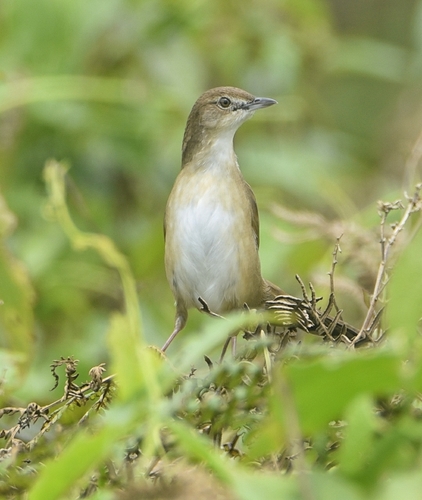 フトオセッカ
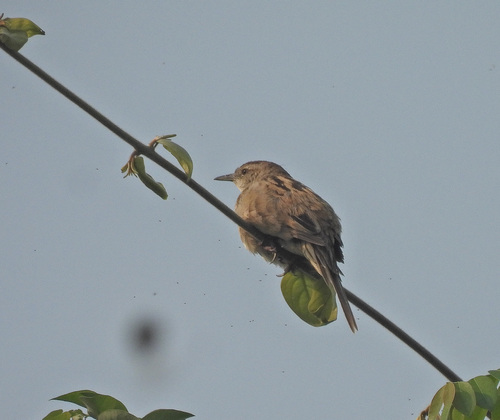 オニセッカ
要点
The most reliable field mark to separate Broad-tailed Grassbird from Striated Grassbird is the tail: Broad-tailed has a broad, rounded, and distinctly graduated tail with thin dark bars and white tips below, while Striated Grassbird’s tail is longer and more pointed. Broad-tailed is a small, mostly brown skulker of high-altitude grasslands in the Western Ghats, with a buff supercilium and uniform brown upperparts. Striated Grassbird is larger and heavier, with a streaked appearance and a preference for more open or wet grasslands. If you see a grassbird with a broad, rounded tail and uniform brown upperparts, especially in the Western Ghats, it is likely Broad-tailed; a larger, streaked bird with a long, pointed tail is Striated.
識別のコツ
- Tail shape and structure: Broad-tailed Grassbird has a broad, rounded, and distinctly graduated tail with thin dark bars and white tips below. Striated Grassbird’s tail is longer, more pointed, and not as obviously graduated. This is the most consistent field mark for adults of both sexes.
- Overall size and build: Striated Grassbird is much larger and heavier (45 g) than Broad-tailed, which is small and more delicate. If the bird looks bulky and long-tailed, suspect Striated.
- Upperparts and streaking: Broad-tailed is uniform brown above, lacking any streaking. Striated Grassbird is streaked above and below, giving a much more patterned appearance. If you see clear streaks, it is not Broad-tailed.
- Supercilium: Broad-tailed has a buff supercilium, which may be less distinct in Striated, but this is a supporting mark only.
- Flank color: In Broad-tailed, northern birds have sandy-brown flanks, while southern birds are more rufous with bright buff on the breast and flanks. Striated is streaked and lacks this regional variation.
- Under-tail pattern: Broad-tailed’s tail is very dark below with white tips to the feathers; this is not described for Striated.
- Bill structure: Broad-tailed has a short, strong bill with a slightly curved culmen and two rictal bristles. Striated’s bill is not described in detail but is generally longer and more slender in the genus Megalurus.
- Legs/tarsi: Broad-tailed has a proportionally long tarsus for its size, but this is subtle and only useful in close views.
- Behavior: Broad-tailed is a skulker, rarely perching in the open except during display flights. Striated is more likely to be seen in the open, perched on tall grass or reeds.
- Display flight: If you see a bird performing a fluttering, lark-like display flight with a fanned tail and trilling song, it is Broad-tailed. Striated does not display in this manner.
- Habitat: Broad-tailed is restricted to high-altitude grasslands in the Western Ghats; Striated is found in more widespread, open, or marshy grasslands, often at lower elevations.
- Vocalization: Only Broad-tailed’s display song is described—a repeated, lark-like trill. If you hear this, it is diagnostic.
- Sex and age: Both sexes are similar in Broad-tailed; no sex differences noted for Striated. No juvenile/immature-specific marks are described for either species.
- Geographic context: If you are in the Western Ghats at high elevation, Broad-tailed is more likely. In open grassland or marshes elsewhere, Striated is expected.
- Pitfalls: The main confusion arises from overall brown coloration and grassland habitat. Always check for tail shape (broad and rounded vs. long and pointed) and presence or absence of streaking.
大きさ
Striated Grassbird is significantly heavier, with an adult mass of about 45 g [wikidata], while Broad-tailed Grassbird is smaller and lighter (no exact mass given, but described as small). Striated also appears larger and bulkier in the field, with a longer tail and more robust jizz. Broad-tailed is compact, with a proportionally long tarsus for its size, but overall more delicate than Striated.
羽色
- Juvenile/immature upperwing pattern: No specific upperwing or flight pattern marks are described for either species in the sources, so this is not a reliable separation point in flight for young birds.
- Adults: Broad-tailed Grassbird is uniform brown above, with a broad, rounded, and graduated tail showing thin dark bars and white tips below. It has a buff supercilium and sandy or rufous-brown flanks depending on region (northern birds paler/greyer, southern birds darker rufous and buffier below). Striated Grassbird, by contrast, is streaked above and below, giving a much more patterned look, and lacks the broad, rounded tail of Broad-tailed. The Striated’s tail is longer, more pointed, and not as obviously graduated or broad-tipped. Both sexes are similar in Broad-tailed; no sex differences noted for Striated.
行動
Broad-tailed Grassbird is a skulker, moving rapidly through dense grass and reeds, usually staying low and hidden except during the breeding season when males perform fluttering display flights with fanned tails. Striated Grassbird is more likely to be seen perched in the open or on tall grass stems, and is less strictly tied to dense cover. Broad-tailed’s display flight is distinctive, with a lark-like trill and fanned tail, while Striated is more often seen singing from exposed perches.
生息環境
Broad-tailed Grassbird is restricted to high-altitude, moist grassy hills in the Western Ghats of southern India, rarely straying from this habitat. Striated Grassbird is more widespread and favors open grasslands, marshes, and reedbeds, often at lower elevations and in wetter areas. If you are in a high, grassy hill in the Western Ghats, Broad-tailed is the likely species; in more open or marshy lowland grassland, especially outside the Ghats, Striated is expected.
声
Broad-tailed Grassbird’s breeding song is a repeated, lark-like trill, often delivered in flight, accompanied by a fanned tail and fluttering display. Other calls include a 'chack' and a 'zink' note. No vocal details are provided for Striated Grassbird in the sources, so vocalization is only a reliable separator if you hear the distinctive Broad-tailed display song.